A 45° pipe run is one of the most common calculations in pipefitting. Once you understand the relationship between the run, set, and travel, the math becomes very simple.
The key number to remember is:
1.414
That is the multiplier used to calculate the travel of a 45° offset.
The Basic 45° Formula
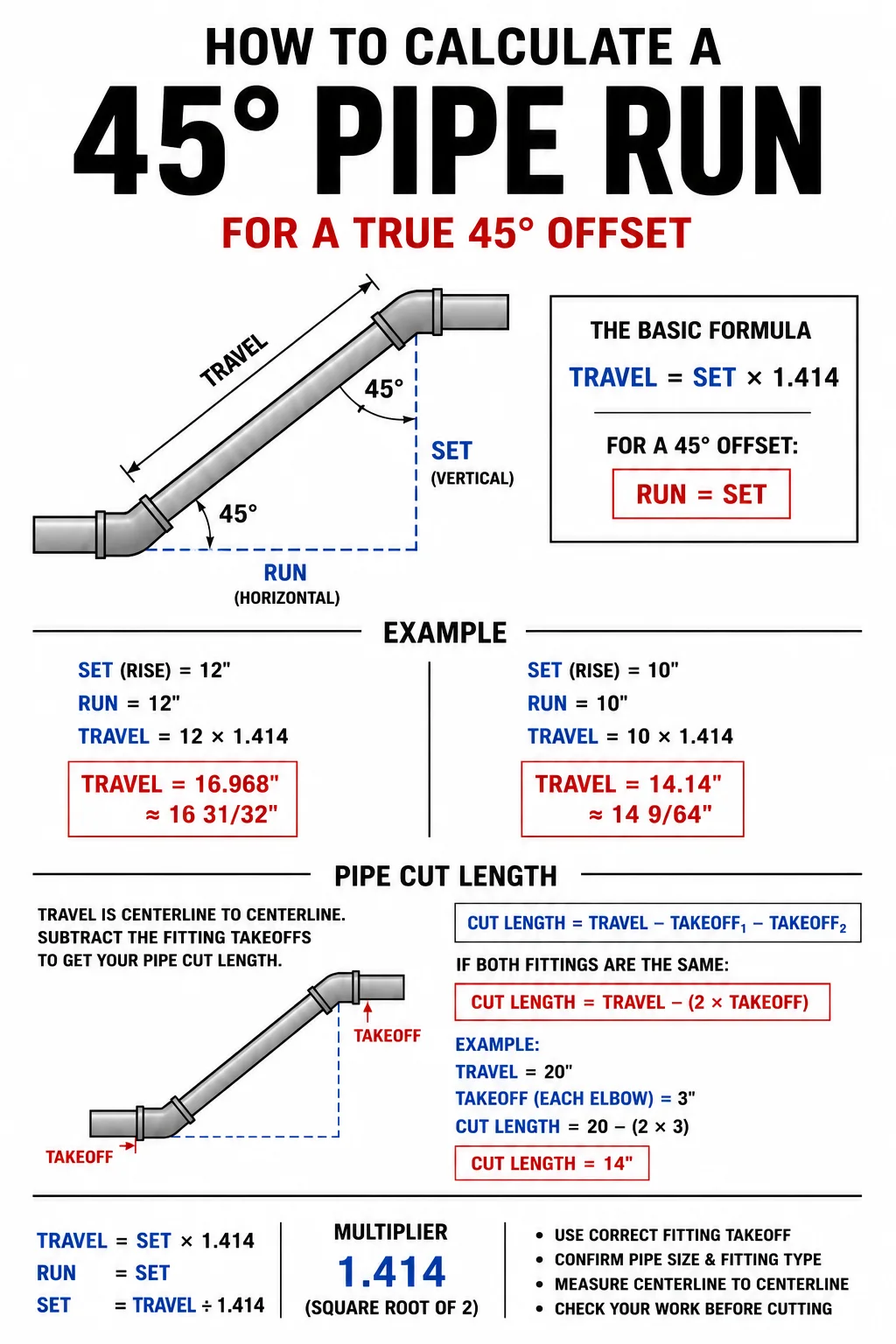
For a true 45° offset:
Travel = Set × 1.414
Because a 45° offset has equal run and set:
Run = Set
So if your vertical change is 12 inches, your horizontal run is also 12 inches.
Then:
12 × 1.414 = 16.968 inches
Rounded for field use:
Travel ≈ 16 31/32 inches
That travel measurement is the centerline distance along the diagonal portion of the pipe.
Understanding Run, Set, and Travel
Before doing the calculation, make sure you know what each term means.
Run is the horizontal distance.
Set is the vertical or sideways change in direction.
Travel is the diagonal centerline distance between the two 45° fittings.
With a true 45° offset, the run and set are equal.
If the pipe needs to move 18 inches upward, it will also move 18 inches forward during that 45° section.
The travel would be:
18 × 1.414 = 25.452 inches
So the diagonal centerline travel is approximately:
25 29/64 inches
Example: 10-Inch 45° Offset
Suppose you need your pipe to move 10 inches vertically using two 45° elbows.
Your set is:
10 inches
Because this is a 45° offset:
Run = 10 inches
Calculate travel:
10 × 1.414 = 14.14 inches
So the center-to-center travel between the two 45° fittings is approximately:
14 9/64 inches
That is the basic geometry before fitting takeoffs are deducted.
The Important Part: Travel Is Not Always Your Pipe Cut Length
This is where new fitters often make mistakes.
The calculated travel is usually a centerline-to-centerline measurement.
It is not automatically the length of the straight pipe you need to cut.
If you are using two 45° elbows, you must subtract the fitting takeoff from both ends.
The basic formula becomes:
Cut Length = Travel − Takeoff of First Fitting − Takeoff of Second Fitting
If both fittings are identical:
Cut Length = Travel − 2 × Fitting Takeoff
For example, suppose your calculated travel is 20 inches and each elbow has a 3-inch center-to-end takeoff.
Then:
20 − 3 − 3 = 14 inches
Your straight pipe cut would be:
14 inches
Always use the actual fitting dimensions for the pipe size and fitting type you are working with.
Another Fast Field Method
Pipefitters often memorize:
45° = 1.414 multiplier
Sometimes you’ll hear it shortened to:
1.41
For rough layout, 1.41 may be close enough.
For fabrication or tighter work, use:
1.414
Example:
Set = 24 inches
24 × 1.414 = 33.936 inches
Travel is approximately:
33 15/16 inches
How to Find the Run From the Travel
Sometimes you already know the diagonal travel and need to determine the run or set.
Use:
Run = Travel ÷ 1.414
Example:
Travel = 28.28 inches
28.28 ÷ 1.414 = 20 inches
So:
Run = 20 inches
Set = 20 inches
Why 1.414 Works
The multiplier comes from the geometry of a right triangle.
A 45° offset creates a right triangle where the run and set are equal.
Using the Pythagorean theorem:
Travel² = Run² + Set²
If both run and set equal 1:
Travel² = 1² + 1²
Travel² = 2
Travel = √2
The square root of 2 is approximately:
1.414
That is where the pipefitter’s 45° multiplier comes from.
A Simple Example You Can Remember
If the offset is:
6 inches
Then:
Run = 6 inches
Travel:
6 × 1.414 = 8.484 inches
If the offset is:
12 inches
Travel:
12 × 1.414 = 16.968 inches
If the offset is:
24 inches
Travel:
24 × 1.414 = 33.936 inches
The pattern never changes for a true 45° offset.
What About Fitting Takeoff?
The multiplier gives you the geometry.
The fitting dimensions determine the actual fabrication cut.
This distinction is extremely important.
Before cutting pipe, determine:
- Pipe size
- Fitting type
- Long-radius or short-radius elbow
- Socket-weld, butt-weld, threaded, or other connection
- Actual center-to-end dimension
- Required weld gap, if applicable
Never assume every 45° elbow has the same takeoff.
Field Example
Imagine an existing pipe is running horizontally and you need to raise the new pipe centerline by 15 inches while continuing in the same general direction.
You plan to use two 45° elbows.
Set:
15 inches
Run:
15 inches
Travel:
15 × 1.414 = 21.21 inches
Your centerline-to-centerline travel is approximately:
21 13/64 inches
Now suppose each fitting has a 2 1/2-inch center-to-end takeoff.
Subtract both:
21.21 − 2.5 − 2.5 = 16.21 inches
Your theoretical straight pipe cut is approximately:
16 13/64 inches
Then account for the fabrication requirements of the particular joint.
The Most Common Mistake
One of the most common mistakes is multiplying by 1.414 and immediately cutting the pipe to that dimension.
Remember:
1.414 gives you travel.
It does not automatically give you the cut length.
You still have to subtract fitting takeoffs.
This is the difference between doing triangle math correctly and actually fabricating the spool correctly.
The 45° Rule to Remember
For a true 45° offset:
Run = Set
Travel = Set × 1.414
Set = Travel ÷ 1.414
And for fabrication:
Pipe Cut Length = Travel − Fitting Takeoffs
If you remember those four relationships, you can solve most basic 45° pipe-run calculations in the field without needing a calculator app or complicated formula sheet.
Final Check Before Cutting
Before making the cut, verify your measurements from the same reference points used on the drawing or in the field.
Make sure you are working centerline-to-centerline where required.
Confirm the elbow dimensions.
Confirm the pipe size.
Confirm the weld gap or joint allowance.
Then calculate the travel, subtract your takeoffs, and check the number one more time.
The math for a 45° pipe run is simple.
The accuracy comes from knowing exactly what dimension you’re calculating.