Knowing the diameter and length of a tank makes calculating its total capacity fairly simple. The harder question is:
How much liquid is actually inside when the tank is only partially full?
That calculation matters in refineries, chemical plants, tank farms, fabrication shops, water systems, terminals, and industrial facilities because a tank’s liquid level does not always translate directly into the same percentage of volume.
For a vertical cylindrical tank with straight sides, 50% level is essentially 50% of the cylindrical volume. For a horizontal cylindrical tank, however, the relationship is nonlinear. A tank reading 25% of its diameter in liquid depth does not contain exactly 25% of its cylindrical capacity.
Understanding why—and knowing how to calculate it—is a useful piece of industrial math.
Start With Tank Geometry
Before calculating anything, identify the tank.
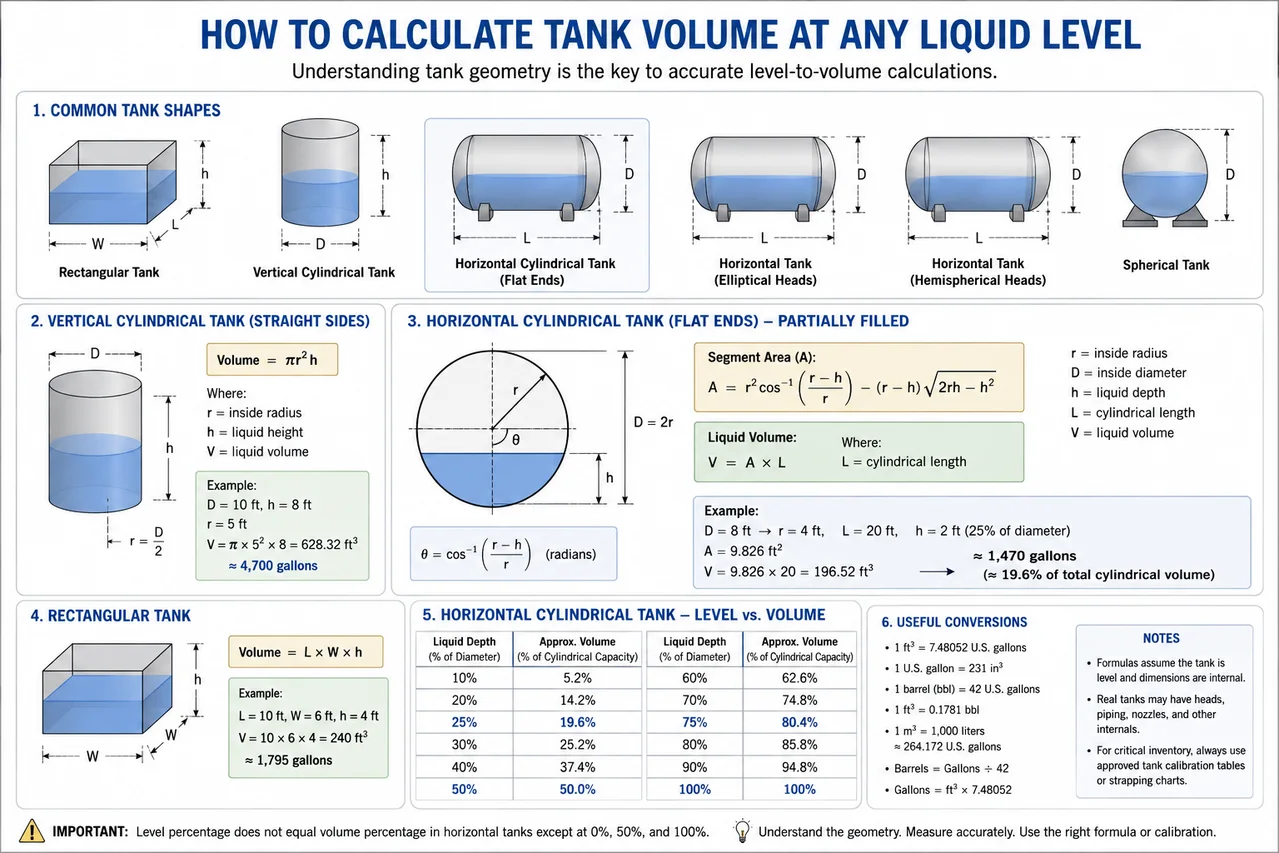
Common tank shapes include:
Vertical cylindrical tanks
Horizontal cylindrical tanks
Rectangular tanks
Horizontal tanks with elliptical heads
Horizontal tanks with hemispherical heads
Horizontal tanks with dished heads
Spherical tanks
Each requires different mathematics.
The easiest case is a rectangular tank.
The next easiest is a vertical cylinder.
A partially filled horizontal cylinder is where the geometry becomes more interesting.
Rectangular Tank Volume
For a rectangular tank:
Volume = Length × Width × Liquid Height
If the tank contains:
Length = 10 ft
Width = 6 ft
Liquid depth = 4 ft
Then:
V = 10 × 6 × 4
V = 240 ft³
To convert cubic feet to U.S. gallons:
Gallons = ft³ × 7.48052
Therefore:
240 × 7.48052 ≈ 1,795 gallons
So the tank contains approximately:
1,795 U.S. gallons
assuming the dimensions represent the actual internal liquid space.
Vertical Cylindrical Tank
For a straight-sided vertical cylinder, use:
V = πr²h
Where:
V = liquid volume
r = inside tank radius
h = liquid height
Suppose a vertical tank has:
Diameter = 10 ft
Liquid height = 8 ft
Radius:
10 ÷ 2 = 5 ft
Volume:
V = π × 5² × 8
V = π × 25 × 8
V ≈ 628.32 ft³
Convert to gallons:
628.32 × 7.48052 ≈ 4,700 gallons
So the straight cylindrical portion contains approximately:
4,700 gallons
at an 8-foot liquid depth.
Why Vertical Tanks Are Easy
The cross-sectional area of a straight vertical cylinder does not change with height.
Every additional inch of liquid adds approximately the same amount of volume.
That means:
25% height ≈ 25% cylindrical volume
50% height ≈ 50% cylindrical volume
75% height ≈ 75% cylindrical volume
This relationship changes if the tank has a cone bottom, dished bottom, roof volume included in the measurement range, internal displacement, or another non-cylindrical section.
Horizontal Cylindrical Tanks Are Different
Now rotate the cylinder onto its side.
The cross-sectional shape becomes a circle.
At the very bottom, the tank is narrow.
Near the middle, it is wide.
Near the top, it becomes narrow again.
Therefore, every inch of liquid level does not represent the same volume.
Conceptually: TOP .---------. .' '. / \ | | |~~~~~~~~~~~~~~~~~| ← Liquid surface |/////////////////| \/////////////// / './//////////.' '---------' BOTTOM
The liquid occupies a circular segment.
That is the geometry we need to calculate.
Horizontal Tank Formula
For a horizontal cylindrical tank with flat ends, first calculate the area of the filled circular segment:
A = r² cos⁻¹((r − h) / r) − (r − h)√(2rh − h²)
Then multiply by tank length:
V = A × L
Therefore:
V = L[r² cos⁻¹((r − h)/r) − (r − h)√(2rh − h²)]
Where:
V = liquid volume
r = inside tank radius
h = liquid depth measured from the bottom
L = cylindrical tank length
cos⁻¹ = inverse cosine
For this formula, the inverse-cosine angle must be evaluated in radians.
Also:
0 ≤ h ≤ 2r
because liquid depth cannot be less than zero or greater than the tank’s internal diameter.
Example: Horizontal Tank Half Full
Suppose a horizontal cylindrical tank has:
Diameter = 8 ft
Radius = 4 ft
Length = 20 ft
Liquid depth = 4 ft
Since the liquid depth equals the radius, the tank is exactly half full.
You don’t actually need the segment formula here.
Total cylindrical volume:
V = πr²L
V = π × 4² × 20
V = π × 16 × 20
V ≈ 1,005.31 ft³
Half:
1,005.31 ÷ 2 ≈ 502.65 ft³
Convert to gallons:
502.65 × 7.48052 ≈ 3,760 gallons
So at exactly half the internal diameter, the tank contains approximately:
3,760 gallons
excluding any head volume.
The Important Part: Quarter-Level Is Not Quarter-Volume
Use the same tank:
Diameter = 8 ft
Radius = 4 ft
Length = 20 ft
Now suppose the liquid depth is:
2 ft
That is 25% of the tank diameter.
But it is not 25% of the volume.
Use:
A = r² cos⁻¹((r − h)/r) − (r − h)√(2rh − h²)
Insert the values:
r = 4
h = 2
First:
(r − h)/r = (4 − 2)/4 = 0.5
Then:
cos⁻¹(0.5) = π/3 ≈ 1.0472 radians
First term:
4² × 1.0472
16 × 1.0472 ≈ 16.755
Second term:
(4 − 2)√[(2 × 4 × 2) − 2²]
2√(16 − 4)
2√12
≈ 6.928
Segment area:
A ≈ 16.755 − 6.928
A ≈ 9.826 ft²
Multiply by tank length:
V ≈ 9.826 × 20
V ≈ 196.52 ft³
Convert to gallons:
196.52 × 7.48052 ≈ 1,470 gallons
The total tank capacity was approximately 7,520 gallons.
Therefore:
1,470 ÷ 7,520 ≈ 19.6%
So a horizontal cylindrical tank at 25% of its diameter in liquid depth contains only about 19.6% of its cylindrical volume.
That’s one of the most important concepts in horizontal tank gauging.
What Happens at 75% Level?
Circular geometry is symmetrical.
If 25% liquid depth corresponds to approximately 19.6% volume, then 75% liquid depth corresponds to approximately:
100% − 19.6% = 80.4%
So:
25% depth ≈ 19.6% volume
50% depth = 50% volume
75% depth ≈ 80.4% volume
This immediately shows why simply multiplying tank capacity by the indicated depth percentage can produce the wrong answer.
Useful Horizontal Cylinder Percentages
For an ideal horizontal cylindrical tank with flat ends:
Liquid Depth
Approx. Volume
10%
5.2%
20%
14.2%
25%
19.6%
30%
25.2%
40%
37.4%
50%
50.0%
60%
62.6%
70%
74.8%
75%
80.4%
80%
85.8%
90%
94.8%
100%
100%
These percentages are based on the circular cross section and are independent of tank diameter and cylindrical length as long as the tank is a uniform horizontal cylinder.
Actual tanks may require calibrated strapping tables.
A Faster Percentage Formula
If you only need the percentage full, you don’t need the tank length.
Calculate the filled segment area and divide it by the full circular area.
Fraction Full = A / πr²
Therefore:
Percent Full = [A / (πr²)] × 100
where:
A = r² cos⁻¹((r − h)/r) − (r − h)√(2rh − h²)
This gives the percentage of cylindrical volume occupied by liquid.
Then:
Liquid Volume = Total Cylindrical Capacity × Fraction Full
This can be faster when total tank capacity is already known.
Example Using Known Tank Capacity
Suppose the manufacturer’s data says a horizontal cylindrical tank holds:
10,000 gallons
and the measured liquid depth is exactly:
25% of the internal diameter
From the circular-segment relationship:
Fraction full ≈ 0.1955
Therefore:
10,000 × 0.1955 ≈ 1,955 gallons
Not:
2,500 gallons
That difference is approximately:
545 gallons
which is large enough to matter in real operations.
Calculating Total Cylindrical Capacity
For a cylindrical tank:
V = πr²L
If all dimensions are in feet, the answer is cubic feet.
Convert using:
1 ft³ ≈ 7.48052 U.S. gallons
So:
Gallons = πr²L × 7.48052
If dimensions are in inches:
1 U.S. gallon = 231 in³
Therefore:
Gallons = Volume in cubic inches ÷ 231
Example Using Inches
Suppose a horizontal cylindrical tank has:
Inside diameter = 72 in
Inside length = 120 in
Radius:
72 ÷ 2 = 36 in
Total volume:
V = π × 36² × 120
V ≈ 488,580 in³
Convert to gallons:
488,580 ÷ 231 ≈ 2,115 gallons
So the ideal cylindrical capacity is approximately:
2,115 gallons
before accounting for heads, fittings, internal structures, unusable volume, and manufacturing dimensions.
Tanks With Heads
Real pressure vessels and storage tanks frequently do not have flat ends.
They may have:
2:1 elliptical heads
Hemispherical heads
Torispherical heads
Flanged-and-dished heads
Once heads are involved, the simple cylindrical formula does not represent the entire tank.
Total tank volume becomes:
Tank Volume = Cylindrical Shell Volume + Head Volume
For a partially filled horizontal vessel, the calculation becomes even more complicated because the liquid occupies portions of both the cylindrical shell and the heads.
In actual plant work, this is one reason engineers and operators frequently use:
Tank calibration tables
Strapping charts
Level-transmitter scaling
Vessel drawings
Manufacturer data
rather than manually calculating every reading.
Hemispherical Heads
If a tank has two true hemispherical heads, together they form one sphere.
Sphere volume:
V = 4/3 πr³
Therefore, two hemispherical heads with radius equal to the vessel radius have a combined volume of:
4/3 πr³
This makes total full capacity relatively easy to calculate.
Partial horizontal fill through the heads is more involved.
2:1 Elliptical Heads
A 2:1 elliptical head is extremely common on pressure vessels.
Its geometry is based on half an ellipsoid.
For an ideal 2:1 elliptical head, the inside head depth is approximately:
D / 4
where D is the inside diameter.
The full internal volume of one idealized 2:1 elliptical head is:
V = πD³ / 24
Therefore, two identical heads contribute:
V = πD³ / 12
when using ideal inside geometry and excluding straight-flange effects.
Actual manufactured heads and vessel drawings should be used when accurate capacity matters.
Why Tank Strapping Charts Matter
Industrial tanks are rarely perfect mathematical objects.
Actual capacity can differ because of:
Head geometry
Shell thickness
Internal piping
Heating coils
Agitators
Columns
Baffles
Nozzles
Tank bottom shape
Manufacturing tolerances
Tank settlement
A strapping chart or tank calibration table relates measured liquid level directly to actual calibrated volume.
It might show:Level Volume 24 in 1,470 gal 25 in 1,560 gal 26 in 1,652 gal 27 in 1,746 gal
Operators can measure level and determine volume without performing the circular-segment calculation every time.
For custody transfer, inventory accounting, and other high-accuracy applications, use the approved calibration data rather than a simplified field calculation.
Level Transmitters and Tank Geometry
Modern plants often measure tank level using instrumentation such as:
Differential-pressure transmitters
Radar level transmitters
Guided-wave radar
Ultrasonic instruments
Float systems
The instrument may measure level accurately but still require volume characterization to report gallons, barrels, or cubic meters correctly.
For a vertical straight-sided cylinder, the conversion is linear.
For a horizontal cylinder, it is nonlinear.
A control system can use a characterization curve or lookup table to convert:
Level → Volume
That is essentially the electronic version of a tank strapping chart.
Converting Gallons to Barrels
In oil and gas work, volume may be expressed in barrels.
One U.S. oil barrel is:
42 U.S. gallons
Therefore:
Barrels = Gallons ÷ 42
If a tank contains 8,400 gallons:
8,400 ÷ 42 = 200 barrels
So:
8,400 gallons = 200 bbl
Converting Cubic Feet to Barrels
Since:
1 ft³ ≈ 7.48052 gallons
and:
1 barrel = 42 gallons
then:
1 ft³ ≈ 0.1781 bbl
Therefore:
Barrels ≈ Cubic Feet × 0.1781
Converting Cubic Meters
For metric calculations:
1 m³ = 1,000 liters
and approximately:
1 m³ ≈ 264.172 U.S. gallons
So a tank containing 20 m³ contains approximately:
20 × 264.172 = 5,283 gallons
or:
20,000 liters
The Measurement Must Be Correct
Even perfect mathematics produces a bad answer if the input measurement is wrong.
For a horizontal cylindrical tank, liquid depth should be referenced consistently from the specified tank datum.
If you’re manually measuring, confirm the internal diameter, the exact zero-level reference, whether the tank is actually level, whether measurements are inside or outside dimensions, and whether the listed tank length includes the heads.
Using outside diameter instead of inside diameter can introduce error, particularly on thick-wall vessels.
What If the Tank Is Tilted?
The standard horizontal-cylinder formula assumes the cylinder is level.
If one end is higher than the other, liquid depth changes along the tank length. The cross-sectional filled area is therefore different at different locations.
Accurate volume may require integration along the length of the tank or a calibrated tank table that specifically accounts for inclination.
For rough field estimates, the standard equation may still be useful, but it should not be treated as a precision inventory calculation.
Tank Volume From Sight Glass Readings
A sight glass may make level appear simple because you can physically see where the liquid is located.
But the same geometry rules still apply.
On a straight-sided vertical tank:
50% sight-glass level ≈ 50% volume
On a horizontal cylindrical tank:
25% level ≈ 19.6% cylindrical volume
50% level = 50% volume
75% level ≈ 80.4% cylindrical volume
So the sight glass gives you level, not necessarily volume percentage.
The geometry of the vessel must still be considered.
Dead Volume and Usable Volume
Another important distinction is the difference between:
Geometric volume
Working volume
and
Usable volume
A tank may mathematically contain 10,000 gallons but not practically deliver all 10,000 gallons.
Liquid may remain below the outlet nozzle.
A suction nozzle may require minimum submergence.
The tank may have a heel intentionally left inside.
Instrumentation may define low-low level above the physical bottom.
Foam space or vapor space may prevent filling to the absolute top.
Therefore:
Usable Capacity ≠ Always Total Geometric Capacity
For operations, the usable range is often more important than theoretical full capacity.
Vapor Space and Freeboard
Many tanks are intentionally not filled completely.
The empty space above the liquid is commonly called vapor space, ullage, or freeboard, depending on the application.
If a 10,000-gallon tank contains 8,000 gallons:
Ullage = 10,000 − 8,000
Ullage = 2,000 gallons
This means 2,000 gallons of geometric capacity remains above the liquid level.
However, the permitted fill limit may be less than the total physical capacity because thermal expansion and operating requirements need space.
Thermal Expansion of the Liquid
Tank inventory can change with temperature even if no liquid enters or leaves the vessel.
Liquids expand when heated.
A simplified liquid expansion estimate is:
ΔV = βV₀ΔT
Where:
ΔV = change in volume
β = volumetric thermal-expansion coefficient
V₀ = original volume
ΔT = temperature change
The coefficient depends heavily on the liquid.
This matters in petroleum storage because the same mass of product can occupy different volumes at different temperatures.
For precise custody-transfer measurements, temperature correction can be extremely important.
Hydrostatic Level and Density
Differential-pressure level measurement works differently from radar.
For a liquid column:
Pressure = Density × Gravity × Height
In common field terms, the hydrostatic pressure at the bottom depends on both:
Liquid height
and
Liquid density
So if product density changes, a DP transmitter calibrated for one density may indicate a different level even though the physical liquid height hasn’t changed.
Radar generally measures distance rather than hydrostatic head and is therefore affected differently by process conditions.
This is why knowing both tank geometry and measurement technology matters.
Example: Calculate a Horizontal Tank From Scratch
Suppose you have a horizontal tank with:
Inside diameter = 10 ft
Inside cylindrical length = 30 ft
Liquid depth = 3 ft
Radius:
r = 10 ÷ 2 = 5 ft
Now calculate the circular segment.
A = r² cos⁻¹((r − h)/r) − (r − h)√(2rh − h²)
Substitute:
A = 25 cos⁻¹((5 − 3)/5) − (5 − 3)√[(2 × 5 × 3) − 3²]
Simplify:
A = 25 cos⁻¹(0.4) − 2√21
cos⁻¹(0.4):
≈ 1.1593 radians
First term:
25 × 1.1593 ≈ 28.9825
Second term:
2 × √21 ≈ 9.165
Therefore:
A ≈ 28.9825 − 9.165
A ≈ 19.818 ft²
Multiply by length:
V ≈ 19.818 × 30
V ≈ 594.54 ft³
Convert to gallons:
594.54 × 7.48052 ≈ 4,448 gallons
So the tank contains approximately:
4,450 gallons
in its cylindrical section.
Notice that the level is:
3 ÷ 10 = 30% of diameter
but the volume is only about:
25.2% of total cylindrical capacity
again demonstrating the nonlinear relationship.
Estimating Volume Between Two Level Readings
Suppose a horizontal tank level rises from 25% depth to 50% depth.
You cannot simply say the tank gained 25% of capacity.
At 25% depth:
Volume ≈ 19.6%
At 50% depth:
Volume = 50%
Therefore, the actual increase is:
50 − 19.6 = 30.4% of tank capacity
If the tank’s cylindrical capacity is 10,000 gallons:
10,000 × 0.304 = 3,040 gallons
So a rise from 25% level to 50% level represents approximately 3,040 gallons, not 2,500 gallons.
This is a very practical reason to understand the geometry.
Reverse Calculation: Volume to Liquid Level
Sometimes you know the volume and want to determine the liquid height.
For a vertical cylinder, this is easy:
h = V / πr²
For a horizontal cylinder, there is no simple elementary rearrangement of the circular-segment equation to isolate h.
Instead, the level is usually determined using:
A lookup table
Spreadsheet
Calculator
Iterative numerical solution
Tank strapping chart
This is another reason calibrated level-volume tables are so useful.
Quick Field Formulas
For a rectangular tank:
V = L × W × h
For a vertical cylindrical tank:
V = πr²h
For a full cylindrical tank:
V = πr²L
For a partially filled horizontal cylindrical tank:
V = L[r² cos⁻¹((r − h)/r) − (r − h)√(2rh − h²)]
For cubic feet to gallons:
Gallons = ft³ × 7.48052
For cubic inches to gallons:
Gallons = in³ ÷ 231
For gallons to oil barrels:
Barrels = Gallons ÷ 42
For cubic meters to gallons:
Gallons ≈ m³ × 264.172
Common Mistakes
Several mistakes can create large errors.
The most common is assuming that level percentage equals volume percentage on a horizontal tank.
Another is using the outside diameter rather than the internal diameter.
A third is including the head-to-head length when the formula only represents the straight cylindrical shell.
Another is entering degrees instead of radians when evaluating the inverse cosine term.
You can also get a technically correct geometric answer that is operationally wrong because you ignored coils, nozzles, internal equipment, heel volume, or the tank’s calibration table.
The math should always match the actual vessel.
When You Should Use the Formula
The formula is especially useful for:
Field estimating
Checking instrument scaling
Understanding tank geometry
Fabrication calculations
Learning how level relates to capacity
Building spreadsheet calculators
Checking whether a displayed number seems reasonable
It is not a replacement for approved calibrated data when the volume affects custody transfer, regulatory reporting, process safety, commercial inventory, or other high-accuracy applications.
The One Rule Worth Remembering
If you remember only one thing from this lesson, remember:
A horizontal cylindrical tank’s liquid-level percentage is not the same as its volume percentage—except at empty, half full, and full.
At 25% depth, the cylindrical portion is only about 19.6% full.
At 50% depth, it is 50% full.
At 75% depth, it is about 80.4% full.
That happens because the width of the circular tank changes continuously with liquid height.
Once you understand the circular-segment geometry behind the tank, the calculation stops looking like a strange formula and starts making sense visually.
For refinery operators, pipefitters, tank builders, instrumentation technicians, millwrights, and industrial maintenance personnel, understanding this relationship is useful even when a plant already provides calibrated tank tables. It gives you the ability to recognize bad numbers, estimate inventory, understand level-transmitter scaling, and troubleshoot situations where level and volume don’t appear to agree.
Continue through the Næxon Learning Center with related lessons on tank strapping charts, differential-pressure level transmitters, radar level measurement, pressure-vessel head calculations, pipe volume, hydrostatic pressure, and industrial unit conversions.