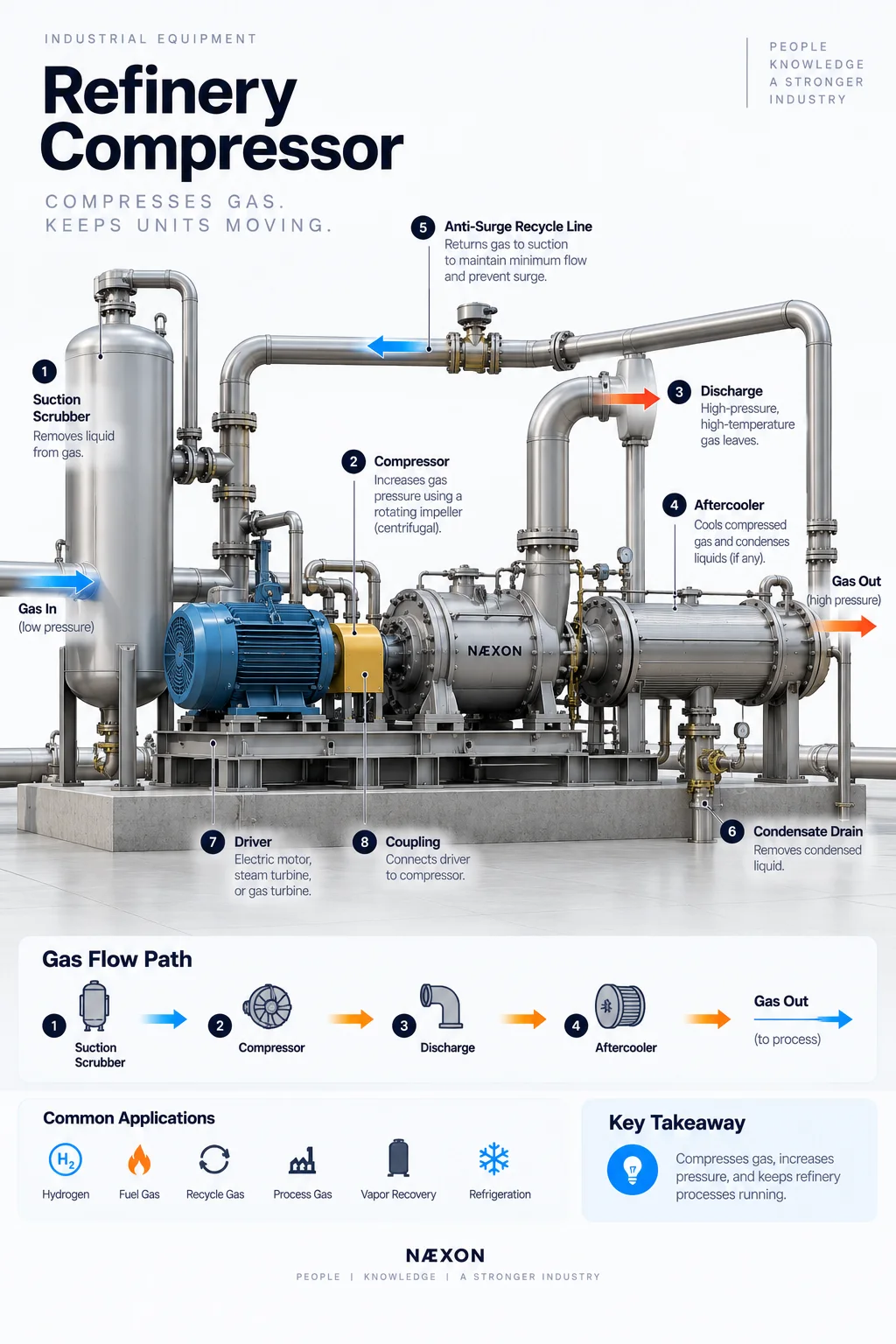
A refinery compressor performs a job similar to a pump—but for gas instead of liquid.
Across refineries, petrochemical plants, LNG facilities, gas-processing plants, and pipelines, compressors move and pressurize hydrogen, natural gas, fuel gas, recycle gas, refrigerants, process vapors, and many other gases.
They are also some of the most critical machines in a process unit. A major compressor trip can reduce production or shut an entire unit down.
For pipefitters, millwrights, operators, welders, machinists, instrument technicians, electricians, inspectors, and maintenance personnel, understanding compressors is essential industrial knowledge.
What Is a Compressor?
A compressor is a machine that increases the pressure of a gas.
The basic concept is:
Low-pressure gas → Compressor → High-pressure gas
Mechanical energy is supplied by a driver such as:
- Electric motor
- Steam turbine
- Gas turbine
- Engine
The compressor transfers that energy into the gas.
But compressing gas creates another important effect:
The gas gets hotter.
That temperature increase influences nearly everything surrounding a compressor—from coolers and piping expansion to lubrication, seals, materials, and operating limits.
Pumps vs. Compressors
This distinction should become automatic.
Pump
Primarily moves liquid.
Compressor
Primarily moves and increases the pressure of gas.
Liquids are relatively difficult to compress.
Gases are highly compressible.
That difference is why compressors operate very differently from centrifugal pumps even though some compressor designs may look similar externally.
Why Refineries Need Compressors
Compressors are used throughout refinery processes.
Common services include:
- Hydrogen compression
- Recycle gas
- Fuel gas
- Wet gas
- Refrigeration
- Process gas
- Vapor recovery
- Flare-gas recovery
- Gas boosting
- Instrument or plant air
- Natural-gas service
Some units cannot operate without continuous compressor service.
Two Major Compressor Families
Industrial workers should recognize two broad categories:
Dynamic Compressors
Gas is accelerated and its velocity energy is converted into pressure.
The most important refinery example is the:
Centrifugal compressor
Positive-Displacement Compressors
A fixed amount of gas is trapped and mechanically reduced in volume.
Examples include:
Reciprocating compressors
and
Rotary screw compressors
Each type has different operating characteristics.
Centrifugal Compressors
A centrifugal compressor works conceptually like a centrifugal pump, but it handles compressible gas.
Gas enters near the center of a rotating impeller.
The impeller accelerates the gas outward.
A diffuser slows the high-velocity gas and converts velocity into pressure.
The basic path is:
Suction → Impeller → Diffuser → Discharge
For higher pressure ratios, several compression stages may be installed in one machine.
1. Compressor Suction
Gas enters through the suction system.
Before reaching the compressor, the gas may pass through equipment such as:
- Suction scrubber
- Knockout drum
- Filter
- Separator
- Instrumentation
One of the most important reasons for this equipment is simple:
Keep liquid out of the compressor when the compressor is not designed to handle it.
Why Liquid Is Dangerous
A compressor is designed around gas behavior.
Unexpected liquid entering the machine can create serious problems.
Depending on compressor type and quantity of liquid, consequences can include:
- Mechanical damage
- Vibration
- Impeller damage
- Cylinder damage
- Valve damage
- Process upset
This is why compressor suction scrubbers are so important.
They separate entrained liquid before gas reaches the machine.
2. Impeller
In a centrifugal compressor, gas enters the impeller eye.
The rotating impeller transfers energy into the gas and accelerates it outward.
The impeller may rotate at thousands—or tens of thousands—of revolutions per minute depending on the machine.
At these speeds, balance, alignment, clearances, bearings, and vibration become extremely important.
3. Diffuser
High-velocity gas leaving the impeller enters the diffuser.
The diffuser provides an expanding flow area that reduces gas velocity and converts part of that kinetic energy into static pressure.
Conceptually:
Impeller = adds velocity and energy
Diffuser = converts velocity into pressure
This is similar to the role played by the volute or diffuser in a centrifugal pump.
4. Compressor Stages
One impeller and diffuser combination can be considered a compression stage.
If greater pressure is required, multiple stages may be used.
Gas moves:
Stage 1 → Stage 2 → Stage 3 → Stage 4
At each stage, additional energy is added.
Pressure increases progressively.
Temperature also tends to increase.
Why Compression Makes Gas Hot
Imagine gas molecules occupying a certain volume.
Compress them into a smaller effective volume while adding mechanical energy.
Gas pressure increases.
So does temperature unless sufficient heat is removed.
This is why compressor discharge piping can be substantially hotter than suction piping.
It also explains why compressors often have cooling systems.
Intercoolers
Instead of compressing gas through several stages without cooling, some systems remove heat between compression stages.
The equipment doing this is an intercooler.
A simplified arrangement is:
Stage 1 → Intercooler → Stage 2
Cooling the gas between stages can reduce the work required for subsequent compression and control discharge temperatures.
After cooling, condensed liquid may need to be removed before the gas enters the next stage.
Aftercoolers
A cooler installed after the final compression stage is commonly called an aftercooler.
Its purpose may include:
- Reducing gas temperature
- Protecting downstream equipment
- Condensing removable liquids
- Meeting downstream process requirements
This means compressor systems often involve much more equipment than the compressor itself.
Compressor Trains
The term compressor train refers to the compressor and associated rotating equipment arranged as a system.
A train may include:
Driver → Coupling → Gearbox → Compressor
or:
Steam Turbine → Compressor
Large refinery compressor trains are precision installations.
Alignment is critical.
Bearings
Compressor rotors can operate at extremely high speeds.
Bearings maintain rotor position.
Large centrifugal compressors may use sophisticated radial and thrust bearing arrangements.
Bearing condition is monitored closely because problems can rapidly become serious.
Common monitoring includes:
- Bearing temperature
- Shaft vibration
- Axial position
- Oil condition
Thrust Bearings
Gas pressure acting through compressor stages can create axial forces along the rotor.
A thrust bearing helps control axial movement.
Excessive axial movement can allow rotating and stationary components to contact each other.
At compressor speeds, that can become destructive very quickly.
Compressor Seals
The shaft must pass through the compressor casing while process gas remains contained.
Special sealing systems are therefore required.
Depending on compressor design, systems may include:
- Dry gas seals
- Oil seals
- Labyrinth seals
- Buffer gas
- Separation gas
- Seal-gas panels
Seal systems can be extremely important in hydrocarbon or hydrogen service.
Dry Gas Seals
Many modern centrifugal compressors use dry gas seals.
Their precision sealing faces operate with a very small controlled gas film between them.
A clean, properly conditioned seal-gas supply is critical.
Contamination or incorrect operating conditions can damage the seals.
Because compressor seals may contain high-pressure flammable gas, their supporting systems deserve the same attention as the compressor itself.
Lubrication System
Large compressors may have dedicated lubrication systems supplying oil to bearings and other components.
A lube-oil system may contain:
- Oil reservoir
- Pumps
- Filters
- Coolers
- Control valves
- Instrumentation
- Backup systems
Loss of lubrication can rapidly damage high-speed rotating equipment.
For that reason, compressor protection systems may shut down the machine automatically if critical lubrication conditions deteriorate.
What Is Compressor Surge?
One of the most important centrifugal-compressor concepts is surge.
A centrifugal compressor requires adequate gas flow to remain in a stable operating region.
If flow becomes too low for the developed pressure conditions, stable forward flow through the compressor can break down.
Flow may fluctuate violently and can momentarily reverse.
This is surge.
Surge is not simply “low flow.”
It is a dynamic instability of the compressor and system.
What Surge Can Do
Severe surge can create:
- Violent vibration
- Pressure oscillations
- Flow reversal
- Noise
- Rotor loading
- Bearing loading
- Seal damage
- Mechanical stress
Repeated severe surge can damage the compressor.
That is why centrifugal compressors commonly have anti-surge systems.
Anti-Surge Recycle
One way to protect a centrifugal compressor is to maintain sufficient flow.
An anti-surge system can route some discharge gas back toward the suction.
Conceptually:
Compressor Discharge → Recycle Valve → Suction
If compressor flow approaches the surge-control region, the recycle valve opens as required.
Gas continues circulating through the compressor even if the downstream process does not require all of it.
The goal is to keep the compressor away from unstable operation.
Why the Recycle Line Can Be Huge
Workers sometimes see a large pipe connecting compressor discharge back toward the suction system.
It may look wasteful.
Why compress gas just to send it back?
Because during certain conditions, protecting a multimillion-dollar compressor is more important than temporarily maximizing process efficiency.
The anti-surge recycle line provides a controlled path for maintaining stable compressor flow.
Compressor Trip
A trip is an automatic or manually initiated shutdown intended to protect personnel, process, or equipment.
A compressor may trip because of conditions such as:
- High vibration
- Bearing problems
- Low lube-oil pressure
- Seal-system problems
- Excessive temperature
- Driver problems
- Process protection signals
- Overspeed on applicable drivers
- Emergency shutdown activation
The exact trip logic is machine-specific.
Never assume two compressors have identical protection systems.
What Happens When a Major Compressor Trips?
A compressor trip can affect much more than the machine itself.
If the compressor is circulating gas through a reactor system, losing it can immediately change:
- Process flow
- Pressure
- Temperature
- Reaction conditions
- Separator conditions
- Furnace operation
- Downstream production
Other equipment may automatically respond or trip.
This is why one compressor shutdown can sometimes affect an entire refinery unit.
Reciprocating Compressors
Not all refinery compressors use impellers.
A reciprocating compressor works more like a piston engine operating in reverse.
A piston moves inside a cylinder.
During the suction stroke:
Gas enters the cylinder.
During compression:
The piston reduces the gas volume.
Pressure rises.
A discharge valve opens.
High-pressure gas leaves.
The cycle repeats.
Major Reciprocating Compressor Components
A reciprocating compressor can include:
- Cylinder
- Piston
- Piston rod
- Suction valves
- Discharge valves
- Crosshead
- Connecting rod
- Crankshaft
- Distance piece
- Packing
- Frame
- Lubrication system
These machines look and behave very differently from centrifugal compressors.
Pulsation
Reciprocating compressors do not produce perfectly smooth flow.
Each piston stroke creates pressure pulses.
These pulsations can travel through the piping.
Systems may therefore use pulsation bottles or dampeners.
Poorly controlled pulsation can contribute to:
- Piping vibration
- Fatigue
- Instrument problems
- Support damage
- Mechanical failures
This makes piping design around reciprocating compressors especially important.
Compressor Piping
Compressor piping is not ordinary piping from a mechanical perspective.
It may experience:
- High pressure
- High temperature
- Thermal expansion
- Vibration
- Pulsation
- Cyclic loading
- Dynamic forces
Support design and installation can therefore be critical.
A missing support or improperly installed restraint can become a serious reliability issue.
Pipe Strain and Alignment
Like pumps, compressors should not be used as anchors for badly aligned piping.
Large nozzle loads can distort compressor casings and affect internal alignment.
Field workers should never assume:
“The bolts can pull it together, so it’s good.”
Flange alignment must meet the applicable engineering and site requirements.
The machine should not be forced to fit the piping.
Small-Bore Connections
Compressor systems often contain significant amounts of small-bore piping and tubing.
Examples include:
- Seal gas
- Lube oil
- Instrument connections
- Drains
- Vents
- Pressure sensing lines
These connections deserve special attention because vibration can contribute to fatigue.
Proper supports and installation matter.
Suction Scrubber
A suction scrubber is commonly installed upstream of compressors.
Its job is to remove entrained liquid from the gas.
Gas enters the vessel.
Velocity decreases.
Liquid separates.
Gas leaves from the upper portion and continues toward the compressor.
Collected liquid is removed from the vessel through a controlled system.
Think:
Compressor wants gas. Scrubber keeps liquid out.
Knockout Drum
A knockout drum performs a similar liquid-separation function in many gas systems.
You will encounter knockout drums throughout refineries—not just at compressor suction.
Understanding them will be useful when we cover vessels separately.
Common Compressor Problems
Field personnel may encounter compressor work related to:
- Surge
- Excessive vibration
- Bearing problems
- Seal leakage
- High discharge temperature
- Lube-oil problems
- Fouled coolers
- Rotor damage
- Impeller fouling
- Alignment problems
- Piping vibration
- Valve problems on reciprocating machines
- Pulsation
- Liquid carryover
- Instrument failures
- Anti-surge valve problems
Because compressors are systems, the root cause may exist outside the compressor casing.
What Workers May Inspect During a Turnaround
Depending on machine design and scope, inspection may involve:
- Rotor
- Impellers
- Diffusers
- Casing
- Bearings
- Seals
- Couplings
- Gearbox
- Shaft
- Compressor valves
- Pistons
- Cylinders
- Packing
- Coolers
- Lubrication systems
- Suction equipment
Precision measurements and cleanliness are extremely important.
Why Cleanliness Matters
Compressor internals, bearings, lubrication systems, and dry gas seals can contain extremely tight clearances.
A small amount of dirt that would seem insignificant on structural work can become a serious problem inside precision rotating equipment.
During maintenance:
Clean means clean.
Foreign material exclusion matters.
Important Terminology
Compressor — Machine that increases gas pressure.
Suction — Low-pressure gas entering the compressor.
Discharge — Higher-pressure gas leaving the compressor.
Impeller — Rotating component adding energy to gas in a centrifugal compressor.
Diffuser — Converts gas velocity into pressure.
Stage — Individual compression step.
Intercooler — Removes heat between compression stages.
Aftercooler — Cools gas after compression.
Surge — Unstable centrifugal-compressor condition involving oscillating and potentially reversing flow.
Anti-Surge Recycle — System maintaining adequate compressor flow by recycling discharge gas.
Dry Gas Seal — Precision shaft-sealing system used on many centrifugal compressors.
Suction Scrubber — Vessel removing liquid before gas enters a compressor.
Trip — Protective shutdown of the compressor.
Pulsation — Pressure fluctuations commonly associated with reciprocating compressors.
What Every Pipefitter Should Know
When you approach a compressor system, do not look only at the machine.
Identify:
- Suction line
- Suction scrubber
- Compressor
- Discharge line
- Anti-surge recycle
- Coolers
- Driver
- Seal system
- Lube-oil system
- Drains and vents
- Supports and restraints
Then ask:
Where is the gas coming from?
Where is it going?
Why does its pressure need to increase?
Where is heat being removed?
How is the compressor protected from low flow?
That is how you begin understanding the compressor as a process system.
Field Rules
When working around compressor systems:
- Remember that compressors primarily handle gas, not liquid.
- Verify all line services using approved drawings.
- Treat suction, discharge, recycle, seal, and lubrication systems as separate critical systems.
- Follow approved isolation, depressurization, lockout/tagout, gas-testing, and line-opening procedures.
- Never force compressor piping into alignment using flange bolts.
- Maintain engineered piping supports, guides, restraints, and flexibility.
- Protect small-bore connections from mechanical damage.
- Maintain strict cleanliness around opened compressor and lubrication components.
- Never alter anti-surge, seal-gas, lubrication, or protective systems without approved engineering direction.
- Respect inspection and alignment hold points.
- Treat abnormal vibration, leakage, temperature, noise, or pressure behavior according to site procedures.
Knowledge Check
- What does a compressor primarily handle?
- What happens to gas temperature when it is compressed?
- How does a centrifugal compressor increase gas pressure?
- What does the diffuser do?
- Why might a compressor use multiple stages?
- What is an intercooler?
- Why is liquid carryover dangerous to many compressors?
- What is compressor surge?
- What does an anti-surge recycle system do?
- Why is a suction scrubber installed?
- How does a reciprocating compressor differ from a centrifugal compressor?
- Why is compressor piping especially sensitive to support and alignment problems?
Practical Field Exercise
Find a centrifugal compressor on an approved refinery P&ID.
Trace:
Suction Vessel → Compressor Suction → Compressor → Discharge → Cooler → Downstream Process
Then find the anti-surge recycle line.
Trace it from the discharge system back toward the suction.
Next, identify:
- Suction scrubber
- Compressor
- Driver
- Cooler
- Recycle valve
- Seal system connections
- Lube-oil connections
Finally, draw three arrows:
Gas In → Compression → High-Pressure Gas Out
Then add a fourth:
Discharge → Anti-Surge Recycle → Suction
If you understand why that fourth arrow exists, you understand one of the most important operating concepts of a centrifugal compressor.
Final Takeaway
A refinery compressor adds energy to gas so that its pressure increases and it can continue through the process.
In a centrifugal compressor:
Gas enters the suction → the impeller accelerates it → the diffuser converts velocity into pressure → higher-pressure gas leaves the discharge.
Compression also generates heat, which is why coolers are often part of the system.
But the compressor itself is only part of the story.
Suction scrubbers protect it from liquid. Bearings support the rotor. Seals contain process gas. Lubrication protects rotating components. Coolers control temperature. Anti-surge systems protect centrifugal compressors from unstable low-flow operation.
The most useful field concept is:
Don’t look at the compressor alone. Follow the gas.
Once you understand where the gas comes from, why it needs compression, where it goes afterward, and how the machine is protected, the entire compressor system begins to make sense.