A centrifugal pump can be installed perfectly, aligned correctly, and connected to properly sized piping yet still perform poorly because of something as simple as the orientation of a reducer. One of the most recognized arrangements in industrial piping is an eccentric reducer installed flat-on-top (FOT) in a horizontal pump suction line.
Pipefitters frequently learn the field rule: “Pump suction—eccentric reducer, flat on top.” The rule is useful, but understanding why it is used—and when it does not apply—is much more valuable.
The purpose is primarily to help maintain a suction-piping geometry that does not create a high point where vapor or gas can collect before entering the pump.
What Is an Eccentric Reducer?
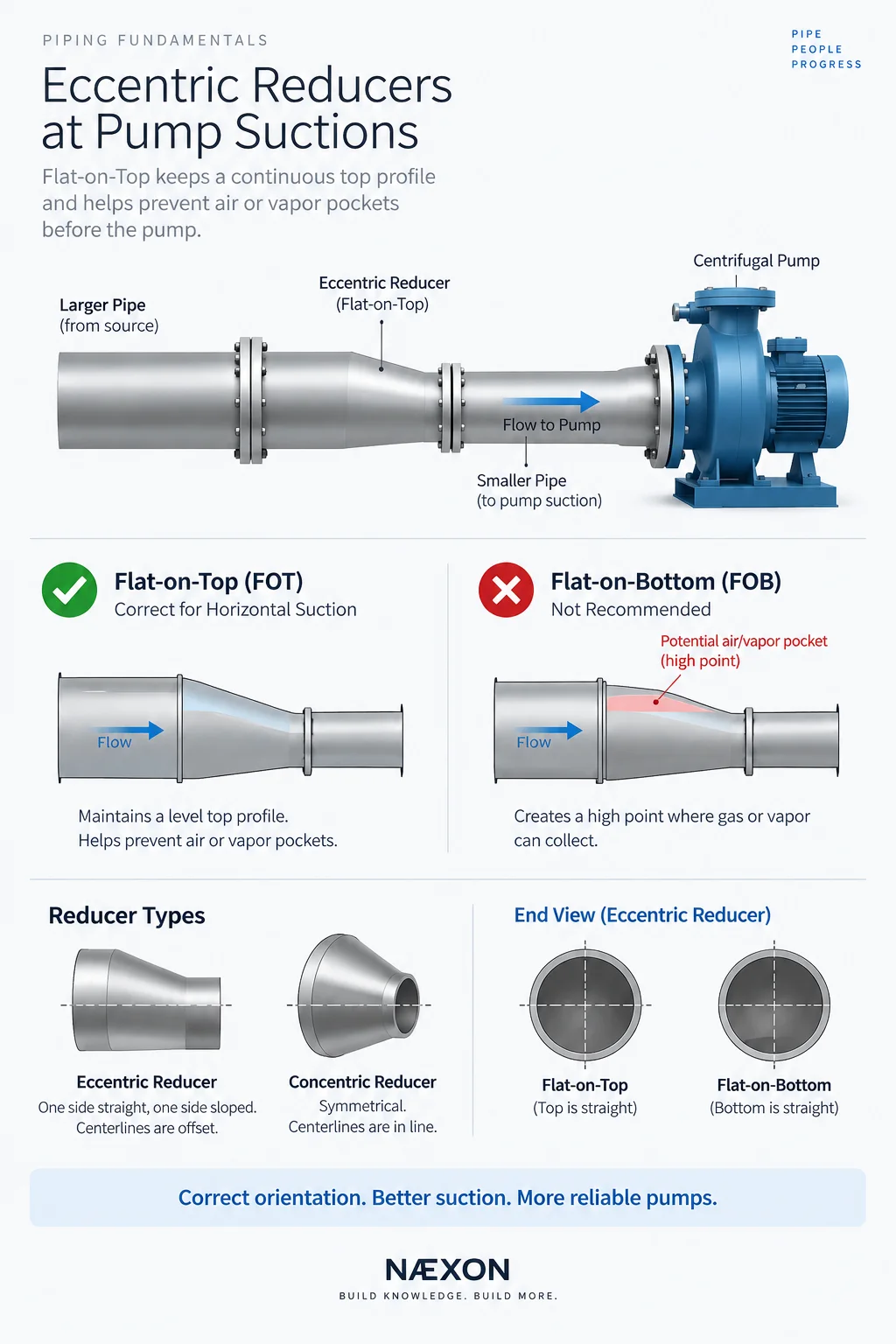
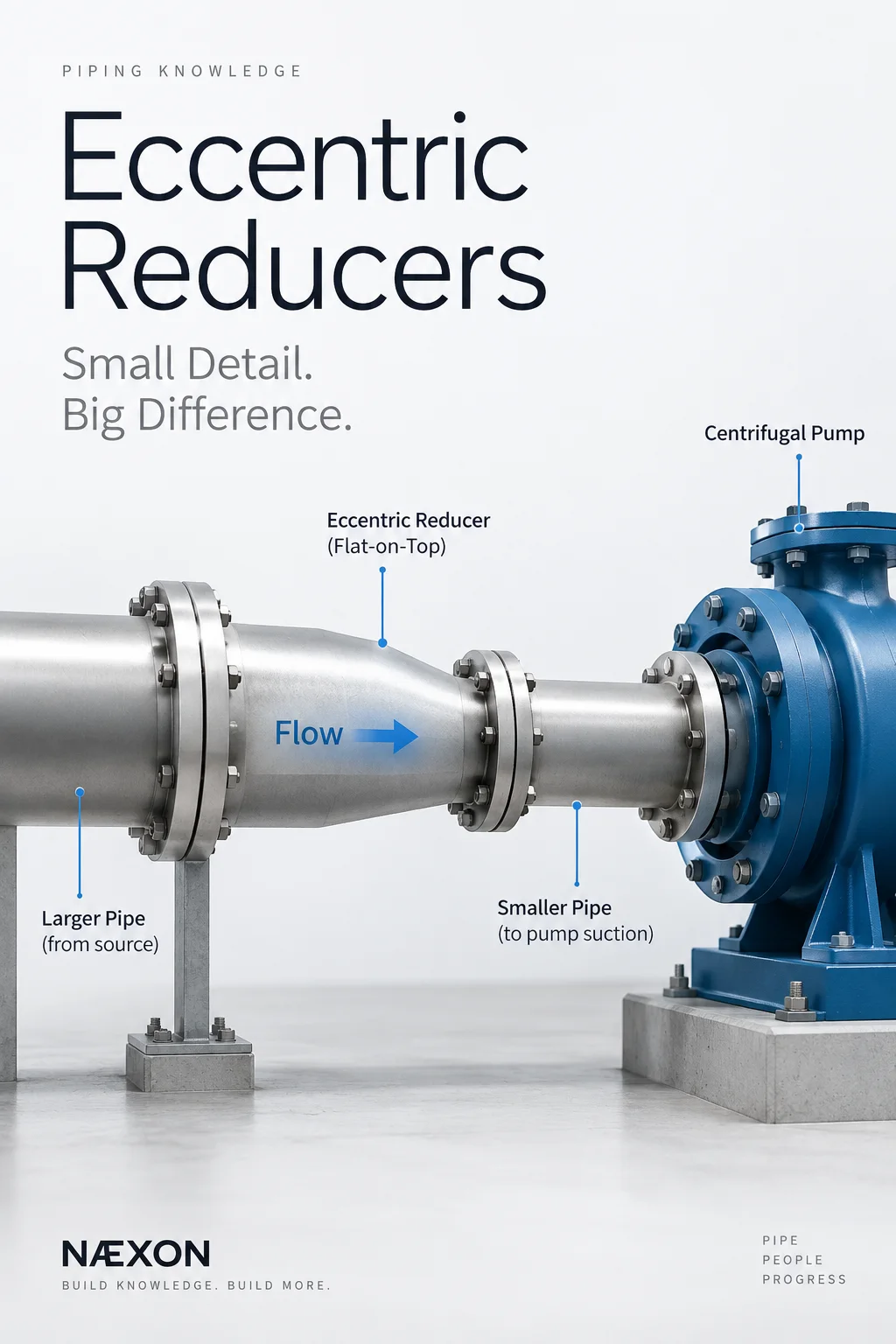
Figure 1. Eccentric reducer orientation at a horizontal centrifugal pump suction. A flat-on-top (FOT) arrangement maintains a continuous upper profile to help prevent air or vapor pockets, while improper orientation can create a high point where gas may collect.
A reducer connects two different pipe sizes. The two common types are concentric and eccentric reducers.
A concentric reducer decreases symmetrically around the pipe centerline. The centerline of the smaller connection remains aligned with the centerline of the larger connection. Viewed from the side, it resembles a symmetrical cone.
An eccentric reducer is different. One side remains essentially straight while the opposite side transitions between the two diameters. Consequently, the centerlines of the large and small ends are offset.
That geometry allows the installer to maintain either the top or bottom elevation of the piping through the transition.
Why Pump Suction Piping Matters
A centrifugal pump does not simply need liquid at its suction flange. It needs a sufficiently stable and adequately supplied flow of liquid.
Poor suction conditions can contribute to unstable operation, excessive vibration, reduced capacity, noise, loss of prime, and cavitation-related problems. The suction system therefore deserves considerably more attention than simply connecting a pipe from a vessel or tank to the pump.
Reducers become particularly important because the suction piping is often larger than the pump suction nozzle. For example, the suction line may be 8-inch pipe while the pump has a 6-inch suction connection. A transition is required somewhere before the nozzle.
The geometry of that transition can influence whether the piping creates a location where gas or vapor can accumulate.
Why Flat-on-Top?
Imagine liquid traveling horizontally toward the pump.
If the reducer creates a pocket or high point along the upper portion of the suction piping, entrained gas or vapor can migrate toward that location and collect. Instead of maintaining a continuous liquid-filled path toward the pump, the piping can develop a gas pocket.
Installing an appropriately oriented eccentric reducer flat-on-top can maintain a continuous upper profile through the transition and eliminate the pocket that certain other arrangements could create.
The basic field objective is:
Do not create an unintended high point in a liquid-filled horizontal suction line where gas can accumulate.
That is the reasoning behind the familiar FOT arrangement.
What Can an Air or Vapor Pocket Do?
Gas entering a centrifugal pump can interfere with normal hydraulic operation. Pumps designed for liquid generally do not handle significant quantities of gas the same way they handle an incompressible liquid.
A gas pocket upstream can contribute to intermittent gas ingestion. The pump may become noisy, discharge pressure can fluctuate, capacity may fall, and vibration can increase.
It is important, however, not to blame every suction problem on the reducer. Pump performance depends on the complete suction system, including available NPSH, liquid temperature, static head, friction losses, valves, strainers, fittings, flow velocity, upstream disturbances and the process itself.
The reducer is only one component—but its orientation can matter.
Concentric vs. Eccentric at a Horizontal Pump Suction
Suppose an 8-inch horizontal suction line must connect to a 6-inch pump nozzle.
With a concentric reducer, both the top and bottom surfaces transition toward the smaller pipe. Depending on the elevations and piping arrangement, this can produce geometry that is undesirable for venting gas toward its intended destination.
With an eccentric reducer installed in the appropriate orientation, one side can remain level while the transition occurs on the other side.
For the common liquid-filled horizontal suction arrangement where preventing a high-point gas pocket is the objective, the flat side is frequently placed on top.
That is why experienced pipefitters will often notice an incorrectly oriented suction reducer immediately.
Don’t Turn the Rule Into an Absolute
This is where field knowledge becomes important.
“Eccentric reducer = flat-on-top” is not a universal rule for every pump and every piping arrangement.
Reducer orientation depends on the actual service and piping configuration. Engineers may intentionally specify another orientation because of drainage requirements, solids, slurry service, vertical piping, pump type, suction source, nozzle arrangement, process requirements, vendor requirements or another design consideration.
The correct question is not simply:
“Which way does an eccentric reducer always go?”
The better question is:
“What must this piping system prevent from collecting, and where does the process need gas, liquid or solids to travel?”
That distinction prevents a useful rule of thumb from becoming a bad habit.
Flat-on-Top vs. Flat-on-Bottom
These descriptions refer to the straight side of the eccentric reducer.
Flat-on-top (FOT) means the straight side is positioned along the top of the pipe.
Flat-on-bottom (FOB) means the straight side is positioned along the bottom.
The required orientation should come from the engineering design, piping specification, isometric, pump manufacturer’s requirements and actual process conditions.
A fitter should never rotate an eccentric reducer solely because a familiar field rule says it normally faces a particular direction.
What About Vertical Pump Suction Piping?
The classic flat-on-top discussion primarily concerns horizontal suction piping.
Once the piping becomes vertical, the same gas-pocket geometry does not apply in exactly the same way. Gravity, flow direction, drainage, venting and the rest of the piping arrangement determine what transition is appropriate.
This is why simply memorizing “pump suction equals eccentric reducer” is incomplete. The orientation and type of reducer must make sense for the actual piping geometry.
Reducer Location Matters Too
Correct orientation does not automatically make the suction piping good.
A pump suction should be evaluated as a complete flow path. Elbows, tees, partially open valves and other disturbances can create nonuniform velocity profiles and swirl entering the pump.
For this reason, engineering and pump-vendor requirements may specify straight-pipe requirements or particular arrangements immediately upstream of the suction nozzle. Those requirements vary with the pump and system, so a universal number of pipe diameters should not be assumed.
If the drawing or vendor documentation specifies a straight run, reducer position or elbow orientation, those requirements take precedence over a field shortcut.
Cavitation and the Reducer
A common misconception is that installing an eccentric reducer flat-on-top automatically prevents cavitation.
It does not.
Cavitation occurs when local liquid pressure falls sufficiently low for the liquid to vaporize, producing vapor bubbles that can subsequently collapse in higher-pressure regions of the pump.
Available NPSH is affected by factors such as suction-vessel pressure, static liquid level, liquid vapor pressure, elevation, suction-line friction and restrictions.
An improperly arranged reducer can contribute to poor suction conditions, but correcting the reducer cannot compensate for a fundamentally inadequate suction system.
Think of FOT orientation as one part of good suction-piping design, not a cure for every pump problem.
Field Example
Consider a centrifugal pump taking suction from a storage vessel.
The vessel outlet feeds an 8-inch horizontal suction line. The pump has a 6-inch suction nozzle, so the piping must reduce from 8 inches to 6 inches before reaching the pump.
The isometric specifies:
8” × 6” Eccentric Reducer — FOT
Before fitting the spool, the pipefitter should verify the direction of flow, identify the large and small ends, determine which surface of the reducer is straight, confirm the required orientation from the drawing and check the resulting elevations.
The fitter should also look beyond the reducer. Is there an upstream elbow? Is the line continuously arranged as intended? Is there an unexpected high point? Does the pump nozzle elevation agree with the field condition? Is there enough room to install and remove the pump?
That is the difference between merely installing a fitting and understanding the system being built.
Common Field Mistakes
One common mistake is treating an eccentric reducer like a concentric reducer and rotating it without considering orientation. Because eccentric reducers are asymmetrical, rotation changes the geometry of the piping.
Another mistake is automatically installing every pump suction reducer flat-on-top without checking the drawing. The general practice may be correct frequently enough to become familiar, but engineered exceptions exist.
Fitters should also avoid forcing the pump nozzle into alignment with improperly fabricated piping. A spool that requires excessive force, come-alongs or flange bolts to pull it into position can transfer unwanted loads into the pump nozzle.
The piping should fit the equipment—not use the equipment to correct the piping.
Troubleshooting a Pump With Suction Problems
If a centrifugal pump is experiencing noise, vibration, unstable discharge pressure or reduced performance, inspect the entire suction system rather than immediately assuming the pump itself has failed.
Check the liquid level and suction source, valve positions, strainers, possible restrictions, leakage points, reducer orientation, piping high points, upstream fittings and whether the operating conditions differ from the design.
Also determine whether the symptoms actually indicate cavitation, gas entrainment, mechanical damage, alignment problems or another issue. Several pump problems can produce similar symptoms.
Good troubleshooting separates the symptoms from the cause.
Field Rules
For horizontal liquid pump suction piping, understand why an eccentric reducer may be specified rather than simply memorizing its orientation. Maintain the intended piping profile and avoid creating unwanted gas pockets. Verify reducer orientation against the isometric, piping specification and pump-vendor requirements. Check nozzle and pipe elevations before fabrication, and never force piping onto a pump nozzle to compensate for bad fit-up.
Most importantly, remember that flat-on-top is a common arrangement—not an unconditional rule.
Knowledge Check
1. Why is an eccentric reducer commonly used on horizontal centrifugal-pump suction piping?
Because its geometry can maintain the desired pipe profile while transitioning between different diameters and help avoid creating an unwanted gas-collection point.
2. What does FOT mean?
Flat-on-top.
3. Does an eccentric reducer installed FOT guarantee that a pump will not cavitate?
No. Cavitation depends on the hydraulic conditions of the entire suction system and available NPSH.
4. Should every eccentric reducer connected to a pump automatically be installed FOT?
No. Orientation depends on the engineered piping arrangement, service, process requirements and equipment requirements.
5. Why shouldn’t piping be forced into alignment with a pump nozzle?
Doing so can impose unwanted loads on the equipment and can indicate that the piping was fabricated or installed incorrectly.
Practical Exercise
Draw a horizontal 10-inch suction line connecting to an 8-inch centrifugal-pump suction nozzle.
Place a 10 × 8 eccentric reducer immediately upstream of the final suction section. First draw it flat-on-top. Then redraw the same arrangement with the reducer rotated 180 degrees.
Trace the upper surface of the piping in both drawings and identify whether either configuration creates an unintended high point where gas could collect.
Next, add an elbow upstream of the reducer and consider how the elbow could disturb the flow entering the pump.
The purpose of the exercise is not simply to memorize the correct-looking drawing. It is to learn to look at pump suction piping as a hydraulic system rather than a collection of fittings.
A good pipefitter should be able to look at the reducer and explain not only which way it goes, but why it goes that way.