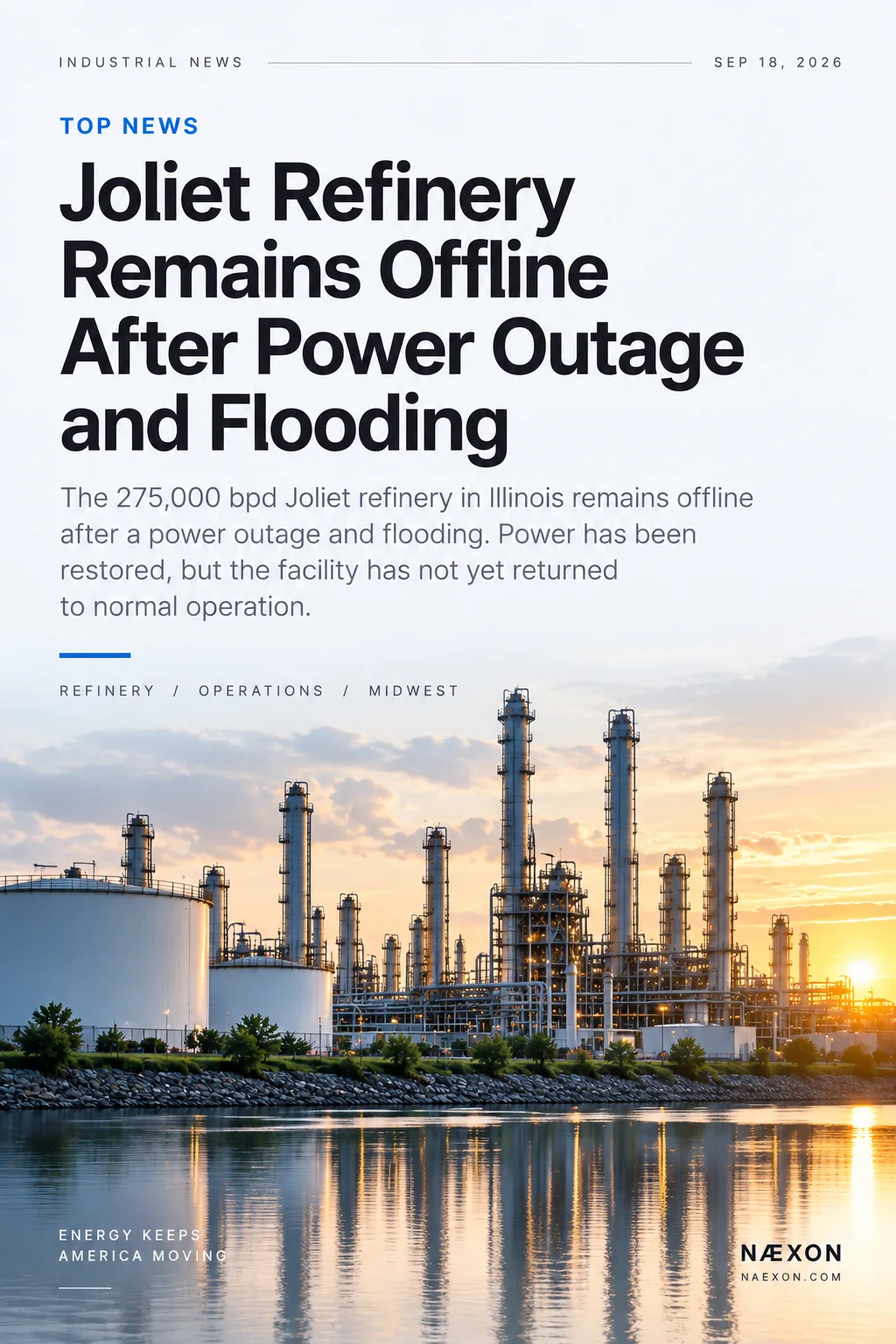
ExxonMobil’s Joliet Refinery Remains Offline After Power Outage and Flooding
ExxonMobil’s 275,000-barrel-per-day Joliet refinery in Illinois remained offline following a power outage and subsequent flooding that overwhelmed a pump at the facility. Electrical service has reportedly been restored, but the refinery had not yet returned to normal operation as of the latest reporting.
The Joliet facility is an important Midwest refinery capable of producing roughly 11 million gallons of gasoline and diesel per day. The outage is significant because the refinery supplies fuel into a large regional market across the Midwest. For industrial workers, contractors and maintenance companies, the immediate question is how quickly the facility can safely restart and whether inspections or repair work uncover additional maintenance requirements.
Massive 6.3-GW Texas Power Project Could Support AI Data Centers
A proposed 6.3-gigawatt combined-cycle natural-gas power project in Encinal, Texas, is being discussed as part of a broader U.S.–South Korea investment package. The proposed investment associated with the project is approximately $22.3 billion.
The concept calls for development in stages, beginning with approximately 1.4 GW of gas-turbine generation before potentially adding another 4.9 GW of combined-cycle capacity. The electricity would help support rapidly expanding AI data centers and semiconductor facilities in Texas.
For the industrial construction workforce, projects of this scale can create enormous demand across power generation, gas infrastructure, structural steel, piping, electrical systems, instrumentation, cooling systems and commissioning. The project remains under discussion, however, and should not yet be treated as a fully committed construction project.
Data-Center Power Costs Move Into the National Spotlight
The enormous electricity requirements of new AI data centers are increasingly becoming an infrastructure issue rather than simply a technology story. Federal lawmakers are considering how the cost of new generation, transmission and other electrical infrastructure needed for large data centers should be allocated.
The debate matters to industrial construction because data-center development is beginning to pull power generation directly into the construction pipeline. Large campuses increasingly require substations, transmission upgrades, backup generation, cooling plants and, in some cases, entirely new utility-scale power projects.
This creates a second layer of opportunity beyond construction of the data-center buildings themselves. Pipefitters, electricians, millwrights, welders, instrumentation technicians, equipment operators and commissioning personnel may increasingly find data-center-related work occurring at power plants and utility infrastructure miles away from the actual campuses.
Virginia Introduces New Data-Center Development Restrictions
Virginia, the largest established U.S. data-center market, announced a new Data Center Accountability Framework as state officials respond to concerns surrounding electricity consumption, project transparency and infrastructure development.
Among the measures is increased disclosure surrounding large projects of 25 MW or greater, while additional provisions are intended to encourage cleaner electricity sources. Some portions of the framework will require legislative action.
This is an important development for contractors watching the data-center boom. The industry is entering a phase where power availability, transmission capacity, community acceptance and regulatory requirements may determine where the next generation of hyperscale campuses gets built.
Baker Hughes Lands Major Equipment Orders for Louisiana LNG Expansion
Baker Hughes has secured major equipment orders connected to Venture Global’s expanding Louisiana natural-gas and LNG infrastructure.
The company will supply 13 gas-compression systems for the Cloud Connector Pipeline. The project will move additional feed gas toward Venture Global’s Plaquemines LNG operation. Baker Hughes will also provide four liquefaction blocks containing eight liquefaction modules for expansion of the Plaquemines facility.
The equipment package includes centrifugal compression equipment, cold boxes, air coolers and integrated control systems. Large equipment commitments like these are important early indicators because they can precede substantial fabrication, mechanical installation, piping, electrical, instrumentation and commissioning activity.
Argent LNG Advances Major Port Fourchon Storage-Tank Package
Argent LNG and CB&I have signed an agreement positioning CB&I as the preferred EPC contractor for three massive full-containment LNG storage tanks at the proposed Argent LNG terminal in Port Fourchon, Louisiana.
Each tank would provide approximately 200,000 cubic meters of working capacity, creating a combined 600,000 cubic meters of LNG storage. The broader proposed terminal is designed for approximately 25 million tonnes per annum of LNG production and represents an estimated investment of roughly $18 billion.
The agreement moves engineering, commercial planning and early execution work forward while the companies negotiate a potential lump-sum turnkey EPC contract. The project remains in the federal regulatory process and has not yet received final approval, so construction should not be considered fully committed.
The project is particularly important for Gulf Coast craft labor because the developers have specifically identified opportunities for Louisiana subcontractors, fabricators, suppliers and skilled trades if the development progresses into construction.
Houston Chemical Plant Power Failure Triggers Heavy Flaring
TPC Group’s Houston-area chemical operation experienced a power outage earlier this week that affected its boilers and caused unusually heavy flaring and visible black smoke.
Plant personnel began restoring power and restarting the boilers while conducting air monitoring around the facility. The company reported that it did not expect an impact on employees or surrounding communities.
The incident is another reminder of how electrical reliability, steam systems and flare infrastructure are interconnected inside petrochemical facilities. A seemingly straightforward electrical interruption can rapidly affect boilers, process operations and flare loading across an operating plant.
U.S. Pipeline Construction Pipeline Remains Strong
Natural-gas infrastructure remains one of the strongest areas to watch for future industrial construction. Approximately 44.9 Bcf/d of additional U.S. natural-gas pipeline capacity has been planned for 2026 and 2027, with roughly 70% of that capacity already under construction according to federal energy data.
Texas dominates the expansion, accounting for more than 29 Bcf/d of planned capacity, while Louisiana represents another major share. Much of the infrastructure is designed to move additional Permian Basin gas toward LNG terminals, power generation and industrial customers.
At the same time, additional petroleum and NGL pipeline projects continue moving through development. That combination keeps Texas and Louisiana at the center of one of the largest concentrations of pipeline, LNG and industrial construction activity in the country.
What Industrial Workers Should Watch Next
The connection between energy infrastructure and data centers is becoming increasingly important. Data-center construction is no longer limited to server buildings. The enormous electrical loads associated with AI are driving development of gas-fired generation, transmission systems, substations, pipelines, cooling infrastructure and other heavy industrial systems.
Louisiana remains one of the most important areas to monitor for LNG and pipeline construction, particularly around Plaquemines and Port Fourchon. Texas continues to combine data-center growth, power generation, natural-gas infrastructure and semiconductor investment on an extraordinary scale.
For skilled trades, the strongest future opportunities may increasingly appear where these industries overlap: natural gas feeding power plants, power plants supporting data centers, pipelines supplying LNG facilities, and massive electrical and mechanical systems connecting everything together.