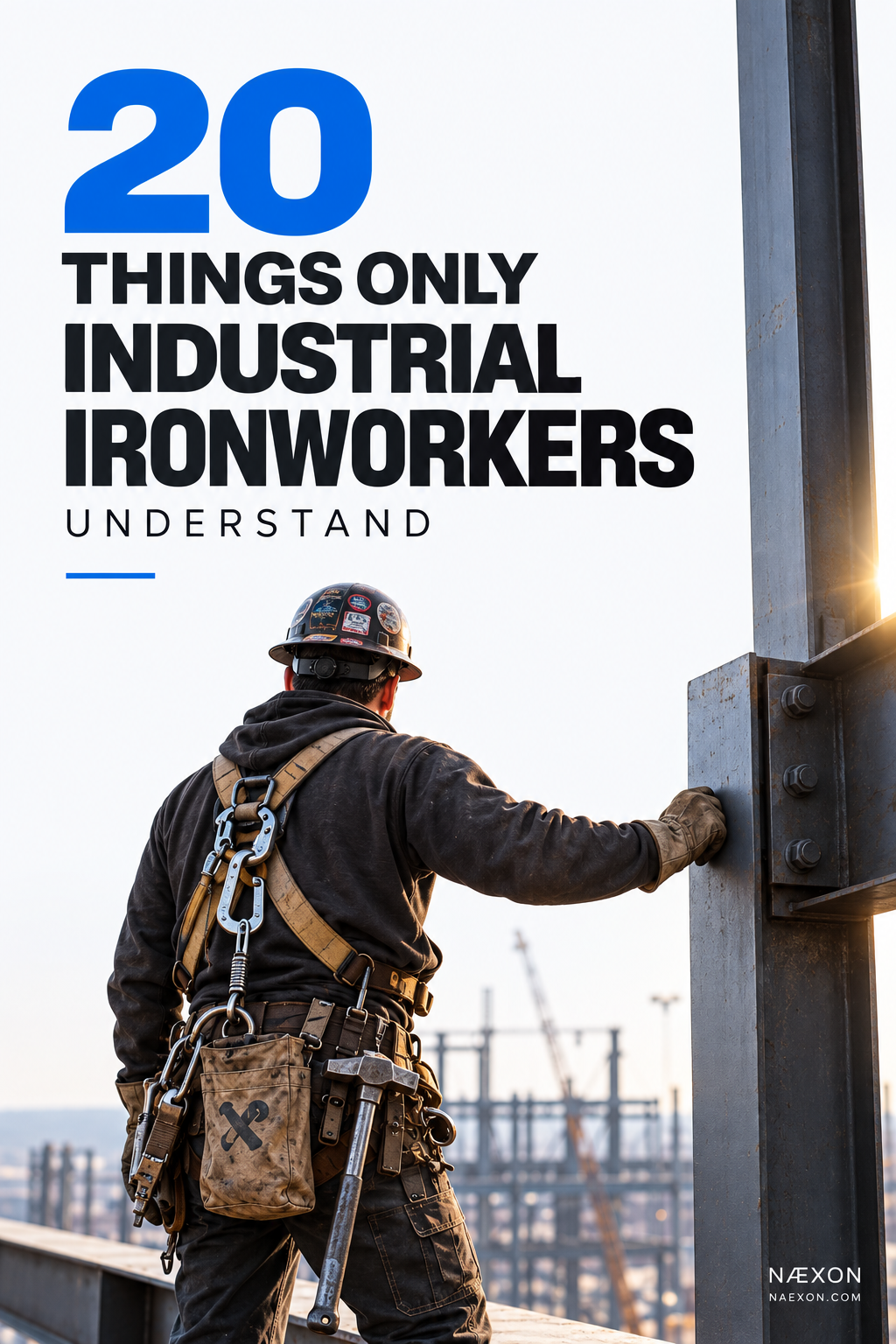
Industrial ironwork looks simple from the ground.
A crane picks up steel. Ironworkers connect it. Repeat.
Then you actually work the trade.
Suddenly you’re hundreds of feet in the air waiting on a beam that’s supposedly “coming right now,” carrying a spud wrench that somehow weighs twice as much at the end of the shift, and listening to somebody on the radio describe the location of a piece of steel as:
“Right there.”
Ironworkers have their own language, habits, humor and problems that are difficult to understand until you’ve spent time around structural steel.
Here are 20 things industrial ironworkers understand immediately.
1. “The Crane Is Coming” Has No Actual Measurement of Time
It could mean five minutes.
It could mean 45 minutes.
It could mean after lunch.
It could mean the operator is currently making somebody else’s pick on the complete opposite side of the project.
But you’re ready.
Your partner is ready.
The connection is ready.
Everyone is looking toward the crane.
Any minute now.
Probably.
2. A Beam Can Be Six Inches Away and Somehow Still Be Nowhere Near Where You Need It
From the ground:
“Looks good!”
From the connection:
Not even remotely good.
A little left.
Little more.
More.
More.
STOP.
Back right.
Too far.
Come back.
Hold it.
Eventually the entire crew begins questioning what the words left and right actually mean.
3. The Spud Wrench Is Basically Part of Your Hand
Other people see a wrench.
An ironworker sees a wrench, an alignment tool, a hole checker and a pointing device.
It’s also occasionally the thing you spend five minutes looking for before realizing it’s hanging exactly where you always keep it.
After enough years, reaching for a spud becomes almost automatic.
4. The Bolt Hole Is Always Almost Lined Up
Never perfectly.
Just close enough to give you hope.
You can see daylight.
The bolt is right there.
The hole is right there.
They simply have no interest in meeting each other.
That’s when the bull pin, drift pin or spud earns its paycheck.
5. “Just One More Piece” Is One of Construction’s Oldest Lies
It’s 4:47 PM.
Everybody knows what time it is.
Then somebody says:
“Let’s get one more.”
One more somehow becomes three.
Then the last piece doesn’t fit.
Then someone needs another bolt.
Then the crane gets tied up.
Congratulations.
You now live here.
6. Ironworkers Can Identify a Beam From 100 Feet Away—Until There Are 40 Identical Beams
“That’s it.”
“No, next one.”
“That one?”
“No.”
“The one underneath it.”
Of course it is.
The correct piece is almost always underneath six other pieces.
The piece mark eventually gets found in the least convenient location possible.
7. Every Piece Gets Heavier the Farther You Carry It
A 35-pound object in the morning:
No problem.
The same 35-pound object after ten hours:
Why was this manufactured from depleted uranium?
Physics works differently after overtime begins.
8. There Is Always One Bolt That Refuses to Participate
Every other bolt goes in.
Beautiful.
Then there’s that bolt.
Turn it.
Tap it.
Realign the connection.
Try again.
Look through the hole.
Try from the other side.
Eventually you start negotiating with it personally.
“Come on. Everybody else went in.”
The bolt remains unconvinced.
9. The Wind Is Completely Different Up There
People on the ground:
“It’s not that windy.”
Ironworker 150 feet up:
Interesting observation.
The ground crew’s weather report becomes increasingly less useful with elevation.
Conditions that feel mild at grade can feel completely different when you’re exposed on the steel.
10. Everyone Becomes an Expert on Your Connection From the Ground
“You just need to pull it over!”
Great.
Thank you.
The person standing safely on concrete 100 feet below has solved structural steel erection.
We’ll notify engineering.
Meanwhile, the connectors are still trying to convince two pieces of steel that they were designed to meet each other.
11. The Radio Works Perfectly Until the Most Important Pick of the Day
All morning:
Crystal clear.
Then the complicated piece comes up.
“Come left about—”
KSSSSHHHHHHH.
“What?”
KSSHHHHHH.
“COME AGAIN?”
Nothing improves a precision crane operation like communicating through what sounds like a drive-thru speaker during a thunderstorm.
12. “It Fit in the Shop” Is Not Helpful Information
Fantastic.
We’re very happy for the shop.
Unfortunately, the beam is currently here.
The connection is currently there.
And the holes currently have different opinions about the situation.
Sometimes the steel needs adjustment.
Sometimes something is oriented incorrectly.
Sometimes the wrong piece arrived.
And sometimes everyone eventually discovers that the drawing has been telling them the answer the entire time.
13. You Start Recognizing Steel by Sound
Steel settling.
A pin being driven.
Bolts hitting the bucket.
A connection pulling together.
After enough years, certain sounds immediately tell you what’s happening even when you aren’t looking directly at it.
Then you hear one unfamiliar sound.
Everybody looks.
That’s universal.
14. Lunch Tastes Better Sitting on Steel
There’s something different about finally sitting down after spending half the day climbing, connecting and moving iron.
The lunch might be completely ordinary.
Sandwich.
Chips.
Water.
But after six hours of ironwork?
Five-star restaurant.
No reservation required.
The view isn’t bad either.
15. Ironworkers Have a Different Definition of “Close”
Normal person:
“That’s about an inch off.”
Ironworker:
“We can get it.”
Two inches:
“We can probably get it.”
Three inches:
“Get the come-along.”
At some point, however, even the most optimistic ironworker quietly starts looking at the drawing again.
That’s usually when “close” officially becomes “something isn’t right.”
16. You Can Never Have Too Many Connecting Bolts—Until You’re Carrying Them
On the ground:
“Grab some extra.”
Good idea.
Halfway up:
Whose idea was it to bring all these bolts?
The relationship between an ironworker and extra hardware is complicated.
You want it nearby.
You simply don’t want to be the person transporting all of it.
17. The Drawing Is Always Somewhere Else When You Actually Need It
Everything is going perfectly.
Then somebody notices something strange.
“Check the print.”
And suddenly the drawing has disappeared from human civilization.
Someone had it.
Nobody currently has it.
Eventually it appears folded underneath something exactly where everybody already looked.
Then someone studies it for five seconds and says:
“Beam’s backwards.”
Silence.
18. The Best Connectors Make Difficult Work Look Boring
Watching an experienced ironworker can be misleading.
Beam comes in.
They control it.
Line it up.
Pin it.
Bolt it.
Done.
An apprentice watches and thinks:
“That doesn’t look too difficult.”
Then the apprentice tries it.
That’s when they discover the journeyman quietly made about 15 decisions in ten seconds.
Where the beam is moving.
How it’s swinging.
Where the connection needs to land.
Which hole to catch first.
Where their hands need to stay.
What the crane needs to do next.
Experience often looks like nothing happened.
That’s because the experienced person prevented the problems before you noticed them.
19. You Never Forget the First Time You Look Down
Most ironworkers remember it.
You’re working.
You’re focused.
Everything feels normal.
Then for some reason you look straight down.
And your brain reminds you:
There is absolutely nothing underneath you for a very long distance.
Then you look back at the connection.
Back to work.
Eventually height becomes part of the environment.
Respect for it shouldn’t disappear.
The experienced ironworker isn’t the person who pretends the hazards aren’t there.
It’s the person who knows they’re there and works accordingly.
20. Nobody Understands the Feeling When the Last Piece Lands
After weeks or months of steel going up, eventually the structure reaches that moment.
The final major piece is picked.
It comes through the air.
The connectors receive it.
The holes line up.
The bolts go in.
And for a moment, you can look across something enormous that didn’t exist when the crew arrived.
People driving past may only see a building.
Ironworkers see every column, beam, connection, climb, difficult pick, windy morning, long shift and problem the crew had to solve to put it there.
That’s one of the things outsiders rarely understand about the trades.
You can physically point at what you helped build.
Years later, you might drive past with your family and say:
“I worked on that.”
And that’s difficult to replace.
The Ironworker Mentality
Industrial ironwork isn’t simply moving structural steel.
It’s learning how steel behaves.
How loads move.
How connections come together.
How to communicate with crane operators and ground crews.
How to recognize when something doesn’t look right.
And how to work efficiently without forgetting that the environment can become unforgiving very quickly.
The jokes, nicknames and arguments become part of the culture.
But underneath them is something more serious:
Trust.
The person beside you needs to know you’re paying attention.
The crane operator needs clear communication.
The ground crew needs to understand the pick.
The connectors need to trust each other.
And everyone needs to respect the erection plan, rigging, fall protection and the steel itself.
That’s what makes experienced ironworkers different.
They don’t just know how to connect steel.
They understand what can happen when people stop respecting it.
The Part Most People Never See
Most people only see the finished structure.
They don’t see the ironworkers walking the steel before sunrise.
They don’t see the connector waiting for the next piece.
They don’t see the rigging being checked.
They don’t hear the radio traffic between the crew and crane operator.
They don’t see the hours spent plumbing, aligning, bolting and welding the structure.
And they definitely don’t see all the times something doesn’t fit exactly the way everyone expected.
The finished building hides the work required to create it.
That’s true across the skilled trades.
When the project is finished, the temporary equipment disappears, the cranes leave, the crews move to another job and eventually nobody can tell who installed what.
But the structure remains.
Respect the Trade
Ironwork demands strength, but strength alone isn’t enough.
It takes awareness.
Communication.
Balance.
Technical knowledge.
Experience.
And the ability to stay focused when the work becomes repetitive, uncomfortable or difficult.
The best ironworkers aren’t simply fearless people walking around at elevation.
They’re skilled tradespeople who understand structural steel, connections, rigging, erection sequencing and the hazards surrounding the work.
There is a major difference.
Confidence comes from knowing the trade.
Complacency comes from forgetting what the trade can do to you.
The goal is to keep the first one without developing the second.
Næxon
The industrial world isn’t built by drawings alone.
Engineers can design the structure.
Fabricators can manufacture the steel.
Detailers can determine the connections.
Cranes can lift the pieces.
But eventually somebody still has to go up there and put everything together.
Ironworkers build the skeleton of industry.
Every refinery structure, power plant, steel mill, manufacturing facility, data center and major industrial project depends on people willing to turn thousands of individual pieces into one structure.
Piece by piece.
Connection by connection.
Bolt by bolt.
And when it’s finished, most people will never know their names.
They’ll simply use what those ironworkers built.
Build it right. Respect the steel. Respect the trade.


