If you’ve worked inside an oil refinery, chemical plant, oilfield, wastewater facility, pipeline operation, tank farm, or certain power and industrial facilities, you’ve probably seen workers wearing a small electronic device clipped high on their shirt.
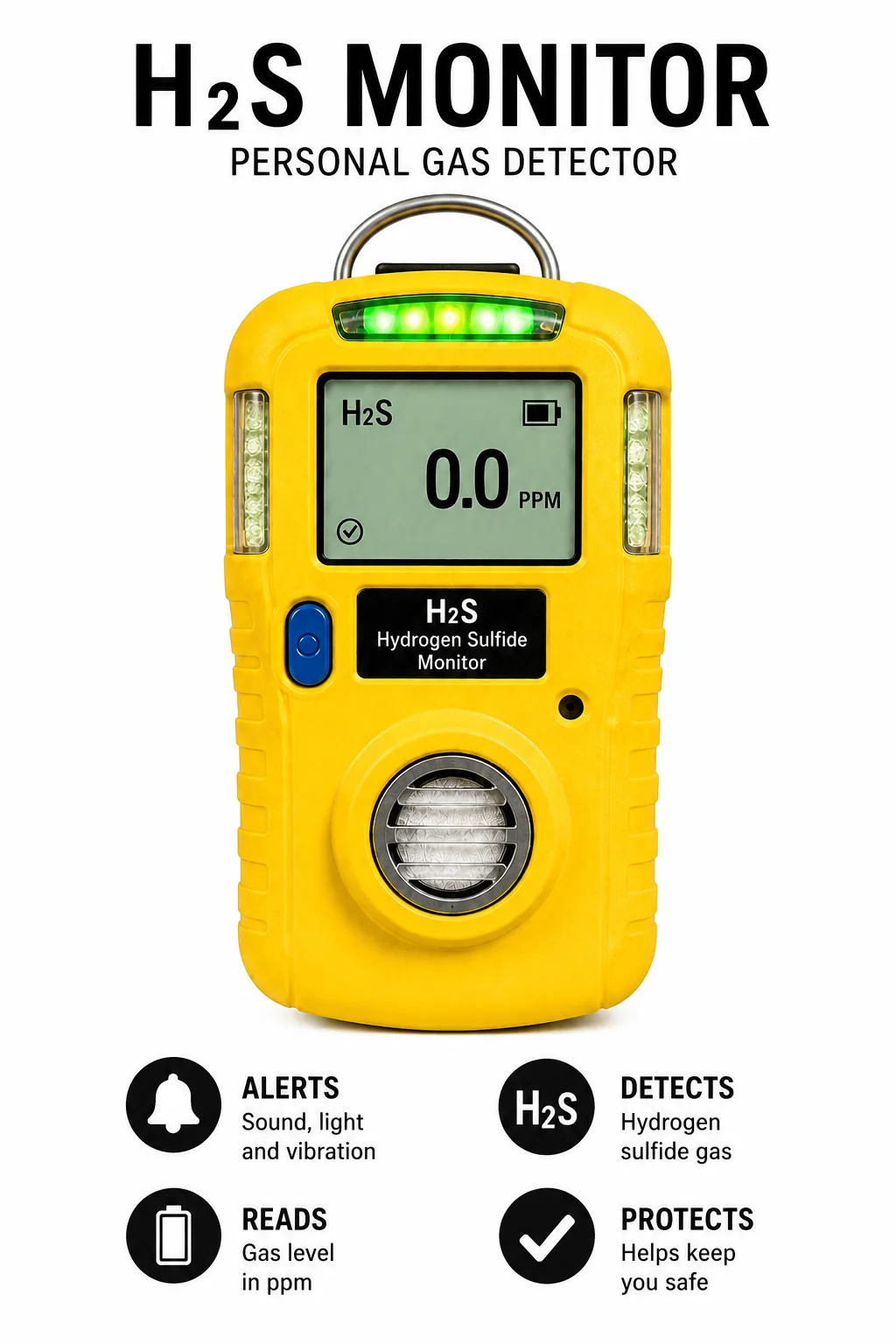
That’s an H₂S monitor.
For many workers, it becomes such a normal part of the daily PPE routine that they clip it on without thinking much about what it’s actually doing.
But that little monitor can warn you about an atmosphere capable of knocking you unconscious—or killing you—before you realize what’s happening.
Understanding your H₂S monitor isn’t just something for the safety meeting. Every worker who wears one should understand what hydrogen sulfide is, what parts per million (ppm) means, where the monitor should be worn, why it alarms, what different readings mean, why you cannot trust your nose, what to do when an alarm activates, and why bump testing and calibration matter.
This guide covers the fundamentals every industrial worker should know.
What Is H₂S?
H₂S is the chemical formula for hydrogen sulfide.
Hydrogen sulfide is a colorless, highly toxic gas that can occur naturally or be generated during industrial processes. Workers can encounter it around crude oil and natural gas operations, refineries, tanks, sewers, wastewater treatment systems, pits, vessels, piping systems and other locations where sulfur-containing materials are present.
At low concentrations, hydrogen sulfide is famous for its rotten-egg smell.
That smell creates one of the most dangerous misconceptions about H₂S:
“I’ll smell it if it’s there.”
Never depend on that.
Hydrogen sulfide can interfere with your ability to smell it. OSHA specifically warns that the sense of smell cannot be relied upon as a warning system, particularly as concentrations increase.
Your nose is not an H₂S detector.
Your gas monitor is.
What Does an H₂S Monitor Actually Do?
A personal H₂S monitor continuously samples the atmosphere immediately around the worker.
Most modern personal H₂S detectors use an electrochemical sensor. When hydrogen sulfide reaches the sensor, the instrument measures the concentration and displays it in parts per million, normally abbreviated ppm.
When the concentration reaches one of the programmed alarm thresholds, the monitor warns the worker.
Depending on the monitor, warnings can include:
- Audible alarm
- Flashing lights
- Vibration
- Displayed gas concentration
- Low-alarm indication
- High-alarm indication
- STEL or TWA exposure alarms
Some modern multi-gas monitors simultaneously measure H₂S along with oxygen, carbon monoxide and combustible gases.
The H₂S monitor isn’t protecting you by removing the gas.
It’s protecting you by telling you the hazard is there.
What happens next depends on your employer’s H₂S contingency plan, training and site procedures.
Understanding PPM
PPM means parts per million.
It’s a way of expressing a very small concentration of gas in the atmosphere.
If your monitor displays:
1 ppm H₂S
that means approximately one part hydrogen sulfide per one million parts of air by volume.
A reading that looks numerically small can still be extremely important.
Don’t look at a monitor displaying 10 ppm and think:
“That’s only ten.”
Ten parts per million is already significant enough that NIOSH sets its recommended 10-minute ceiling at 10 ppm.
At What PPM Does an H₂S Monitor Go Off?
This is one of the most important things to understand:
There is no universal alarm setting for every H₂S monitor on every jobsite.
The monitor can be configured according to the employer’s safety program, site requirements, manufacturer configuration and applicable exposure criteria.
A common industry low-alarm setting is around 10 ppm.
High alarms are often configured around 15–20 ppm or higher, depending on the facility and safety program.
Never assume your monitor uses those exact settings.
Before entering an H₂S-designated area, you should know what your specific monitor’s low alarm, high alarm, STEL and TWA settings are and what actions your site requires for each alarm.
The Numbers Every Worker Should Know
Several different occupational exposure numbers are commonly discussed, and they’re easy to confuse.
1 ppm
ACGIH recommends a 1 ppm eight-hour TWA.
5 ppm
ACGIH recommends a 5 ppm short-term exposure limit (STEL).
10 ppm
NIOSH recommends a 10 ppm ceiling for 10 minutes.
OSHA’s construction standard lists an 8-hour limit of 10 ppm.
Ten ppm is also widely used in industry as an H₂S warning/alarm point.
20 ppm
OSHA’s general-industry standard establishes a 20 ppm ceiling.
That doesn’t mean 20 ppm is the normal level at which every worker should simply continue working.
Your company’s program may require evacuation at a much lower concentration.
50 ppm
Under OSHA’s general-industry Table Z-2 provision, exposure may reach 50 ppm for one 10-minute period only if no other measurable H₂S exposure occurs during that eight-hour shift.
This is an exposure-limit provision—not permission for a worker to intentionally remain inside a 50 ppm atmosphere simply because the number hasn’t exceeded 50.
Follow the site’s H₂S plan and evacuation requirements.
100 ppm — IDLH
This is the number every refinery and industrial worker should recognize.
NIOSH considers 100 ppm H₂S Immediately Dangerous to Life or Health (IDLH).
IDLH means conditions pose an immediate threat to life, could cause irreversible adverse health effects, or could impair a person’s ability to escape.
A worker should never interpret 100 ppm as simply the next level above a high alarm.
This is an extremely dangerous atmosphere requiring specific respiratory protection, training and procedures.
A Simple H₂S PPM Reference
0 ppm: No H₂S detected by the monitor.
1–5 ppm: Low-level exposure territory; occupational limits and company requirements become important.
10 ppm: NIOSH 10-minute ceiling; also a common industry alarm point.
20 ppm: OSHA general-industry ceiling.
50 ppm: OSHA general-industry maximum peak provision under very specific conditions.
100 ppm: NIOSH IDLH.
As concentrations continue rising beyond this point, the potential consequences become increasingly severe and can include rapid collapse, respiratory failure and death.
These numbers should never replace your facility’s written H₂S procedure.
Why You Cannot Trust the Rotten-Egg Smell
This deserves repeating because workers have died after making this mistake.
At relatively low concentrations, H₂S can produce the familiar rotten-egg odor.
Then your ability to smell it can diminish.
A worker may incorrectly think:
“I smelled it a minute ago, but now it’s gone.”
That does not necessarily mean the atmosphere became safe.
It could mean your ability to detect the gas by smell has been affected.
Never use smell to determine whether an H₂S area is safe.
Use properly maintained atmospheric monitoring equipment and follow the facility’s procedures.
Where Should You Wear an H₂S Monitor?
This is another area where jobsite myths develop.
Because H₂S is somewhat heavier than air, some workers believe the personal monitor should be worn on the belt, waist or even near the boot.
That’s generally not where a personal exposure monitor belongs.
The purpose of a personal monitor is to measure the atmosphere you’re breathing.
It should normally be worn in your breathing zone.
For practical purposes, that’s high on the upper torso near your nose and mouth.
Common locations include:
Shirt collar
Upper chest
Lapel
Outside upper breast pocket
Industrial Scientific describes the breathing zone as approximately a hemisphere forward of the shoulders within about six to nine inches of the nose and mouth.
That’s why you’ll commonly see experienced refinery workers wearing their gas monitor clipped high on their FR shirt.
Your monitor should also remain exposed to the surrounding atmosphere.
Don’t bury it underneath clothing.
Don’t put it inside your pocket.
Don’t cover the sensor opening.
Don’t attach it somewhere that makes the alarms difficult to hear, see or feel.
And don’t move it down to your boot simply because somebody tells you H₂S is heavier than air.
Follow the monitor manufacturer’s instructions and your site’s gas-monitoring program.
This is also one reason properly fitted industrial clothing matters. Your PPE and monitoring equipment need to work together without unnecessarily interfering with movement or equipment placement. Næxon covers that relationship in The Importance of Proper Fit in Workwear and How It Improves Productivity on the Jobsite.
But Isn’t H₂S Heavier Than Air?
Yes. Hydrogen sulfide has a vapor density greater than air.
That matters when evaluating where gas may accumulate.
Low areas deserve particular attention, including pits, trenches, vessels, sewers, enclosed spaces and poorly ventilated areas.
But gas behavior on an actual industrial site is more complicated than simply saying:
“Heavy gas always stays on the ground.”
Temperature, wind, ventilation, process pressure, release velocity, equipment configuration and surrounding structures can influence dispersion.
That’s why atmospheric testing and site-specific hazard assessment matter.
Your personal monitor still belongs where it can represent the air you’re breathing.
What Should You Do When Your H₂S Monitor Alarms?
Your facility’s H₂S procedure always controls.
Generally, an H₂S alarm means you should treat the warning seriously and follow the site’s required response immediately.
That may include stopping work, leaving the affected area, moving according to the designated escape route, proceeding crosswind or upwind when directed by site procedures, reporting to the designated muster location, notifying supervision or operations and preventing unauthorized re-entry.
Do not simply silence the monitor and continue working.
Do not assume it’s malfunctioning.
Do not remove it because the noise is annoying.
Do not walk toward the suspected leak to “see where it’s coming from.”
And do not return because the smell disappeared.
Let trained and properly equipped personnel determine when the area is safe for re-entry.
Workers preparing for major outages should understand that gas monitoring is only one piece of refinery protection. Næxon’s What to Wear During Refinery Turnarounds & Maintenance Outages covers additional PPE and workwear considerations encountered during these projects.
Never Become the Second Victim
One of the most dangerous situations involving H₂S occurs when a worker collapses and another worker instinctively runs in to help.
If the first worker was overcome by a toxic atmosphere, the rescuer can be overcome too.
Then another person enters.
Now there are multiple victims.
This is why industrial rescue procedures exist.
If somebody collapses in a suspected H₂S atmosphere, do not enter an unsafe or unknown atmosphere without the required training, respiratory protection, rescue equipment and procedures.
At IDLH concentrations, respiratory protection requirements become critical. An ordinary dust mask, welding respirator or casual half-mask setup is not a substitute for the respiratory equipment required for an IDLH H₂S atmosphere.
Call or activate the site’s emergency response system and follow the facility’s rescue procedure.
What Is a Bump Test?
Workers sometimes confuse bump testing with calibration.
They’re related, but they’re not exactly the same thing.
A bump test exposes the monitor to a known concentration of test gas to verify that the sensor responds and that the monitor’s alarms function.
Think of it as asking:
Can this monitor actually detect gas and warn me?
The monitor may look completely normal while its sensor inlet is blocked, its sensor has failed, or another component isn’t functioning correctly.
That’s why a monitor simply turning on isn’t proof that it’s ready to protect you.
Many facilities require bump testing before each day’s use or according to the manufacturer’s and employer’s established program.
Follow your facility’s procedure and the manufacturer’s instructions for your exact instrument.
What Is Calibration?
Calibration goes further.
During calibration, a known concentration of certified calibration gas is applied to the detector and the instrument’s response is adjusted or verified against that known concentration.
In simple terms:
Bump test = Does it respond?
Calibration = Is it measuring correctly?
Calibration frequency depends on the monitor, manufacturer recommendations, employer program, operating environment and test results.
Never attempt to arbitrarily change calibration or alarm settings unless you’re authorized and trained to do so.
What About TWA and STEL Alarms?
Some monitors do more than alarm based on the concentration at that exact second.
They can also calculate accumulated exposure.
TWA means Time-Weighted Average.
It evaluates exposure averaged over a specified work period.
STEL means Short-Term Exposure Limit.
It addresses shorter-duration exposure.
That means a worker can potentially trigger an exposure alarm based on accumulated exposure even when the instantaneous reading isn’t at the monitor’s high-alarm setting.
If your monitor shows TWA or STEL, you should know what those alarms mean before starting work.
Single-Gas vs. Four-Gas Monitors
An H₂S-specific personal monitor measures hydrogen sulfide.
A common multi-gas monitor may measure several atmospheric hazards simultaneously, often including:
H₂S — Hydrogen sulfide
CO — Carbon monoxide
O₂ — Oxygen concentration
LEL — Combustible gas/vapor concentration relative to the Lower Explosive Limit
These instruments are especially important for atmospheric testing and confined-space work because an atmosphere can contain more than one hazard.
An area having zero H₂S doesn’t automatically mean the atmosphere is safe.
There could still be oxygen deficiency, carbon monoxide or combustible gas.
Personal Monitoring Is Not the Same as Confined-Space Testing
This distinction matters.
A monitor clipped to your chest provides personal atmospheric monitoring.
Confined-space entry may require atmospheric testing before entry and continuous or periodic monitoring according to the permit and hazard assessment.
Depending on the application, a pumped monitor with sampling tubing may be used to test remotely before a worker enters.
Never assume that clipping on your personal H₂S monitor automatically satisfies every confined-space atmospheric-testing requirement.
Where H₂S May Be Encountered
Workers may potentially encounter hydrogen sulfide around:
- Oil and gas wells
- Refineries
- Crude oil systems
- Natural gas operations
- Tanks and vessels
- Process piping
- Sewers
- Wastewater treatment
- Manholes
- Pits
- Confined spaces
- Tank cleaning operations
- Certain chemical processes
- Sulfur-containing materials
- Drilling and production operations
The exact hazard depends on the process and facility.
Industrial workers moving between these environments also face different PPE requirements. Næxon’s Ultimate Guide to Industrial Workwear explains how workwear and PPE requirements change across refineries, pipelines, power plants, fabrication shops and other industrial settings.
Check Your Monitor Before the Shift
Before relying on a personal gas detector, follow your employer’s inspection and testing procedure.
At minimum, workers should know whether the instrument has passed the required functional testing, whether it has sufficient battery life, whether the sensor openings are unobstructed, whether the display is functioning, whether audible/visual/vibration alarms operate, and whether the monitor is within its required calibration interval.
If something doesn’t look right:
Don’t guess.
Don’t borrow someone’s monitor and assume it’s good.
Don’t say, “It worked yesterday.”
Take it to the appropriate safety department, tool room, instrument technician or authorized person according to site procedure.
Keep the Sensor Open to the Atmosphere
Your gas detector has to encounter the contaminated atmosphere before it can detect it.
That means the sensor inlet matters.
Paint.
Mud.
Tape.
Oil.
Dust.
Heavy grime.
Clothing.
Stickers.
Improper covers.
Any obstruction around the sensor opening can potentially interfere with the instrument’s ability to sample the surrounding atmosphere.
Treat a gas monitor like lifesaving equipment—not another object hanging from your shirt.
Follow the manufacturer’s approved cleaning procedure as well. Some cleaning chemicals can interfere with sensitive gas sensors.
Don’t Assume Another Worker’s Monitor Will Protect You
Standing beside somebody wearing an H₂S monitor isn’t the same thing as wearing your own monitor when personal monitoring is required.
Gas concentrations can vary by location.
One worker may be closer to the source.
Another may be downwind.
One worker may be lower in a vessel.
Another may be above the release.
A few feet can matter.
If your job requires personal monitoring, wear your assigned monitor correctly.
H₂S and Refinery PPE
A gas monitor is only one component of refinery protection.
Depending on the facility and task, workers may also need FR clothing, hard hats, safety glasses, gloves, hearing protection, protective footwear, respiratory protection, face shields, fall protection and task-specific PPE.
For workers who spend long shifts climbing pipe racks, working around hot equipment, welding, fitting and performing maintenance, PPE also needs to remain functional throughout the shift. Næxon’s guide to What Every Welder Should Know About Flame-Resistant Apparel explains why FR clothing is another critical layer of industrial protection.
The Most Important H₂S Rules to Remember
If you remember nothing else from this article, remember these principles:
Never trust your nose.
Wear your personal monitor in your breathing zone.
Know your monitor’s actual alarm settings.
Treat every alarm seriously.
Never silence an alarm and continue working unless your written procedure specifically establishes the safe response.
Never enter an unknown or H₂S-contaminated atmosphere to rescue someone without proper training, equipment and authorization.
Know that 100 ppm H₂S is considered IDLH by NIOSH.
Bump-test and calibrate according to your employer’s program and manufacturer requirements.
Never intentionally cover or obstruct the sensor.
Follow your site’s H₂S contingency and emergency-response plan—not something you heard from another jobsite.
That Little Monitor Deserves Your Attention
A personal H₂S monitor is easy to take for granted.
You clip it onto your shirt every morning.
Walk through the gate.
Attend the toolbox meeting.
Go to work.
After months or years of hearing nothing from it, the monitor can start feeling like just another piece of equipment hanging from your FR shirt.
Until the day it alarms.
Then that little device may be providing the most important information you receive during your entire shift.
Hydrogen sulfide doesn’t care how experienced you are.
It doesn’t care whether you’re an apprentice, journeyman, foreman, operator, pipefitter, welder, boilermaker, millwright or superintendent.
And it doesn’t care whether you’ve worked around H₂S for twenty years without an incident.
Respect the monitor.
Understand the numbers.
Wear it correctly.
Know your escape procedure.
And when it alarms, take it seriously.
Because on an H₂S jobsite, the monitor clipped to your chest isn’t an accessory.
It’s there to warn you when the air you’re breathing may no longer be safe.