Walk through a refinery parking lot before daylight and you can often tell who works there before you ever see a company badge.
The faded welding cap stuffed into a back pocket. The bandana tied around a neck or tucked beneath a hard hat. The pearl-snap shirt worn open at the collar. Beat-up boots. Safety glasses. A shirt that has been washed so many times it fits like it was made specifically for the person wearing it.
Nobody held a meeting and decided this was how industrial workers should dress.
It happened naturally.
Over decades of refinery work, pipeline construction, fabrication, welding, power generation, shutdowns, turnarounds, oilfield work and heavy construction, workers borrowed clothing from different corners of American work culture and made it their own.
What started as practical workwear gradually became something bigger.
It became blue-collar style.
Industrial Style Was Never Designed in a Fashion Studio
Most fashion trends begin somewhere intentionally.
Industrial style didn’t.
The people working in refineries, fabrication shops, pipelines and construction sites were trying to solve much simpler problems:
How do I stay comfortable for 12 hours?
How do I keep sparks off my head?
How do I keep sweat out of my eyes?
How do I wear clothing that can survive climbing steel, crawling through equipment and working around dirt, grease and heat?
Function came first.
Style followed.
That distinction is important because industrial workers have always been suspicious of clothing that looks like workwear but cannot actually work.
A shirt can look tough in a photograph.
The real test happens after hundreds of hours on the job.
That is why durability, mobility and proper fit remain such important parts of industrial workwear.
The jobsite decides what survives.
And over time, the things that survived became part of the culture.
The Pearl-Snap Shirt Crossed Into Heavy Industry
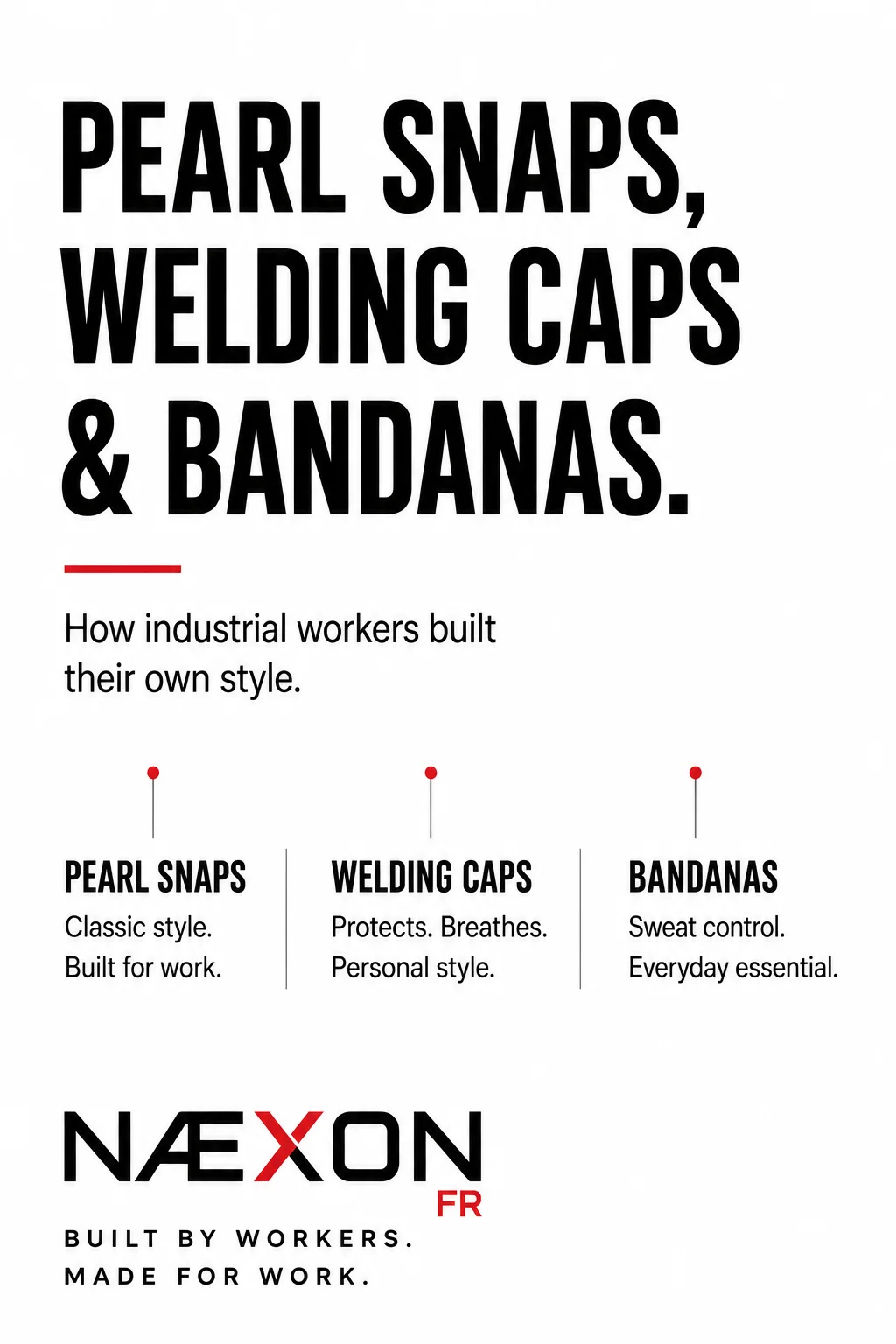
Pearl snaps weren’t created specifically for welders, pipefitters or refinery workers.
Their roots are much more closely connected to Western clothing, ranch work and cowboy culture.
But culturally, the distance between a ranch hand and an industrial craftsman isn’t as large as it might seem.
Both worlds value clothing that can take abuse.
Both involve long hours.
Both have strong traditions built around craftsmanship, independence and pride in the work.
And both developed clothing styles that became recognizable far beyond the workplace.
Eventually, Western-style shirts found a natural home in oilfields, pipelines, fabrication shops and industrial construction.
The pearl snap was especially suited to that transition.
Instead of a row of ordinary buttons, snap closures create a distinctive appearance and are convenient to operate. Combined with Western yokes, chest pockets, durable materials and a work-oriented cut, the pearl-snap shirt became something that could look good without looking out of place beside a welding machine.
Modern versions pushed the idea even further.
Today’s industrial pearl-snap shirts can combine that traditional Western appearance with modern construction, improved mobility and flame-resistant materials where appropriate.
That’s a major reason the style has lasted.
It doesn’t look like disposable workwear.
A good pearl-snap shirt can walk out of a refinery at 5:30 p.m., get cleaned up and still look completely natural at dinner later that night.
That crossover between work and everyday life is one of the defining characteristics of modern blue-collar style.
Welding Caps Became Personal
Few pieces of industrial clothing reveal personality as quickly as a welding cap.
Originally, the purpose is straightforward.
A welding cap helps protect the head and hair from sparks, spatter and debris, while also helping manage sweat underneath welding hoods and other equipment.
But welders didn’t leave them boring.
Patterns appeared.
Paisley.
Flames.
Skulls.
Flags.
Camo.
Bright colors.
Company logos.
Trade references.
Inside jokes that only another welder would understand.
Some workers rotate caps constantly. Others find one pattern they like and wear essentially the same style for years.
The way the cap is worn can become personal too.
Bill forward.
Bill backward.
Bill turned sideways.
Folded and stuffed into a back pocket when the hood comes off.
Eventually, the welding cap became one of the most recognizable pieces of clothing in welding culture.
You can see a good welding cap sitting on a table without a welding machine anywhere nearby and immediately know the world it belongs to.
That’s culture.
The Bandana Might Be the Most Universal Piece of Blue-Collar Gear
Before cooling towels, performance headbands and moisture-management accessories existed, workers had the bandana.
And it never really disappeared.
There is a reason.
A simple square of material can solve an impressive number of problems.
Workers use bandanas around the neck, underneath hard hats, around the forehead, inside welding hoods or simply to wipe away sweat and grime.
They can help manage sweat during hot weather and provide an additional layer between skin and equipment when appropriate.
But just like welding caps, workers eventually turned something purely functional into something personal.
Patterns became part of the identity.
Paisley might be the classic.
But skulls, money prints, camouflage, flames, custom graphics and countless other designs became common.
Næxon took that same jobsite tradition into its own industrial workwear and accessories, including oversized 24” × 24” bandanas designed around the needs of demanding industrial environments.
The bandana is a perfect example of blue-collar style because nobody needs to explain how to wear one.
Workers figure it out themselves.
Every Trade Develops Its Own Look
Spend enough time around industrial construction and you begin noticing subtle differences between trades.
Welders develop one look.
Pipefitters develop another.
Ironworkers have their own style.
Electricians, boilermakers, millwrights, operators, scaffold builders and riggers all develop small traditions of their own.
Some of those differences come from the work itself.
Some come from geography.
Texas jobsites don’t always look exactly like Midwest jobsites.
Pipeline culture isn’t identical to refinery culture.
A fabrication shop has a different rhythm than a power-plant outage.
And shutdown workers who travel from project to project tend to pick up pieces of all of them.
The result is a constantly evolving industrial style that doesn’t belong to one particular trade.
It belongs to the workforce.
Even the language develops the same way. Industrial workers have created an enormous collection of nicknames, sayings and expressions that rarely exist outside the trades. We documented many of them in The Language of the Blue Collar: 250 Funny Words, Phrases & Jobsite Lingo.
Clothing works similarly.
It’s another way workers recognize their own.
The Shutdown Accelerated Everything
If there is one environment where industrial culture gets mixed together quickly, it’s the turnaround.
Thousands of workers can arrive from different states, contractors and trades.
One worker might have just finished a refinery project in Texas.
Another came from a power plant outage in Ohio.
Another spent months in Louisiana.
Someone else just dragged up from a pipeline job.
For several weeks they work the same schedule, eat in the same lunch tents, stand in the same tool lines and walk through the same gates.
Ideas travel.
Slang travels.
Tools travel.
Clothing styles travel.
A welding cap pattern someone sees in Louisiana can show up months later on a job in Illinois.
A particular way of wearing a bandana spreads through a crew.
A pearl-snap shirt somebody originally associated with oilfield work suddenly starts appearing in a fabrication shop.
Turnarounds don’t just move skilled labor around America.
They move blue-collar culture.
Anyone heading into one also quickly learns why clothing has to do more than look good. Our guide to what to wear during refinery turnarounds and maintenance outages covers the practical side of preparing for those demanding jobs.
Workwear Started Looking Good Because Workers Demanded Better
For years, there was an assumption that industrial clothing didn’t need to look particularly good.
It just needed to survive.
That attitude has changed.
Today’s workers still demand durability, but many also want better fit, better proportions, better materials and better design.
There is no reason a flame-resistant shirt needs to fit like a tarp.
There is no reason safety equipment has to look terrible.
There is no reason clothing built for industrial work cannot have personality.
And there is certainly no rule saying a craftsman has to stop looking like himself when he walks through the gate.
Proper fit can also affect mobility and comfort during demanding work, something we discuss in greater detail in The Importance of Proper Fit in Workwear and How It Improves Productivity on the Jobsite.
The modern industrial worker expects both.
Performance and appearance.
The Jobsite Became Its Own Fashion Filter
Industrial workers don’t care much about runway trends.
They have a much harsher test.
Wear it to work.
If it survives, it’s good.
If it restricts movement, it’s gone.
If it tears immediately, it’s gone.
If it’s uncomfortable after four hours, imagine wearing it for twelve.
If it can’t handle repeated washing, grease, sweat, sparks and constant movement, eventually workers stop buying it.
That creates something fashion rarely has:
natural selection.
The jobsite eliminates bad design.
The clothing and accessories that remain tend to be the things workers genuinely enjoy using.
That’s how a simple welding cap can survive generations.
That’s how the bandana refuses to disappear.
That’s how a Western pearl-snap shirt can travel from ranch culture into oilfields, pipelines and refineries and still look completely natural.
There’s Pride Behind the Style
The most interesting part of blue-collar fashion isn’t actually the clothing.
It’s what the clothing represents.
A worn welding cap might remind someone of a project where they finally broke out as a welder.
A beat-up pearl-snap shirt might have survived three shutdown seasons.
A bandana might have traveled through five states stuffed into the same drag-up bag.
A hard hat covered with stickers becomes almost a résumé.
Every mark has a story.
Industrial workers spend enormous portions of their lives on jobsites. During a turnaround, a worker might spend more waking hours with the crew than with anyone else for weeks at a time.
Naturally, a culture develops.
And naturally, that culture develops a look.
From the Jobsite to Everywhere Else
The funny thing is that blue-collar style eventually escaped the jobsite.
Pearl snaps are worn casually.
Work boots became everyday footwear.
Truckers’ caps became mainstream fashion.
Bandanas appear everywhere.
Workwear jackets became streetwear.
Clothing originally designed around hard physical labor eventually became fashionable to people who may never step inside a refinery.
But industrial workers wear it differently.
Because for them, it isn’t a costume.
The welding cap actually goes underneath a hood.
The bandana actually gets soaked with sweat.
The pearl-snap shirt actually gets worn through a twelve-hour shift.
The boots really do walk miles across concrete, gravel and steel grating.
That’s the difference between wearing the look and living it.
Built by the People Who Wear It
Industrial workers never needed someone to tell them what their style should be.
They built it themselves.
One generation passed habits to another. Western workwear mixed with welding culture. Oilfield style crossed into refineries. Pipeline workers carried traditions across state lines. Shutdown hands brought pieces of every jobsite home with them.
Somewhere along the way, pearl snaps, welding caps, bandanas, boots, safety glasses and worn work shirts became more than equipment.
They became recognizable symbols of the people doing the work.
That’s the part of industrial culture Næxon believes is worth preserving.
Workwear should still perform when the shift gets ugly. It should still withstand the environments it was designed for. Safety requirements always come first.
But none of that means industrial workers have to surrender their identity.
The trades didn’t borrow their style from fashion.
Fashion eventually borrowed it from the trades.
Explore more stories, guides and blue-collar culture in the Næxon Resources Center.