Socket-weld fittings look simple: slide the pipe into the socket, weld around the outside, and move on.
But there is one small detail that matters far more than it looks:
The pipe generally should not be welded while bottomed tightly against the socket shoulder.
For socket-weld joints made to the applicable piping requirements, a small axial clearance is established between the end of the pipe and the bottom of the socket before welding. That space gives the joint room to accommodate thermal expansion during welding.
It is a tiny gap with an important job.
What Is a Socket-Weld Fitting?
A socket-weld fitting has a recessed socket machined into it. Instead of preparing two beveled ends for a butt weld, the pipe is inserted into the fitting and joined with an external fillet weld.
Socket-weld construction is commonly encountered in smaller-bore piping where the service, specification, pressure class, material and governing code permit it.
Common socket-weld components include:
- 90° and 45° elbows
- Tees
- Couplings
- Unions
- Reducers
- Socket-weld flanges
- Valves with socket-weld ends
If you’re still learning industrial piping terminology, the Næxon Refinery Turnaround Dictionary is a useful companion reference for many of the terms you’ll hear around fabrication and maintenance work.
The Basic Fit-Up
A common field explanation is:
Bottom it out. Back it off. Then tack it.
The pipe is first inserted fully into the socket so the fitter knows it has reached the shoulder. It is then withdrawn the amount required by the applicable drawing, specification, WPS or code before welding.
A commonly referenced socket-weld assembly clearance is approximately 1/16 inch (1.5 mm) before welding, but this should not be treated as a universal field rule for every joint.
Always use the project specification, approved fabrication procedure, WPS and governing code for the actual job.
That distinction matters.
There isn’t a different made-up gap for every nominal pipe size. The required fit-up comes from the applicable engineering requirements—not from guessing based on how large the fitting looks.
Why Not Leave the Pipe Bottomed Out?
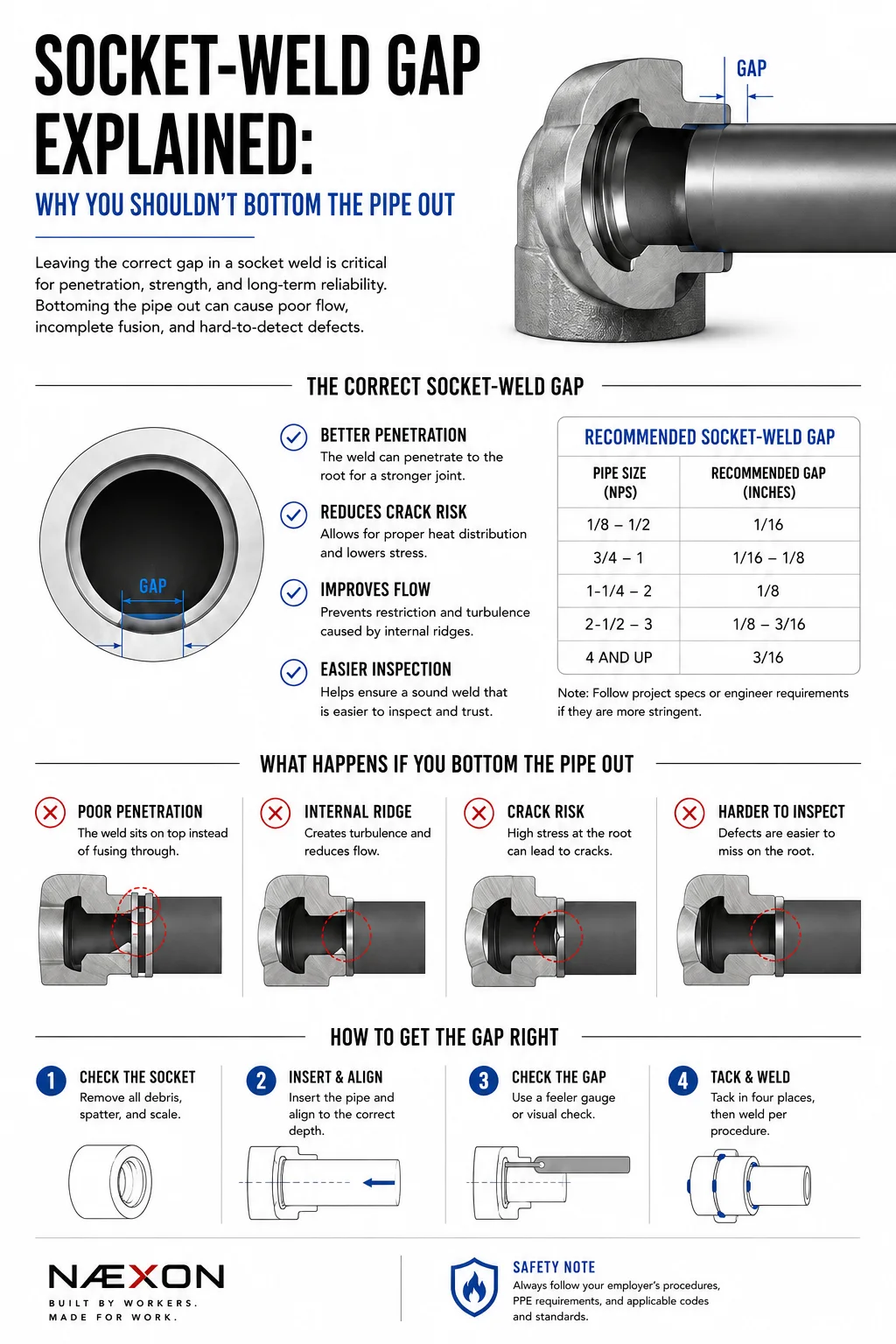
The reason is thermal expansion and restraint.
Steel expands as its temperature rises.
During welding, the pipe and fitting around the joint experience substantial localized heating. If the pipe end is already hard against the bottom of the socket, there is little axial clearance available as the heated components expand.
That can increase restraint and localized stress in the joint.
The clearance gives the assembly room to accommodate that movement.
Think of it this way:
The gap isn’t there because the fitter couldn’t push the pipe in far enough.
The gap is there intentionally.
That is an important difference.
What Can Happen When the Pipe Is Bottomed Out?
When the pipe is tightly seated against the socket shoulder and then welded, thermal expansion can create additional stresses at the joint.
Under cyclic service, vibration, thermal cycling or other demanding conditions, unnecessary restraint is exactly what you don’t want to introduce into a welded piping system.
This does not mean every socket weld accidentally made without the intended clearance will immediately crack or fail.
Engineering doesn’t work that way.
Material, service conditions, weld quality, geometry, temperature, loading and many other factors affect performance.
The point is that proper fit-up eliminates an avoidable source of restraint and follows the intended joint configuration.
The Gap Is Behind the Weld
This is where apprentices sometimes get confused.
A socket-weld gap is not the same thing as the root opening on a butt weld.
On a butt weld, the welder is working directly with the joint preparation between the pipe ends.
On a socket weld, the pipe extends inside the fitting. The intentional axial clearance exists between the end of the pipe and the internal socket shoulder.
The fillet weld is deposited around the outside where the pipe enters the fitting.
Understanding that geometry makes the entire concept easier.
For workers building their welding knowledge, Næxon’s Ultimate Guide to Passing a Welding Test for Oil & Gas Jobs also explains why following the WPS and checking fit-up before striking an arc are so important.
Don’t Confuse Socket Depth With the Required Clearance
There are two different measurements involved.
Socket depth is how far the pipe can enter the fitting.
Assembly clearance is the intentional space left between the pipe end and socket bottom before welding.
A fitter shouldn’t simply look at the fitting and estimate where the pipe should sit.
The correct approach is to establish the required insertion position according to the job procedure.
On repetitive fabrication, shops may use approved gauges, depth marks or other controlled methods so each joint is assembled consistently.
A Simple Field Method
When permitted by the applicable procedure, the basic idea is straightforward.
Insert the properly prepared pipe until it contacts the socket bottom.
Establish the required withdrawal.
Verify alignment.
Tack the joint without allowing the pipe to move back against the shoulder.
Then weld it according to the approved WPS.
That last part matters.
It’s possible to establish the clearance correctly and then accidentally lose it while fitting, tacking or handling the assembly.
Fit-up isn’t finished until the joint stays where you put it.
Cleanliness Still Matters
The gap gets most of the attention, but it isn’t the only thing that determines a good socket weld.
The pipe OD and fitting socket should be properly prepared according to the applicable procedure. Dirt, oil, scale, paint, moisture and other contaminants can interfere with welding.
The pipe should also be properly aligned.
A perfect axial clearance doesn’t compensate for poor alignment, contamination or an improperly deposited fillet weld.
Industrial welding is a system of small details.
The Næxon Learning Center repeatedly comes back to the same principle: good fabrication starts before the arc is struck.
What About the Fillet Weld?
Socket-weld joints use an external fillet weld.
The required weld dimensions and profile are determined by the applicable design, specification, WPS and code—not by simply making the weld as large as possible.
More weld metal does not automatically mean a better joint.
The welder still needs proper fusion, correct electrode or filler-metal handling, appropriate heat input, good tie-in and a sound finished profile.
If you’re developing your welding technique, Næxon’s guide to overhead welding discusses puddle control, heat management and why small adjustments matter so much in field welding.
Why Socket Welds Are Used
Socket-weld construction has several practical advantages when correctly specified.
The fitting helps establish pipe alignment, there is no conventional butt-weld root opening to maintain between two beveled pipe ends, and the process works well for many small-bore industrial piping applications.
But socket welds also have characteristics engineers must consider.
Their internal geometry includes a crevice associated with the socket configuration, and their suitability depends on service conditions and the governing piping design.
That is why the choice between socket weld, threaded, butt-weld or another connection method belongs to the piping design—not to whichever fitting happens to be sitting in the gang box.
The Mistake Experienced Fitters Catch
Picture an apprentice fitting socket-weld piping.
He cleans everything.
Checks his measurements.
Pushes the pipe firmly into the elbow.
Squares it.
Tacks it.
And proudly tells the journeyman:
“It’s bottomed out tight.”
That’s exactly when the experienced fitter stops him.
Not because the pipe wasn’t inserted correctly initially.
Because he forgot what comes next.
Bottom it to establish position.
Create the specified clearance.
Then secure the fit-up.
It is one of those small lessons that can separate someone who knows how pieces fit together from someone who understands why they’re assembled that way.
Follow the Drawing, WPS and Governing Code
Socket-weld requirements can vary with the piping system and governing standard.
Depending on the work, requirements may come from ASME piping codes, component standards, owner specifications, engineering drawings, fabrication procedures and the approved Welding Procedure Specification.
If those documents establish a particular requirement, that requirement controls the work.
Never substitute a Learning Center article—or an old jobsite rule of thumb—for the engineering documents governing an actual pressure-piping system.
That same discipline applies throughout industrial construction. Whether you’re fitting socket welds, reading drawings, preparing welds or working a refinery turnaround, understanding the specification is part of understanding the trade. The Næxon Industrial Workwear & Skilled Trades Resources library brings those subjects together in one place.
The 1/16-Inch Lesson
Some of the most important lessons in pipefitting are measured in fractions of an inch.
Socket-weld clearance is one of them.
To someone unfamiliar with piping, that tiny space may look like sloppy fit-up.
To an experienced fitter, it represents something completely different:
intentional clearance for the welded assembly.
The next time you fit a socket-weld connection, remember the principle:
Don’t weld the pipe hard against the bottom of the socket unless the governing procedure specifically requires that configuration. Establish the required clearance, keep it during tack-up, and weld the joint according to the approved procedure.
Sometimes the difference between simply putting pipe together and understanding pipefitting is knowing why a tiny gap was left there on purpose.