A bad hire doesn’t always look expensive on the first day.
On paper, it’s one fitter earning an hourly wage.
But put the wrong person on a critical piping system in a refinery, chemical plant, power plant, pipeline facility, data center, or other major industrial project, and that hourly wage can become one of the smallest numbers involved.
One wrong measurement can scrap material.
One flange installed incorrectly can hold up an entire spool.
One bad fit-up can create weld repairs.
One misunderstood drawing can send fabrication in the wrong direction.
And one mistake that survives fabrication, inspection, testing and startup can become vastly more expensive once the system is operating.
That’s why experienced industrial contractors understand something that isn’t always obvious from a résumé:
A good fitter doesn’t just install pipe. A good fitter protects the project from expensive mistakes.
The Cost Starts Long Before the Pipe Leaks
When people hear “bad pipefitter,” they often picture an ugly fit-up or crooked pipe.
That’s only the beginning.
Industrial construction is interconnected. The fitter’s work affects welders, riggers, crane operators, inspectors, engineers, supervisors, scaffold crews, insulation crews and ultimately operations.
Suppose a fitter misreads an isometric and fabricates a spool incorrectly.
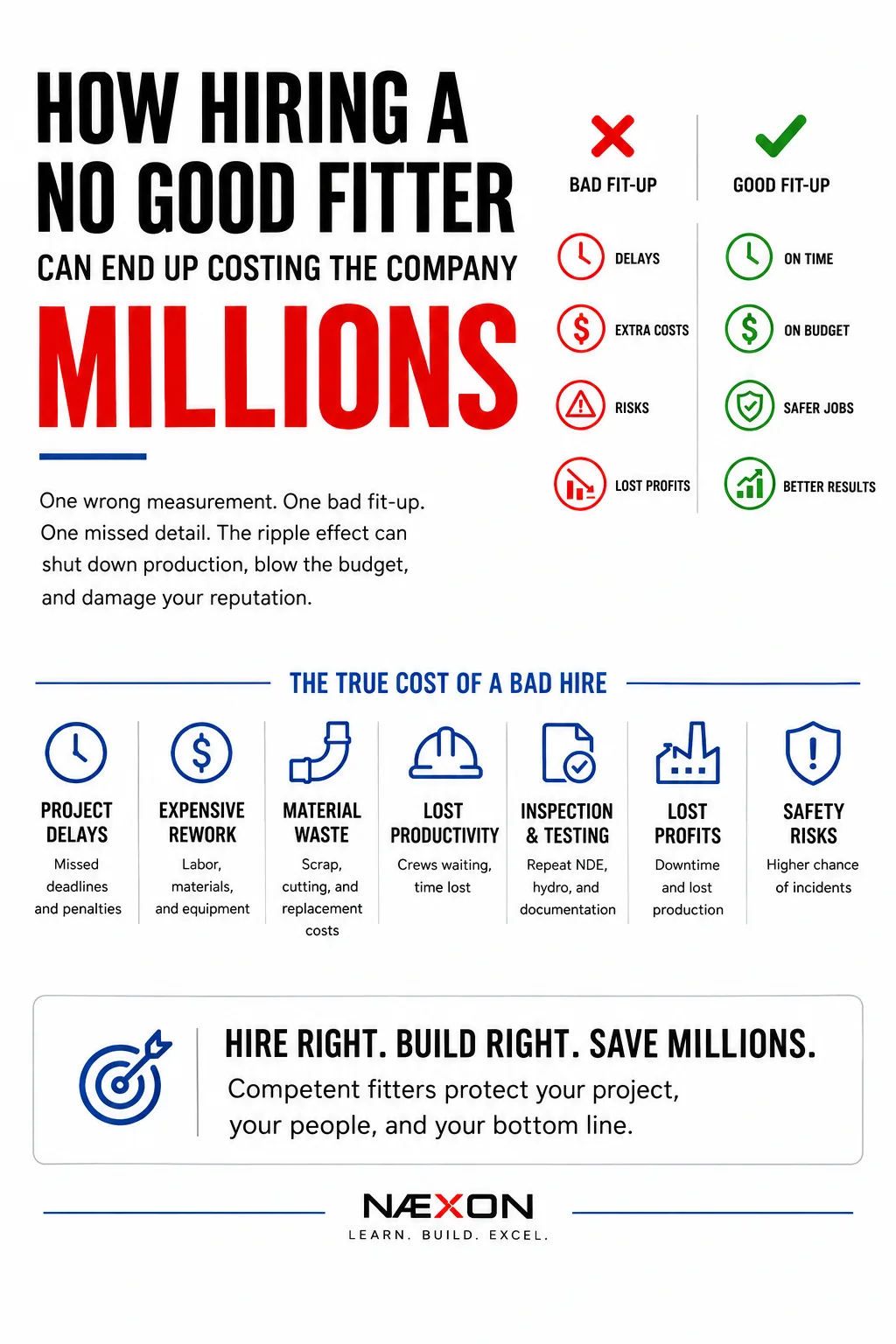
The company may now be paying for the original labor, welding consumables, equipment, inspection and material.
Then someone discovers the mistake.
Now the company pays again.
The spool may need to be cut apart. New material may have to be ordered. Welds may need to be removed. The fitter and welder perform the work again. NDE may have to be repeated. Coatings or insulation may need repair.
Meanwhile, another crew could be standing around waiting for that spool.
The company isn’t paying for one mistake anymore. It’s paying for the chain reaction created by that mistake.
Understanding drawings correctly is so fundamental that we dedicated an entire Næxon Learning Center series to how to read piping isometric drawings. On industrial work, reading the drawing is part of building the pipe.
One Wrong Dimension Can Travel Through an Entire System
A dangerous fitter isn’t necessarily the person who doesn’t know something.
Everyone has things they haven’t learned yet.
The dangerous fitter is the person who doesn’t know—and doesn’t verify.
Imagine a critical spool fabricated several inches too long.
Maybe somebody measured from the wrong reference point.
Maybe they didn’t account for fitting takeoff.
Maybe they misunderstood whether a dimension was center-to-center or face-to-face.
Maybe they simply read the tape wrong.
If the mistake is caught immediately, the cost might be relatively small.
If that spool gets welded, inspected, transported, rigged into position and partially installed before somebody realizes it doesn’t fit, the cost multiplies.
Now you may have:
- Fitter and welder rework
- Replacement pipe or fittings
- Additional welding consumables
- Additional NDE
- Crane and rigging time
- Scaffold modifications
- Supervisor involvement
- Engineering review
- Schedule delays
- Other trades waiting on the correction
A $100 mistake can become a $10,000 problem surprisingly quickly.
On sufficiently large or schedule-critical projects, accumulated errors and delays can become much more expensive.
Bad Fit-Up Makes the Welder’s Job Harder
A great welder cannot magically correct every bad fit-up.
Excessive hi-lo, inconsistent root openings, poor alignment, damaged bevels, contaminated surfaces and improperly prepared tacks all make welding more difficult.
Then something predictable happens.
The welder spends additional time trying to compensate for problems that should have been corrected before welding started.
Production slows.
The probability of repair can increase.
And if the weld fails inspection, the company pays again.
The weld may need to be excavated or removed. It gets repaired. Then it may require another round of inspection.
That’s why good fitters and good welders work together.
The fitter gives the welder a joint that can be welded correctly.
Our Næxon Learning Center article on socket-weld gap and why pipe shouldn’t simply be bottomed out is a good example. Something as small as an intentional fit-up clearance can matter because industrial piping is built around controlled dimensions and procedures.
Flanges Can Become Extremely Expensive Mistakes
Ask experienced pipefitters where seemingly small mistakes create big headaches and flanges will eventually enter the conversation.
A flange can be:
Out of level.
Out of square.
Rotated incorrectly.
Installed at the wrong elevation.
Wrong bolt-hole orientation.
Wrong face type.
Wrong rating.
Wrong material.
And sometimes it looks perfectly fine until the mating equipment or spool arrives.
Then nothing lines up.
A fitter who understands flange bolt-hole orientation and two-holing isn’t simply making the installation look professional. Correct orientation allows the next component to connect as designed.
If a large spool has already been fabricated around an incorrectly positioned flange, fixing that mistake can involve substantially more than loosening a few bolts.
Now Put the Mistake on Critical Equipment
The financial consequences become much larger when piping connects to equipment.
Pumps.
Compressors.
Turbines.
Heat exchangers.
Boilers.
Pressure vessels.
Control valves.
Process equipment.
Good piping installation isn’t about forcing everything together until the bolts start.
Piping has to meet the alignment and installation requirements of the project and equipment manufacturer.
Using bolts, chainfalls or other force to drag badly misaligned piping into position can transfer unwanted loads into equipment or piping.
That’s no longer just a craftsmanship problem.
It can become a reliability problem.
Rework Is More Expensive Than Doing It Right Once
Industrial contractors track productivity closely for a reason.
Every project is built around labor hours.
If a spool should require ten hours to fit and weld but poor workmanship forces the company to spend another ten hours repairing it, the company didn’t simply lose ten hours.
Those workers could have spent those hours producing the next spool.
So rework creates two losses:
The cost of correcting yesterday’s work and the lost opportunity to complete today’s work.
Multiply that across hundreds or thousands of welds and fittings and the financial effect becomes serious.
That’s why experienced hands sometimes appear slower during initial fit-up.
They measure twice.
Check orientation.
Verify the drawing.
Check the fitting.
Confirm material.
Look at the flange.
Ask a question when something doesn’t make sense.
Then they build it.
That extra five minutes can save hours later.
Shutdowns Make Bad Workmanship Even More Expensive
During normal construction, a contractor may have some ability to recover from delays.
During a refinery or power-plant shutdown, the clock can be brutal.
Facilities may have large workforces, rented equipment, cranes, scaffolding, specialty contractors, inspection personnel and support services mobilized around a tightly controlled schedule.
The owner wants the unit returned to service.
Now imagine a critical spool doesn’t fit during final installation.
Production stops while the crew figures out why.
Measurements are checked.
Supervision gets involved.
Maybe engineering gets called.
The spool gets removed.
It goes back to fabrication.
The crew waits.
Inspection waits.
The schedule starts slipping.
The cost isn’t limited to the fitter who made the original mistake.
Everybody downstream can feel it.
For workers unfamiliar with how these projects operate, our Refinery Turnaround Dictionary explains many of the terms, positions and processes encountered during industrial shutdown work.
The Million-Dollar Scenario
Can one bad fitter literally cost a company millions?
Potentially—but usually not because someone cut one piece of pipe an inch short.
The truly massive losses occur when workmanship contributes to a larger chain of events.
Consider a hypothetical critical-path installation.
Poor fit-up creates rework.
Rework delays hydrotesting.
The failed schedule pushes another activity.
That activity delays turnover.
Turnover delays startup.
If a production facility cannot return to operation when planned, the economic consequences can dwarf the cost of the actual pipe repair.
At that point, the expensive part isn’t the pipe.
It’s time.
Major industrial facilities can produce enormous economic value when operating. Lost production, contract consequences, additional labor, equipment rental and schedule disruption can turn relatively small construction problems into very large financial losses.
That doesn’t mean every bad fit-up becomes a million-dollar event.
It means industrial construction contains situations where small mistakes can propagate into extraordinarily expensive consequences.
The Bigger Danger: A Fitter Who Won’t Admit He Doesn’t Know
Nobody knows everything.
Not apprentices.
Not journeymen.
Not foremen.
Not general foremen.
Not superintendents.
The best craftsmen understand that.
If something doesn’t look right, they stop and verify.
They check the drawing.
They check the specification.
They ask the foreman.
They confirm the dimension.
They verify the material.
They find the answer before making the mistake permanent.
A worker pretending to know something can be far more expensive than a worker willing to say:
“I haven’t done this before. Show me.”
You can teach someone a fitting takeoff.
You can teach someone how to two-hole a flange.
You can teach someone how to calculate an offset.
It’s much harder to teach someone to care after they’ve decided they don’t.
Speed Is Not the Same as Productivity
Industrial construction sometimes creates the wrong incentive.
A fitter looks fast.
He’s constantly moving.
Pipe gets cut quickly.
Spools get tacked quickly.
Everybody thinks production is flying.
Then inspection begins.
Or installation begins.
And the problems start appearing.
A slower fitter whose work installs correctly the first time may ultimately produce far more value.
Real productivity isn’t how quickly something leaves the fabrication table.
It’s how efficiently acceptable work reaches completion.
There is a big difference.
What Makes a Good Industrial Fitter Valuable?
A strong fitter brings more than the ability to turn wrenches.
They understand drawings.
They understand measurements.
They understand fitting takeoffs.
They understand elevations and centerlines.
They understand flange orientation.
They understand offsets.
They recognize material.
They understand basic rigging.
They know what good weld preparation looks like.
They understand that equipment shouldn’t simply be forced into alignment.
Most importantly, they know when something doesn’t look right.
That judgment is built through experience.
Næxon created its Learning Center and industrial Resources around that exact idea: the more workers understand why something is done, the better decisions they can make when the job doesn’t perfectly match the textbook example.
Companies Shouldn’t Hire a Résumé. They Should Hire Competence.
Years in the trade matter.
But twenty years around pipe doesn’t automatically mean twenty years of learning.
Contractors need people who can demonstrate the skills required for the position they’re being hired to perform.
That can mean practical testing.
Drawing interpretation.
Layout exercises.
Trade-specific questions.
Hands-on demonstrations.
Reference checks.
And, depending on the position, verified certifications or qualifications.
A company shouldn’t be embarrassed to determine whether someone can actually perform the work.
The worker is about to touch piping systems that may cost millions of dollars to construct and potentially far more to operate.
Competency verification is cheap compared with industrial rework.
The Best Fitter on the Crew Might Be Saving Money Nobody Ever Sees
Here’s the strange part about excellent craftsmanship:
When it’s done correctly, nothing dramatic happens.
The spool fits.
The flange lines up.
The welder gets a clean joint.
The weld passes inspection.
The hydro passes.
The equipment connects correctly.
The system starts.
Nobody holds a meeting.
Nobody writes an incident report.
Nobody calculates how much money was saved.
The crew simply moves to the next piece.
That’s why the true value of a skilled tradesperson can be difficult to measure.
A good fitter may prevent expensive problems every week without anybody ever knowing those problems almost happened.
And that is exactly the point.
The cheapest mistake on an industrial project is the one a skilled worker catches before it becomes a mistake.