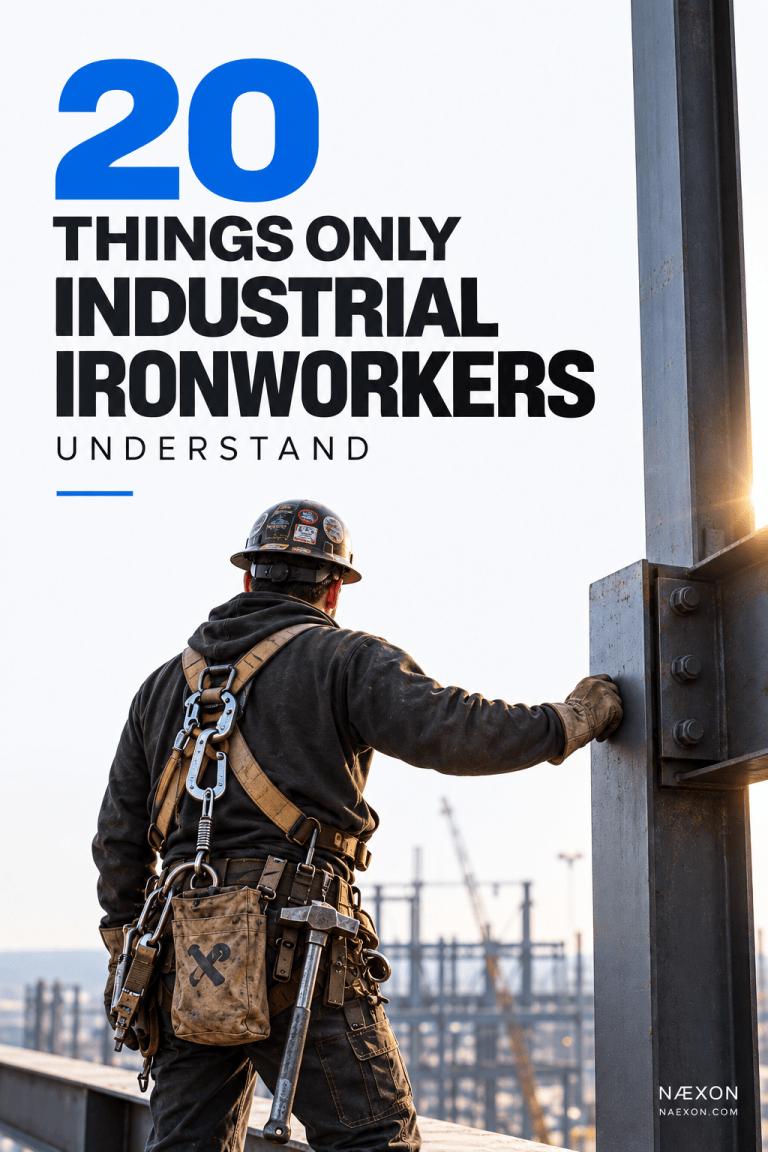
You can wear the boots – but you can never fill them.
You can wear the welding cap.
You can cover your hard hat in stickers from jobs you’ve never worked.
You can put every tool imaginable in your gang box and dress like you’ve spent twenty years working shutdowns.
But eventually, the job starts.
And that’s when everybody finds out.
Looking like a hand and actually being a hand are two completely different things.
In the industrial trades, reputation isn’t built by what you look like walking through the gate. It’s built by what happens after you get there.
The Jobsite Figures You Out Pretty Fast
Industrial jobs have an interesting way of exposing people.
You can talk your way through orientation.
You can make a good first impression.
You can tell everybody about the refinery you worked at five years ago, the giant project you supposedly ran, or the impossible weld you once made.
Then somebody hands you a drawing.
Or asks you to lay something out.
Or tells you to rig a piece of equipment.
Or gives you a problem that wasn’t covered in the morning plan.
Now the résumé doesn’t matter nearly as much.
Can you do the work?
Experienced tradesmen usually don’t need very long to figure that out.
Real Hands Usually Don’t Have to Announce It
There’s a funny pattern on jobsites.
The person constantly explaining how good he is often isn’t the person everybody goes looking for when something difficult needs to be done.
The real hand may be standing ten feet away saying almost nothing.
Then the foreman walks over:
“Hey, come look at this.”
That tells you more than a hundred stories.
Competence creates its own reputation.
When people know you can solve problems, they remember you.
That’s one reason reputation matters so much in industrial construction. As we discussed in How the Best Refinery Workers Earn Callbacks Again and Again, being somebody contractors want back can be more valuable than simply being somebody who can get hired once.
A Hand Knows the Basics Cold
Being good doesn’t mean knowing everything.
Nobody does.
A great pipefitter can encounter piping he has never seen.
A welder can run into an unfamiliar procedure.
An electrician can open equipment he’s never worked on.
A millwright can get assigned machinery he’s never rebuilt.
Experience isn’t knowing the answer to every possible question.
It’s having such a strong command of the fundamentals that you can figure out what you don’t know.
For a pipefitter, that might mean understanding drawings, measurements, offsets, fittings, flange orientation and layout.
For a welder, it means understanding the process, preparation, consumables, heat and what the weld is actually doing.
For an electrician, it means understanding the system instead of simply memorizing which wire went where last time.
Fundamentals travel from job to job.
That’s exactly why Næxon continues building the Learning Center around practical industrial knowledge rather than information that only applies to one project.
A Hand Thinks Ahead
This is one of the biggest differences.
An inexperienced worker often sees the task directly in front of him.
An experienced hand sees the next five steps.
Before cutting something, he thinks about how it’s going to fit.
Before fitting pipe, he thinks about how it’s going to weld.
Before setting equipment, he thinks about access.
Before making something permanent, he asks whether the next trade can still do its work.
Before lifting something, he thinks about where it’s going to land.
Before tightening the last bolt, he asks:
“What am I about to trap?”
Good tradesmen don’t simply complete tasks.
They anticipate consequences.
A Hand Doesn’t Need a Foreman Standing Over Him
Give a good worker a clear task and he gets moving.
He knows when he needs clarification.
He knows when something doesn’t look right.
He knows when to stop rather than bury a mistake.
And he knows the difference between taking initiative and freelancing outside the plan.
That last part matters.
Being independent doesn’t mean ignoring procedures, drawings, specifications, permits, supervision, or safety requirements.
It means the foreman shouldn’t have to remind you every fifteen minutes that you’re at work.
A Hand Can Admit, “I Don’t Know”
This one separates more people than you’d think.
There is nothing impressive about pretending to understand something you don’t.
Especially in industrial construction.
“I don’t know, but I’ll find out” is infinitely more useful than confidently doing something wrong.
The best tradesmen ask questions.
They verify dimensions.
They check drawings.
They ask operators.
They consult procedures.
They call somebody over for another set of eyes.
Experience should make you more aware of how badly assumptions can hurt you—not more afraid to ask questions.
A Hand Doesn’t Blame the Tools
Every tradesman has fought bad equipment.
Bent levels.
Dead batteries.
Cheap grinders.
Worn-out leads.
Bad tape measures.
Ancient company tools that should have been retired during the Bush administration.
But there’s a difference between recognizing that a tool is genuinely unsuitable and blaming every bad result on equipment.
Good workers understand their tools, maintain them and know their limitations.
They also respect other people’s equipment.
That’s why something as simple as The Unwritten Code of Borrowing Tools resonates across almost every trade.
Tools are part of your livelihood.
Treat them accordingly.
A Hand Leaves Good Work Behind
Here’s one of the simplest tests.
Look at the finished product after the worker walks away.
Is it clean?
Is it straight?
Is it properly supported?
Are the bolts right?
Are the welds prepared correctly?
Was unnecessary damage avoided?
Was the work area cleaned?
Could another tradesman come behind him and understand what was done?
There is pride in workmanship that can’t really be faked.
Even when nobody will ever see the finished work again.
Some of the finest industrial craftsmanship in America is hidden behind insulation, inside equipment, above ceilings, underground and hundreds of feet in the air.
The worker still knew it was there.
That matters.
A Hand Understands That Fast Isn’t Always Fast
Everybody loves production.
Nobody wants a worker who takes eight hours to do a two-hour task.
But speed without control creates rework.
Cut it wrong and you cut it twice.
Install it wrong and somebody removes it.
Rush a fit-up and the welder fights it.
Skip planning and the entire crew waits later.
The best workers can move quickly because their fundamentals are strong.
They aren’t rushing.
They’re efficient.
There’s a difference.
A Hand Makes the Crew Better
This may be the biggest sign of all.
A genuinely good tradesman doesn’t only produce good work himself.
He improves the people around him.
He shows an apprentice an easier way to make a layout.
He catches a mistake before another worker burns hours fixing it.
He helps another trade when it makes sense.
He passes down tricks somebody once taught him.
He doesn’t intentionally hide knowledge just so he can remain “the smartest guy on the crew.”
Industrial knowledge has always traveled person to person.
Journeyman to apprentice.
Welder to helper.
Foreman to journeyman.
Old hand to young hand.
That’s how the trades survive.
Looking the Part Still Matters—Just Not for the Reason You Think
There is nothing wrong with taking pride in how you show up.
Good boots matter.
Proper PPE matters.
Quality industrial workwear matters.
A welding cap, work shirt or piece of gear can become part of a tradesman’s identity.
Workers should be proud of their trade.
That’s a major part of what Næxon represents.
But workwear should support the person doing the work—not become a costume pretending to replace experience.
You can buy good gear on your first day.
You can’t buy ten years of lessons.
Reputation Arrives Before You Do
Industrial construction is much smaller than it looks.
Work enough shutdowns, outages, refineries, power plants, pipelines and major construction projects and eventually the same names start appearing again.
Someone knows somebody.
Foremen remember people.
Superintendents remember people.
Workers talk.
A good reputation can get your name mentioned before the manpower call ever goes out.
A bad reputation can do exactly the same thing.
That’s why one of the most valuable things a tradesman carries from project to project isn’t inside his tool bag.
It’s his name.
You Don’t Decide When You’ve Become a Hand
That’s probably the funniest part.
There isn’t a ceremony.
Nobody hands you a certificate that says:
CONGRATULATIONS. YOU ARE OFFICIALLY A HAND.
It happens gradually.
One day somebody starts asking for your opinion.
An apprentice begins watching how you do something.
A foreman gives you the difficult assignment.
Someone from an old job calls and asks where you’re working.
Then another contractor wants you back.
Eventually you realize something changed.
You stopped trying to convince everybody you knew what you were doing.
Your work started doing the talking for you.
Looking like a hand might get somebody’s attention.
Actually being one earns something far more valuable:
Respect.
:::