Walk onto a large construction site, refinery, power plant, chemical facility, or industrial project and you’ll probably notice hard hats in several different colors.
White. Yellow. Blue. Orange. Green. Red.
It is easy to assume every color has one universal meaning.
It doesn’t.
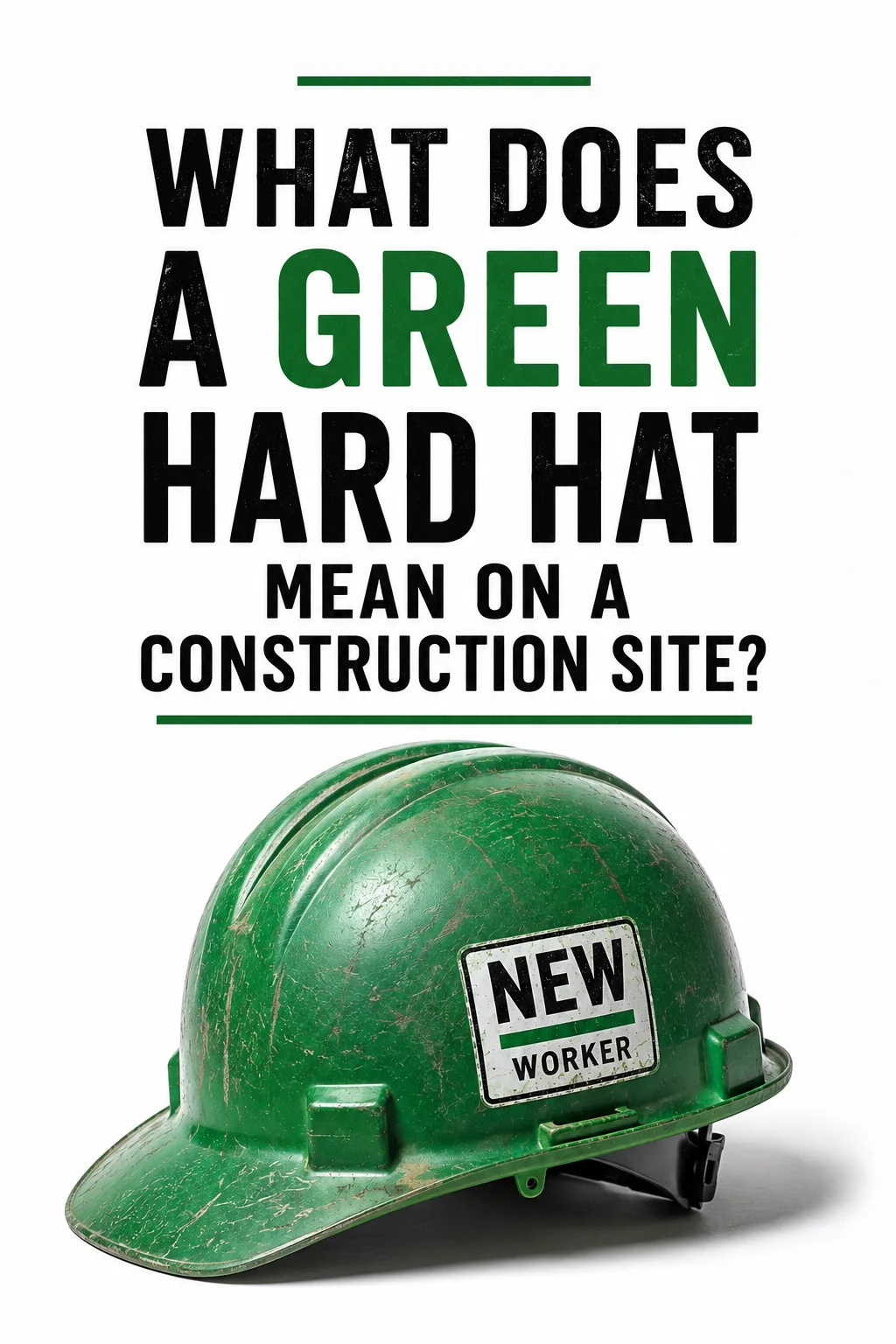
But green hard hats are commonly associated with new or inexperienced workers on many jobsites, which is where terms like “green hand,” “greenhorn,” and “green hat” come from.
On some projects, a green hard hat or another green identifier helps experienced workers immediately recognize someone who may be new to the trade, company, facility, or industrial environment.
That doesn’t automatically mean the person doesn’t know anything.
And it definitely doesn’t mean every construction site follows the same system.
Here’s what a green hard hat can actually mean—and why the distinction matters.
What Does a Green Hard Hat Mean?
There is no single universal hard-hat color code used across every construction company and industrial facility.
Individual employers, contractors, projects, and facilities can establish their own identification systems.
That means a green helmet at one facility could have a completely different meaning somewhere else.
However, green has traditionally been used on some jobsites to identify new workers, trainees, apprentices, or workers who require additional awareness and supervision.
Some sites accomplish the same thing without issuing an entirely green hard hat.
They may use a green stripe, sticker, decal, vest, or another visual identifier instead.
The principle is the same:
Make the worker’s experience status visible to the crew.
Why Are New Workers Called “Green”?
Calling someone “green” isn’t unique to construction.
The word has been used for generations to describe somebody who is inexperienced or new to something.
Industrial workers took that concept and made it part of jobsite vocabulary.
A new worker might be called:
A green hand.
A greenhorn.
A green hat.
Or simply green.
Depending on the crew, those words can be used seriously, jokingly, or somewhere in between.
But behind the nickname is an important reality.
Industrial jobsites can be unforgiving places to learn.
Being New to a Site Isn’t the Same as Being New to the Trade
This distinction matters.
Imagine a pipefitter with twenty years of refinery experience starting work at a facility he has never entered before.
He’s certainly not new to pipefitting.
But he is new to that facility.
He may not know the evacuation routes, muster points, unit boundaries, site-specific alarms, traffic patterns, restricted areas, permit procedures, or facility-specific hazards yet.
Likewise, an experienced welder entering a new chemical plant may understand welding extremely well while still needing time to learn that particular site’s procedures.
That’s why “new” can mean several different things.
New to construction.
New to the trade.
New to the company.
New to industrial work.
Or simply new to that particular facility.
A good crew understands the difference.
Why Identify New Workers?
Because experience changes what people notice.
An experienced industrial worker can walk into an area and immediately start recognizing potential problems.
Overhead work.
Suspended loads.
Pinch points.
Open grating.
Temporary hoses.
Scaffolding.
Barricades.
Hot surfaces.
Operating equipment.
Vehicle traffic.
Pressure systems.
Confined spaces.
Simultaneous operations.
A new worker may physically see all those things without yet understanding what they mean.
That situational awareness takes time to develop.
A visual identifier can tell the surrounding crew:
Pay attention to this person. They may need additional guidance.
Used correctly, that’s not humiliation.
It’s another layer of communication.
The Green Hat Shouldn’t Be a Target
Industrial construction has always had a rough sense of humor.
New hands get tested.
Apprentices get teased.
Everybody remembers being the new person at some point.
But there is a major difference between joking with somebody and intentionally setting them up to fail.
A green worker who asks a basic question shouldn’t be afraid to ask the next one.
If somebody doesn’t understand a lift plan, permit boundary, line-of-fire hazard, flange break, scaffold tag, lockout requirement, or work procedure, you’d rather hear:
“I don’t understand this.”
than:
“Yeah, I got it.”
when they don’t.
Industrial work contains too many hazards for pride to become a training method.
Every Journeyman Was Green Once
This gets forgotten surprisingly quickly.
Nobody walked onto their first industrial project already knowing everything.
Every experienced pipefitter once had to learn fittings.
Every welder once struggled with an arc.
Every ironworker had a first day at elevation.
Every millwright had to learn alignment.
Every instrumentation technician had to troubleshoot a first loop.
Every crane operator had a first lift.
Every foreman once stood on the other side of the toolbox talk.
Experience is accumulated one shift at a time.
The worker wearing the green identifier today could be running a crew ten years from now.
The Best Crews Develop Their Green Hands
Strong crews don’t just identify inexperienced workers.
They develop them.
An experienced craft professional can teach things that are difficult to learn from a classroom alone.
How to organize a work area.
How to recognize when something doesn’t look right.
How to communicate during a lift.
How to read the job before grabbing tools.
How to protect yourself from line-of-fire hazards.
How to work efficiently without rushing.
How to ask the right questions.
How to think ahead.
Technical knowledge matters too.
A new pipefitter needs to understand measurements, fittings, flanges, valves, drawings, takeoffs, offsets, and industrial piping fundamentals—not simply memorize what the journeyman beside them does.
That’s one reason we’ve built the Næxon Learning Center: to give industrial workers another place to strengthen the technical knowledge behind their trade, from fundamentals through practical field calculations and more advanced industrial subjects.
Don’t Assume Hard-Hat Colors Mean the Same Thing Everywhere
This is probably the most important thing to remember.
You cannot reliably walk onto an unfamiliar jobsite and determine everyone’s position or experience solely from hard-hat color.
A white hard hat doesn’t automatically mean supervisor.
A blue hard hat doesn’t universally mean electrician.
A red hard hat doesn’t universally mean emergency personnel.
And a green hard hat doesn’t automatically mean apprentice.
Those associations may exist on particular projects, but site-specific rules control the actual meaning.
Before relying on helmet colors, learn the identification system used by your employer and facility.
This becomes especially important for traveling industrial workers.
A refinery in Texas may operate differently from a chemical facility in Louisiana, a power plant in Ohio, or a major construction project somewhere else.
Never assume yesterday’s rules followed you through the gate.
What Happens When the Green Hat Comes Off?
That’s where things get interesting.
At some point, the new worker isn’t really new anymore.
They know where they’re going.
They understand the site’s expectations.
They recognize hazards faster.
They know the crew.
They’ve learned the terminology.
Their hands begin moving without somebody explaining every step.
Then another new worker arrives.
And suddenly the person who needed help six months ago is explaining something to somebody else.
That’s how trade knowledge survives.
Journeyman to apprentice.
Foreman to journeyman.
Experienced hand to green hand.
Generation after generation.
You can teach a tremendous amount from books, diagrams, training programs, and technical articles. Those resources matter, and workers can continue building those fundamentals throughout the Næxon Learning Center.
But industrial craftsmanship has always contained another form of education:
One worker showing another worker how it’s done.
Green Doesn’t Mean Useless
Being green simply means there’s more to learn.
That’s not an insult.
That’s the beginning.
The dangerous worker isn’t necessarily the person who knows they’re inexperienced.
Sometimes it’s the person who has enough experience to become confident but not enough experience to recognize what they still don’t know.
Good industrial workers never completely stop learning.
Technology changes.
Procedures change.
Equipment changes.
Standards change.
Projects change.
And every new facility can teach you something the previous one didn’t.
That’s why the best craftsmen can have twenty or thirty years in the trade and still ask questions.
From Green Hat to Old Hand
Eventually, the green worker becomes the experienced worker.
The clean hard hat gets scratched.
The empty toolbox fills up.
The unfamiliar terminology becomes everyday language.
The first shutdown becomes one of dozens.
The worker who once needed somebody watching over them becomes the person everyone looks toward when something doesn’t make sense.
That’s the progression industrial construction depends on.
So if you see somebody wearing a green hard hat, green stripe, or another new-worker identifier, remember what you’re actually looking at.
Not necessarily somebody who doesn’t belong there.
You’re looking at somebody who is still learning.
Teach them right.
Because one day, they’re going to be teaching the next one.
Continue exploring Næxon Resources for more about industrial careers, work culture, safety, PPE, and life inside the skilled trades. For technical training—including pipefitting fundamentals, industrial calculations, drawings, welding knowledge, fittings, flanges, valves, and field techniques—continue into the Næxon Learning Center.