Næxon Resources | Industrial Work, Craft Coordination & Jobsite Culture
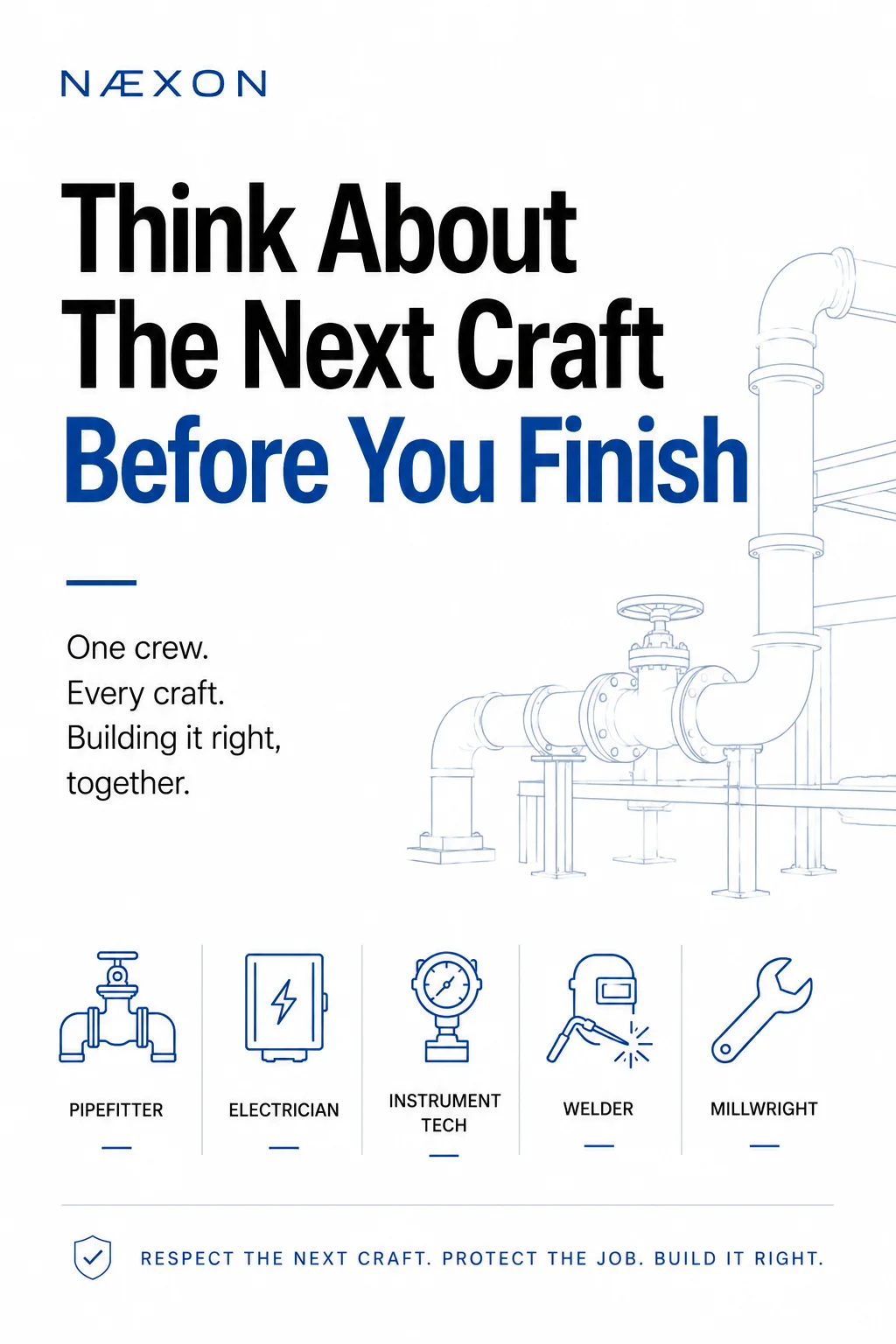
A pipefitter can finish his installation perfectly and still make an electrician’s job miserable.
An electrician can install beautiful conduit and accidentally block access to a valve.
A welder can complete a flawless weld only for someone to discover there is no room to install insulation.
A scaffold crew can build exactly where they were told and completely eliminate access to something another craft needs tomorrow.
None of these workers necessarily did bad work.
They simply finished their work without thinking about what happens next.
On a major industrial project, refinery turnaround, power plant outage, data center, chemical facility, or new construction job, very little work exists by itself.
Every craft leaves something behind for somebody else.
The best industrial workers understand that.
They do not only ask:
“Is my work finished?”
They also ask:
“Can the next crew still do theirs?”
That small difference in thinking can separate an average jobsite from an exceptionally productive one.
Your Finished Work Becomes Someone Else’s Starting Point
Industrial construction is essentially one enormous sequence.
Structural steel creates the foundation for equipment, piping, electrical systems, instrumentation, platforms, supports, and access.
Equipment gets set.
Piping gets installed.
Welds get completed.
Electrical systems are routed.
Instrumentation gets connected.
Insulation gets installed.
Systems get tested.
Operations eventually takes control.
The exact sequence changes from project to project, but the principle remains the same:
One craft’s finish line is often another craft’s starting line.
If you leave the job in a condition that makes the next operation difficult, the project pays for it later.
Maybe immediately.
Maybe three weeks from now.
But eventually somebody has to deal with it.
“Looks Good From My House” Is Expensive
Industrial workers have probably heard some version of:
“Looks good from my house.”
It is funny when everyone knows it is a joke.
It becomes expensive when it becomes an actual work philosophy.
Imagine piping installed directly through an area where another trade needs access.
The piping may technically be correct.
The welds may pass inspection.
The supports may be correct.
The installation may match the drawing.
But if another system also has to occupy that space, the project now has a coordination problem.
Somebody may have to relocate work.
Engineering may become involved.
Materials may need modification.
Scaffolding may need rebuilding.
Inspections may need repeating.
The project pays twice for work that could have been coordinated once.
Good Tradespeople See Beyond Their Own Scope
A strong pipefitter understands piping.
A great industrial pipefitter also notices the conduit rack beside him, the instrument connection underneath the valve, the equipment access behind the spool, and the platform another crew still needs to install.
The same principle applies everywhere.
A millwright setting equipment considers the piping connections that eventually have to align with it.
An ironworker installing structural members considers future equipment and piping access.
An electrician routing conduit considers valve operation and maintenance access.
An instrumentation technician considers whether transmitters and instruments can actually be reached after insulation and other systems are installed.
A rigger considers what must remain accessible after the lift is complete.
A scaffold builder considers who needs to work from that scaffold and what they need to reach.
The worker is still responsible for his own craft.
But he understands that his craft exists inside a much larger system.
Access Matters More Than People Think
One of the easiest ways to create problems for another craft is to eliminate access.
Industrial facilities are crowded.
Piping, conduit, cable tray, structural steel, equipment, valves, instruments, ductwork, supports, platforms, insulation, and dozens of other components may occupy the same general area.
A few inches can matter.
Consider a valve.
Installing piping without considering valve access can leave operators unable to comfortably operate the valve.
Or consider a flange.
Everything may fit perfectly during construction.
Then insulation is installed.
Now there may not be enough room to work around the bolts during future maintenance.
The same thing happens with instrument connections, junction boxes, electrical panels, equipment covers, strainers, filters, drains, vents, lubrication points, inspection locations, and removable components.
Installation is only one part of the component’s life.
Someone may eventually have to operate it, inspect it, maintain it, repair it, or remove it.
Great industrial workers think about that person too.
Think About the Wrench
Here is one of the simplest field habits anyone can develop.
When something is being installed, imagine somebody having to work on it later.
Can a wrench get onto the bolt?
Can the bolt actually come out?
Can the valve handle make its full travel?
Can the equipment cover be removed?
Can an instrument technician reach the connection?
Can insulation fit around it?
Can maintenance remove the component without dismantling something unrelated?
Can a worker safely position himself to perform the work?
A drawing can show that two components technically fit.
The field determines whether a human being can actually work between them.
Those are not always the same thing.
The Next Craft Might Be You
There is another reason to leave good access.
You might be the person coming back.
Industrial workers sometimes treat future maintenance as somebody else’s problem.
Then six months later they return for another outage.
Suddenly that valve with terrible access becomes their valve.
That flange surrounded by obstructions becomes their flange.
That equipment installed against a wall becomes their equipment to remove.
Industrial facilities have long memories.
Poor installation decisions can survive for decades.
So can good ones.
Coordination Prevents Rework
Rework is one of the biggest enemies of industrial productivity.
A crew installs something.
Another craft arrives.
There is a conflict.
Supervision gets involved.
Measurements are taken.
Drawings are checked.
Engineering may review the condition.
Then somebody has to modify completed work.
The crew may need new material.
Scaffolding may have to return.
Quality control may have to reinspect the work.
Coatings may require repair.
Insulation may need removal and replacement.
Testing may need to be repeated.
One coordination problem can create work for five different departments.
The frustrating part is that many of these situations begin with something extremely small.
A conversation that never happened.
Sometimes Thirty Seconds Saves an Entire Shift
Good coordination does not always require meetings, emails, drawings, and management.
Sometimes it is simply one worker asking another:
“Hey, are you guys coming through here?”
Thirty seconds.
That question can prevent hours of rework.
Experienced industrial workers develop the habit of communicating before permanently occupying questionable space.
They talk to the electrician.
They ask the instrument hand.
They check with the millwright.
They verify with the ironworker.
They involve supervision when necessary.
Nobody needs to become an expert in every craft.
You only need enough awareness to recognize when your work might affect somebody else.
Respect Between Crafts Shows Up in the Work
Jobsite respect is not only about getting along during lunch.
It shows up in what you leave behind.
Did you block somebody’s access?
Did you leave something unnecessarily difficult to remove?
Did you occupy space another craft clearly needs?
Did you leave sharp edges, debris, loose material, or other unnecessary problems behind?
Did you communicate a condition the next crew should know about?
Did you finish your work in a way that allows the project to keep moving?
A worker who consistently thinks about those things becomes valuable very quickly.
Other crafts notice.
Foremen notice.
Superintendents notice.
The Best Foremen Think Several Crafts Ahead
This mindset becomes even more important in supervision.
A good foreman cannot think only about what his crew is doing today.
He needs to think about what happens after his crew finishes.
If the pipefitters install this spool today, can the welders reach every weld?
After welding, can nondestructive examination be completed?
Can the system be tested?
Can insulation access it?
Can instrumentation finish its connections?
Does scaffolding need to remain?
When can another craft safely enter the area?
What work must happen before equipment or piping permanently blocks access?
That is sequencing.
And sequencing is one of the biggest differences between simply managing workers and actually managing work.
The Project Does Not Care Which Craft Was Right
When two trades conflict, arguments can begin quickly.
“That’s where the drawing showed it.”
“We were here first.”
“That’s not our problem.”
“Engineering needs to figure it out.”
Sometimes one side really is correct.
But the project still has a problem.
The owner does not receive additional production because one craft won the argument.
The schedule does not improve because somebody proved the other crew wrong.
Ultimately, everything still has to fit, function, operate, and be maintainable.
The strongest industrial teams understand this.
Solve the problem first.
Figure out how to prevent the next one afterward.
Leave Room for the People Who Come After You
There is a certain professionalism in leaving good work behind.
Not merely work that passes inspection.
Work that makes sense.
Work that can be maintained.
Work that does not unnecessarily interfere with another craft.
Work that somebody can look at five years later and think:
Whoever installed this actually thought about it.
That reputation matters.
Industrial jobs are enormous, but the industrial workforce can feel surprisingly small.
Workers cross paths again.
Foremen remember good hands.
Superintendents remember crews that solve problems instead of creating them.
Companies remember workers who help projects move.
Your work becomes part of your reputation long after you leave the gate.
Learn Your Trade—Then Learn How Your Trade Connects to Everything Else
Mastering your own craft should always come first.
But the longer you work in industry, the more valuable it becomes to understand what happens around your craft.
Pipefitters benefit from understanding equipment alignment, rigging, welding, instrumentation, structural steel, and basic system operation.
Welders benefit from understanding fit-up, piping configuration, accessibility, sequencing, and inspection requirements.
Electricians benefit from understanding equipment locations, piping systems, instrumentation, structural limitations, and maintenance access.
Riggers benefit from understanding what each craft is trying to install and how components must ultimately be positioned.
That broader industrial knowledge is one reason Næxon’s Learning Center covers multiple skilled trades instead of treating each craft as an isolated world.
Pipefitting, welding, rigging, electrical, instrumentation, millwright work, ironwork, safety, and industrial fundamentals constantly overlap in the field.
Understanding those connections makes better tradespeople.
Finish Your Work Like You Have to Do the Next Job Too
There is an easy rule worth carrying onto any industrial project:
Finish your work like you are the person who has to work behind it.
Leave access.
Think about maintenance.
Protect other completed work.
Communicate conflicts early.
Do not occupy space carelessly.
Consider what happens next.
You do not have to do another craft’s job for them.
You simply need to avoid making their job unnecessarily harder.
Because the best industrial workers do more than complete their assignment.
They leave the job ready for the next person.
And when every craft starts working that way, something interesting happens.
Pipefitters stop fighting electricians.
Electricians stop blocking instrumentation.
Ironworkers start anticipating equipment access.
Scaffold crews understand the work happening around them.
Maintenance gets better access.
Rework drops.
The schedule moves.
And instead of ten separate crafts trying to finish ten separate jobs, you finally have what an industrial project actually needs:
One crew building one facility.