A 5-Part Field Training Series for Riggers, Signal Persons and Industrial Crews
A crane operator can be only a short distance from the load and still be unable to see what is happening where the work is being performed.
A pipe rack may block the operator’s view. A vessel may hide the landing area. Structural steel may prevent the operator from seeing one end of a long pipe spool. During a blind pick, the operator may not be able to see the load at all.
In situations like these, clear communication between the signal person and crane operator becomes critical.
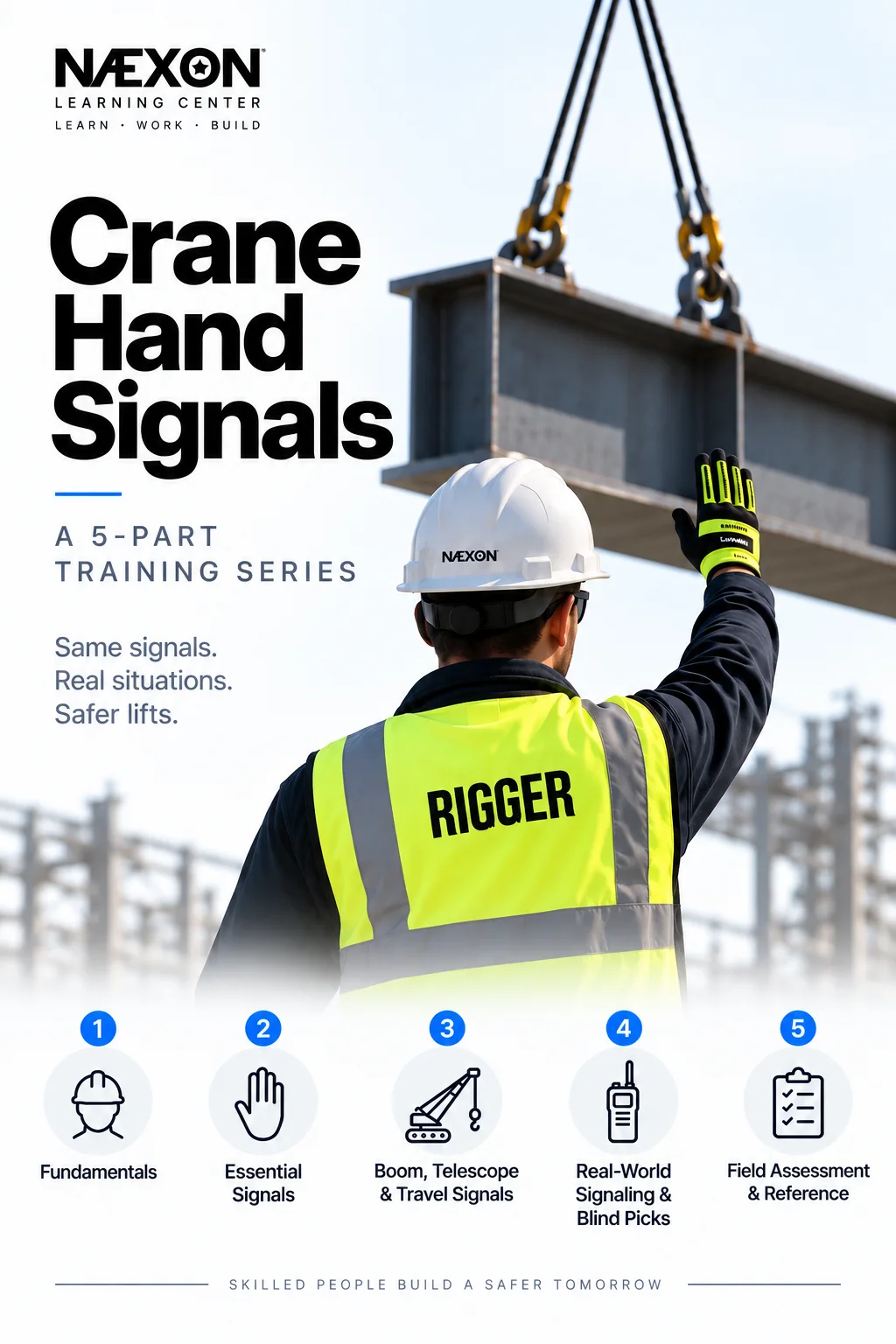
That is why the Næxon Learning Center created the Crane Hand Signals Course, a five-part field-focused training series designed to help industrial workers understand not only what standard crane hand signals look like, but what they mean, which crane functions they control, how the load may respond, and how those signals are applied during realistic lifting operations.
The course progresses from the fundamentals of signaling through essential hand signals, boom and travel commands, blind-pick communication and finally a complete hand-signal reference and field assessment.
The objective is simple:
Learn the signal. Understand the movement. Watch the load. Communicate clearly.
Why Crane Hand Signals Matter
Crane signaling can look simple when viewed on a chart.
Raise your finger and make a circle.
Point your thumb upward.
Extend your arm.
Move both arms.
But the actual responsibility behind those movements is much greater.
A signal can command the operator to raise or lower a suspended load, change boom angle, telescope the boom, swing the upperworks or move the crane itself.
The signal person therefore needs to understand more than the gesture.
They need to begin connecting four things:
SIGNAL → CRANE FUNCTION → LOAD MOVEMENT → HAZARD AWARENESS
That connection is the foundation of this course.
Built Around Real Industrial Lifting
This course was created with the industrial jobsite in mind.
Think about a pipefitter crew receiving a fabricated spool through an existing pipe rack.
A millwright crew setting a pump onto anchor bolts.
Ironworkers receiving structural steel.
Boilermakers moving components around vessels and structures.
Riggers directing equipment into congested areas where the crane operator cannot see the final landing location.
These are not situations where simply memorizing a picture of a hand signal is enough.
The signal person must communicate clearly while continuing to monitor the load, rigging, load path, surrounding structures, nearby workers and changing conditions.
That is why the Næxon Crane Hand Signals Course is divided into five progressive lessons.
Part 1 — Hand Signal Fundamentals
Crane Hand Signals: Fundamentals — Part 1 of 5
Every signal person needs a foundation before learning individual commands.
Part 1 introduces the responsibilities behind crane signaling: when signaling may be necessary, maintaining communication with the operator, proper positioning, visibility, situational awareness and what should happen when communication becomes unclear.
Students also begin learning that the signal person is not simply standing beside the lift making hand movements.
The signal person becomes an important part of the communication system used to control crane movement.
Part 1 establishes one of the central ideas carried throughout the entire course:
Clear Signal. Clear Movement.
If you are new to crane signaling, this is where the course should begin.
Part 2 — Essential Crane Hand Signals
Crane Hand Signals: Fundamentals — Part 2 of 5
After understanding the fundamentals, Part 2 introduces seven essential crane hand signals:
Hoist
Lower
Stop
Emergency Stop
Swing
Move Slowly
Dog Everything
Each signal is broken down so students can understand the physical gesture, the command being communicated and the expected crane movement.
This lesson also establishes an important safety distinction between Stop and Emergency Stop and reinforces the importance of making signals clear, deliberate and immediately recognizable to the operator.
Instead of simply memorizing seven pictures, students begin understanding what those signals actually tell the crane operator to do.
Part 3 — Boom, Telescope & Travel Signals
Crane Hand Signals: Fundamentals — Part 3 of 5
Part 3 introduces one of the most important concepts in understanding crane movement:
Hoisting the load is not the same as raising the boom.
A crane can change boom angle, change boom length, move the load line, rotate its upperworks and, depending on the equipment, travel.
Each function affects the lifting operation differently.
Part 3 covers Raise Boom, Lower Boom, Extend Telescoping Boom, Retract Telescoping Boom, Raise Boom and Lower Load, Lower Boom and Raise Load, crane travel and applicable crawler travel signals.
Students learn to distinguish between:
Boom angle
Boom length
Load-line movement
Swing
Equipment travel
These distinctions become increasingly important when the load is being maneuvered through congested industrial structures.
Part 4 — Real-World Signaling & Blind Picks
Crane Hand Signals: Fundamentals — Part 4 of 5
Part 4 takes the signals learned in the previous lessons and puts them into realistic lifting situations.
This is where the course moves beyond memorization.
Students learn about blind picks, radio communication, voice communication, multiple signal persons, transferring signaling responsibility, communication failure, congested industrial lifting areas, load rotation and tight final placement.
The lesson examines situations such as moving a long pipe spool through structural steel and setting equipment where the operator cannot see the final landing area.
Students also learn an important principle:
Never replace communication with assumptions.
If required communication disappears, the answer is not to guess what the signal person or operator probably intended.
The operation requiring signaling must remain controlled.
Part 4 also emphasizes watching the entire suspended load, not simply the hook.
A long spool can rotate.
One end can sweep toward structural steel.
Rigging can shift.
Clearance can disappear.
People can enter the load path.
Good signaling requires thinking ahead of the load.
Part 5 — Field Assessment & Complete Hand Signal Reference
Crane Hand Signals: Fundamentals — Part 5 of 5
Part 5 brings the entire course together.
It serves as both a complete crane hand-signal reference and final field-focused assessment.
Students review the signals covered throughout the course, including Hoist, Lower, Stop, Emergency Stop, Swing, Raise Boom, Lower Boom, Extend, Retract, combination boom/load signals, Move Slowly, Dog Everything, Main Hoist, Auxiliary Hoist, Travel and applicable crawler and trolley signals.
But the final lesson does not stop at recognition.
Students are challenged to answer four questions:
What signal is being given?
What crane function does it control?
What should happen to the load?
What hazards should the signal person monitor during that movement?
Part 5 also includes signal-recognition exercises, crane-function questions, realistic lifting scenarios, communication-failure exercises, signal-transfer exercises, hazard-recognition exercises and a final knowledge check.
The goal is to move from simply remembering signals toward actually understanding lifting communication.
Why We Built the Course in Five Parts
Putting every crane hand signal onto one poster is useful as a reference.
It is not the same as teaching someone what those signals actually do.
Consider:
HOIST vs. RAISE BOOM
Both can change the position of the hook, but they command completely different crane functions.
The same is true for:
LOWER vs. LOWER BOOM
SWING vs. TRAVEL
RAISE BOOM vs. RAISE BOOM AND LOWER LOAD
LOWER BOOM vs. LOWER BOOM AND RAISE LOAD
Those distinctions deserve more than a small illustration.
The worker needs to understand the movement behind the signal.
That is why the Næxon course progresses one layer at a time:
FUNDAMENTALS → ESSENTIAL SIGNALS → CRANE MOVEMENT → REAL-WORLD APPLICATION → ASSESSMENT
Each lesson prepares the student for the next.
Learn the Signal. Then Learn What It Does.
Memorizing crane hand signals is useful.
Understanding crane movement is better.
A developing signal person should learn to think through the complete movement before automatically giving a command.
Ask:
What movement do I need?
Which crane function creates that movement?
What will happen to the suspended load?
Where will the load travel?
What could the load contact?
Can the operator receive my signal?
Can I adequately monitor the operation?
Has anything changed since the previous movement?
That is the difference between remembering a gesture and understanding the lifting operation around it.
Who Should Take This Course?
The course is especially useful for workers who perform or work around industrial lifting operations, including riggers, signal persons, pipefitters, welders, ironworkers, millwrights, boilermakers, crane crews, foremen, supervisors and other industrial craft workers.
Even workers who are not serving as designated signal persons can benefit from understanding the signals being used around them.
When a crane is moving equipment over or around an industrial work area, understanding what is happening contributes to better situational awareness.
Training Is Not the Same as Qualification
There is an important distinction every student should understand.
The Næxon Crane Hand Signals Course is an educational and training resource.
Completing these five lessons should not be represented as automatically making someone an OSHA-qualified signal person.
For construction operations covered by OSHA’s crane requirements, signal-person qualification involves specific knowledge, competency, evaluation and documentation requirements.
Employers remain responsible for ensuring workers meet the requirements applicable to their equipment, operations and jobsites.
Use this course to learn, study, practice, review and prepare.
Always follow the employer’s lift procedures, equipment requirements, site rules and applicable regulations.
Start the Complete Crane Hand Signals Course
The course is designed to be completed in order:
01 — Hand Signal Fundamentals
↓
02 — Essential Crane Hand Signals
↓
03 — Boom, Telescope & Travel Signals
↓
04 — Real-World Signaling & Blind Picks
↓
05 — Field Assessment & Complete Hand Signal Reference
If you are new to crane signaling, do not jump directly to the reference chart.
Start with Part 1 and work through all five lessons.
The course is intentionally progressive.
Each lesson moves you from recognizing a signal toward understanding the crane movement, anticipating the load’s response and making better decisions around lifting operations.
Clear Signal. Clear Movement.
A crane operator controls the machine.
But there are situations where the operator cannot see the load, the landing area, an obstruction or what is happening on the other side of a structure.
That is when clear communication becomes especially important.
Learn the signals.
Understand what they command.
Watch what the load actually does.
Recognize when conditions change.
Know when movement should stop.
And never allow guessing to replace clear communication.
The hands communicate the command.
The signal person’s judgment protects the lift.
Næxon Learning Center | Learn · Work · Build.