A flame-resistant work shirt can have excellent fabric, strong stitching, quality hardware, and the right protective rating, but if it does not fit correctly, it may be uncomfortable and interfere with the way a worker moves through a shift. Industrial work demands much more from clothing than simply looking good while standing still. A pipefitter reaching overhead for a flange, a welder positioning inside a tight space, an electrician working above shoulder height, or a millwright climbing around equipment all need a shirt that moves with the body.
The right FR work shirt should provide enough room for movement and appropriate layering without becoming excessively loose, bulky, or likely to interfere with the work. Fit is therefore not simply a matter of appearance. It is part of how functional workwear performs in the field.
Start With the Shoulders
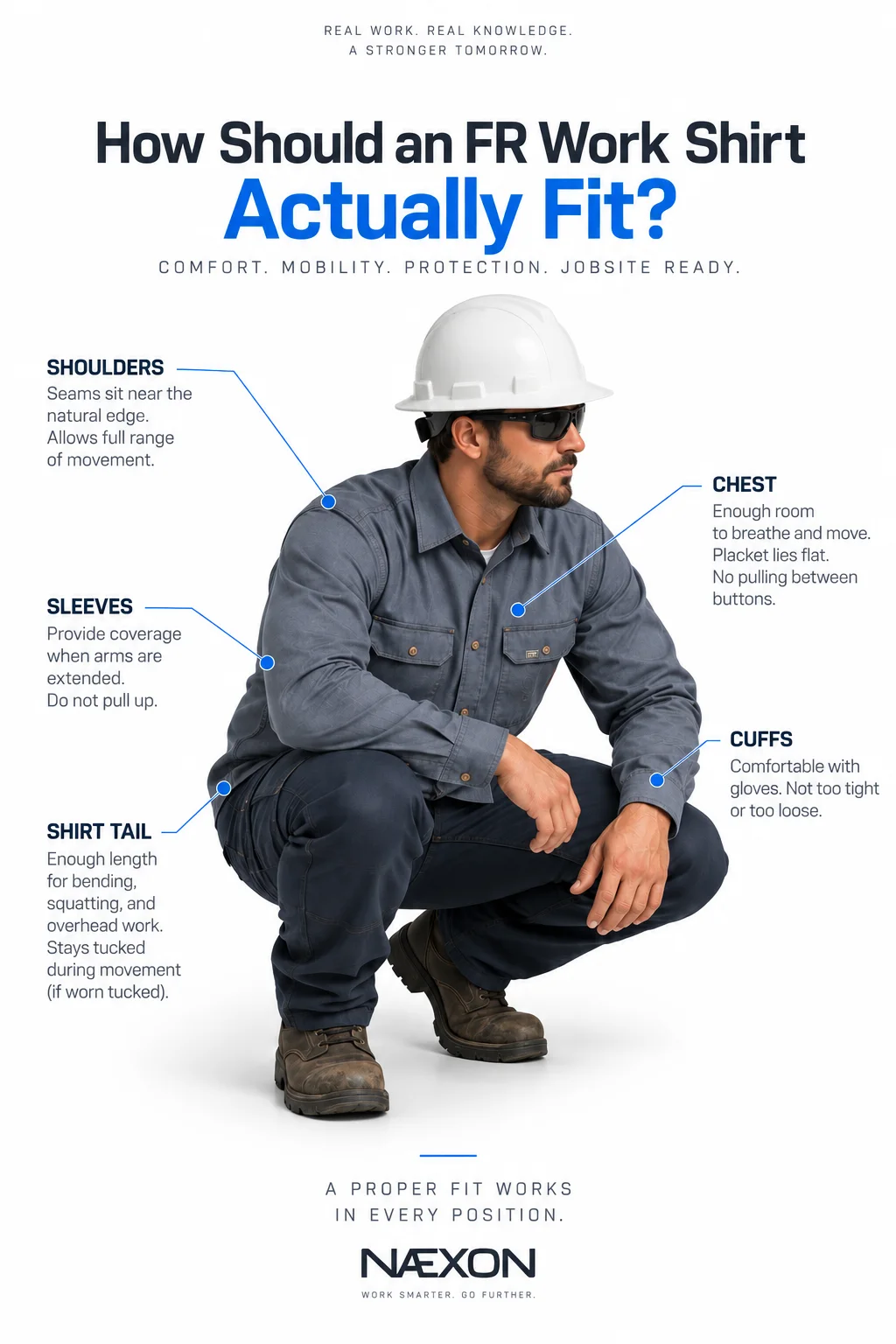
The shoulders are one of the best places to determine whether a work shirt fits correctly.
The shoulder seams should generally sit near the natural edge of the shoulders. If they sit too far inward, the shirt may feel restrictive when the arms move forward or overhead. If they hang far beyond the shoulders, the entire garment may be oversized.
This becomes especially noticeable during industrial work. When trying on an FR shirt:
- Reach forward as though tightening a bolt.
- Raise both arms as though working overhead.
- Cross your arms as though reaching around piping or equipment.
If the shirt immediately pulls hard across the upper back or shoulders, the fit may be too restrictive.
A work shirt should be evaluated while moving, not just while standing in front of a mirror.
The Chest Should Have Working Room
A properly fitted FR shirt should not be stretched tightly across the chest.
When the shirt is buttoned normally, the front placket should lie reasonably flat. If the fabric is pulling between the buttons or creating obvious tension across the chest, more room may be needed.
At the same time, bigger is not automatically better.
Excess material can bunch underneath harnesses, welding jackets, reflective vests, tool belts, or other PPE. Extremely loose clothing may also be undesirable around certain moving equipment or machinery.
The goal is functional clearance: enough room to breathe, bend, reach, and work without carrying unnecessary fabric.
Sleeve Length Matters More Than Many Workers Realize
Work-shirt sleeves often feel fine when the arms are hanging naturally. The real test comes when the arms are extended.
Button the cuffs and reach straight forward. Then reach overhead.
The sleeves should provide useful coverage without pulling excessively up the forearms. If normal work movements cause the cuffs to travel dramatically toward the elbows, the sleeves may be too short or the shirt may be too tight through the shoulders and back.
Sleeves that are excessively long create a different problem. Material can bunch around the wrists and interfere with gloves or other equipment.
The ideal sleeve length provides coverage while still allowing the hands and wrists to function normally.
Pay Attention to the Cuffs
Cuffs are a small part of the garment, but they can have a major effect on how the shirt feels throughout a shift.
A cuff that is too tight can become uncomfortable when worn with gloves or during repetitive hand movements. A cuff that is excessively loose may slide over the hand or interfere with work.
Workers should also consider how their shirt interacts with the gloves they normally wear.
A welder wearing gauntlet-style welding gloves may have different preferences from an instrument technician wearing lighter work gloves. The clothing system should work together rather than each piece of PPE fighting against another.
Check the Back When Reaching Forward
This is one of the most useful fit tests for industrial workwear.
Put the shirt on, button it normally, and extend both arms straight forward as though reaching across a fabrication table.
Pay attention to the upper back.
You should feel room for movement. The shirt should not feel as though the shoulder seams are being pulled apart.
This matters because industrial workers spend enormous amounts of time reaching in front of themselves. Grinding, welding, fitting pipe, tightening bolts, operating tools, pulling cable, handling rigging, and assembling equipment all involve forward arm movement.
A shirt that feels perfect with the arms at the sides can become uncomfortable very quickly once actual work begins.
The Shirt Tail Needs Enough Length
A work shirt also needs sufficient body length.
Industrial workers bend, squat, kneel, climb, crawl, and reach overhead throughout the day. If the shirt is too short, those movements can cause it to pull out of the pants or ride upward.
This is particularly noticeable when reaching overhead.
Raise both arms above your head. The bottom of the shirt will naturally move upward, but it should not feel dramatically short during normal movement.
Workers who prefer their shirts tucked in often benefit from enough shirt-tail length to remain tucked during repeated bending and reaching. Workers who wear shirts untucked should still have adequate coverage without choosing so much length that the garment becomes cumbersome.
Don’t Judge Fit Using Only Your Waist Size
Two workers who wear the same pants size may need completely different shirt sizes.
Upper-body proportions matter. Important measurements and body characteristics include:
- Chest circumference
- Shoulder width
- Arm length
- Torso length
- Overall build
Even the type of work being performed can change what size feels right.
That is why simply saying, “I wear a 34 waist, so I must wear a medium shirt,” is unreliable.
Whenever possible, use the manufacturer’s garment measurements or sizing chart and compare them with a shirt that already fits you well.
Work Fit Is Different From Fashion Fit
Modern casual shirts are often designed to follow the body closely. That can look good outside work.
Industrial workwear has another job.
During a normal shift, a worker may need to:
- Reach above the head
- Bend underneath piping
- Climb ladders or scaffolding
- Crawl through restricted areas
- Operate a chain fall
- Work from elevated platforms
- Position tools in awkward locations
A shirt that looks perfectly tailored while standing still may become restrictive under those conditions.
This does not mean FR clothing should look oversized or sloppy. It means mobility has to be part of the fit.
Good industrial workwear should look professional while still allowing the worker to actually work.
Consider What You Wear Underneath
Another important question is whether the shirt will be worn directly over a base layer or over additional clothing.
A shirt that fits perfectly over a lightweight undershirt may become restrictive when worn over additional layers in colder weather.
Industrial workers who travel for shutdowns and construction projects understand how dramatically conditions can change. The same worker might be on a Gulf Coast project during extreme heat and later work an outdoor winter project in the Midwest.
If layering is part of the job, it should be considered when choosing the fit.
Just remember that clothing worn as part of an FR/PPE system should be compatible with the hazards and the employer’s requirements.
Avoid the “I’ll Just Size Up Twice” Approach
Some workers automatically buy FR shirts significantly larger than their normal size because they assume more room always means more comfort.
That can create its own problems.
An unnecessarily oversized shirt may:
- Bunch underneath PPE
- Interfere with normal movement
- Create excessive material around the arms
- Hang too far below the waist
- Become uncomfortable or annoying during a long shift
Instead of automatically jumping multiple sizes, look for a shirt designed with sufficient mobility through the shoulders, back, chest, and arms.
Proper pattern design is better than unnecessary bulk.
The Five-Minute Work Shirt Fit Test
Before deciding that an FR shirt fits properly, put on the clothing and equipment you commonly wear with it and perform a few realistic movements.
- Button the shirt and cuffs normally.
- Reach both arms straight forward.
- Reach overhead.
- Cross your arms.
- Bend at the waist.
- Squat down.
- Rotate your torso left and right.
- Reach behind yourself.
- Put on your normal work gloves, safety vest, harness, or other commonly worn PPE when appropriate.
Pay attention to where the garment pulls.
A slight change in fabric tension during movement is normal. Severe pulling across the shoulders, chest, elbows, or back is not what you want from a work shirt.
Also check the opposite problem. If large amounts of fabric are hanging around the arms, torso, or cuffs, the shirt may be larger than necessary.
You are looking for four things:
- Coverage
- Mobility
- Comfort
- Controlled fit
Signs Your FR Shirt May Be Too Small
A shirt may be too small if you notice several of the following:
- Buttons pulling apart across the chest
- Tightness through the shoulders when reaching forward
- Cuffs pulling significantly upward when extending your arms
- A restrictive collar when properly closed
- The shirt constantly pulling out when bending or reaching
- Limited movement through the upper back
- Excessive tension around the elbows or shoulders
Another clue is when you unconsciously modify how you wear the shirt just to stay comfortable.
If you constantly leave buttons open, unbutton the cuffs, or avoid certain movements because the garment feels restrictive, the fit deserves another look.
Signs Your FR Shirt May Be Too Large
Oversizing can be just as easy to recognize. Common signs include:
- Shoulder seams falling well beyond the natural shoulders
- Sleeves extending over part of the hands
- Excess fabric bunching heavily around the waist
- Large amounts of loose material around the arms
- The shirt ballooning underneath a safety vest or harness
Some workers intentionally prefer a relaxed fit, and personal comfort matters. But there is a difference between relaxed and excessively oversized.
Workwear should give you room without getting in your way.
Shrinkage and Care Can Change the Fit
The shirt that fits perfectly on day one may not fit exactly the same after repeated laundering.
Fabric construction and manufacturer care instructions matter. Excessive heat or improper laundering can affect some garments, and FR clothing also requires proper care to maintain its intended performance.
This is another reason workers should understand how to wash and dry their specific FR garments rather than treating every work shirt exactly the same.
For a deeper explanation of FR garment care, continue through the Næxon Resources workwear series, where we cover washing, drying, storage, inspection, and replacement of industrial workwear.
Fit Is Also About the Entire PPE System
An FR shirt rarely exists by itself on an industrial jobsite.
Depending on the work, the complete PPE system may also include:
- FR pants
- Safety glasses
- Work or welding gloves
- Hard hat
- Hearing protection
- High-visibility equipment
- Fall protection
- Welding PPE
- Additional protective layers
The shirt should function as part of that system.
For example, a shirt that seems comfortable by itself may bunch badly underneath a harness. Sleeves may interact differently with welding gloves. A collar may feel different when additional neck protection is being used.
When possible, evaluate workwear the way you actually intend to wear it.
FR Clothing Still Has to Match the Hazard
Fit is important, but it does not replace proper garment selection.
A comfortable shirt is not automatically the correct protective garment for a particular task. Workers should follow their employer’s hazard assessment, site requirements, and applicable PPE standards when selecting flame-resistant or arc-rated clothing.
If you’re new to FR clothing, read the previous Næxon Resource article, “FR vs. Regular Workwear: What’s the Difference?” It explains why FR clothing exists, what flame resistance actually means, and why not every garment labeled FR should automatically be considered appropriate for every industrial hazard.
You can also start with “What Makes a Great Industrial Work Shirt?”, Resource #1 in this series, for a broader look at fabric, construction, durability, comfort, and jobsite functionality.
The Næxon Field Rule
A work shirt should be judged in working positions—not standing positions.
When trying on an FR work shirt:
- Reach.
- Bend.
- Squat.
- Stretch.
- Put your gloves on.
- Try it underneath the PPE you regularly wear.
Industrial work happens in motion. Your workwear should be selected the same way.
Final Takeaway
The best-fitting FR work shirt is not necessarily the tightest shirt or the biggest shirt. It is the one that provides appropriate coverage while allowing the worker to move naturally throughout the job.
The shoulders should move freely. The chest should have working room. The sleeves should maintain useful coverage when the arms extend. The cuffs should work with the hands and gloves. The shirt tail should provide sufficient length during bending and overhead work.
Most importantly, the garment should still be appropriate for the actual hazard.
FR workwear has to do more than look like workwear. It has to work when you do.
Continue exploring the Næxon Resources and Næxon Learning Center for practical guides covering industrial workwear, PPE, tools, field skills, fabrication, welding, pipefitting, rigging, electrical work, millwright work, and the knowledge industrial workers use every day.