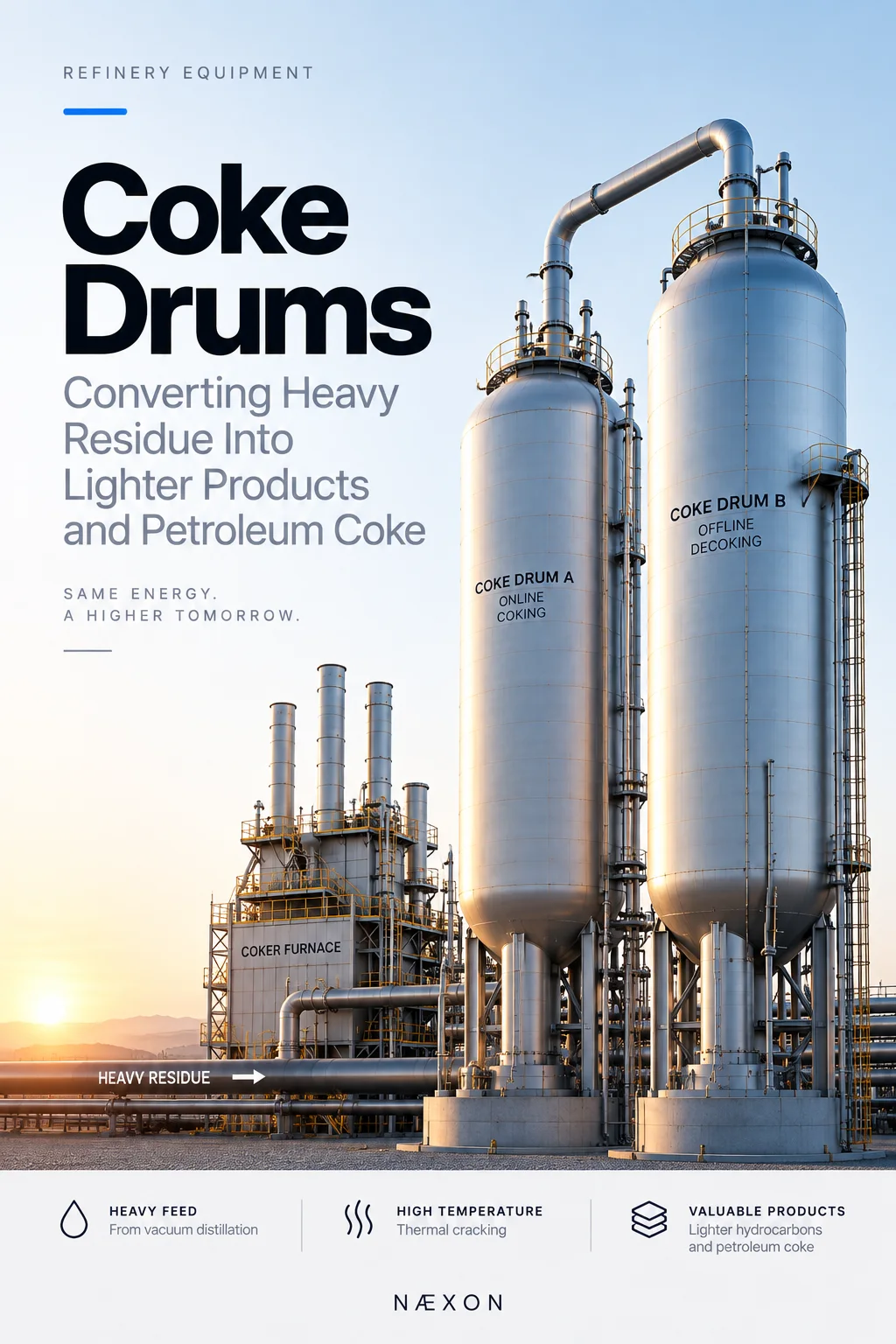
Coke drums are some of the largest, hottest, and most demanding pieces of equipment found in a refinery. They are the heart of the Delayed Coking Unit, commonly called the DCU or coker.
The purpose of delayed coking is to take extremely heavy refinery residue—the material remaining after lighter hydrocarbons have already been recovered—and thermally crack it into lighter hydrocarbon vapors while leaving behind solid petroleum coke.
Unlike the FCC reactor and regenerator, delayed coking does not depend on circulating catalyst. It relies primarily on high temperature and time.
A simplified process is:
Heavy Residue → Coker Furnace → Hot Feed → Coke Drum → Lighter Hydrocarbon Vapors + Solid Petroleum Coke
Coke drums normally operate in pairs or groups so the refinery can continue processing feed while another drum is being cooled, opened, decoked, and prepared for the next cycle.
For pipefitters, boilermakers, welders, operators, scaffold builders, riggers, and other refinery workers, the coke drum is especially important because it combines extreme temperature, thermal cycling, large piping, heavy valves, steam, high-pressure water, confined-space concerns, and enormous mechanical loads.
What Is a Coke Drum?
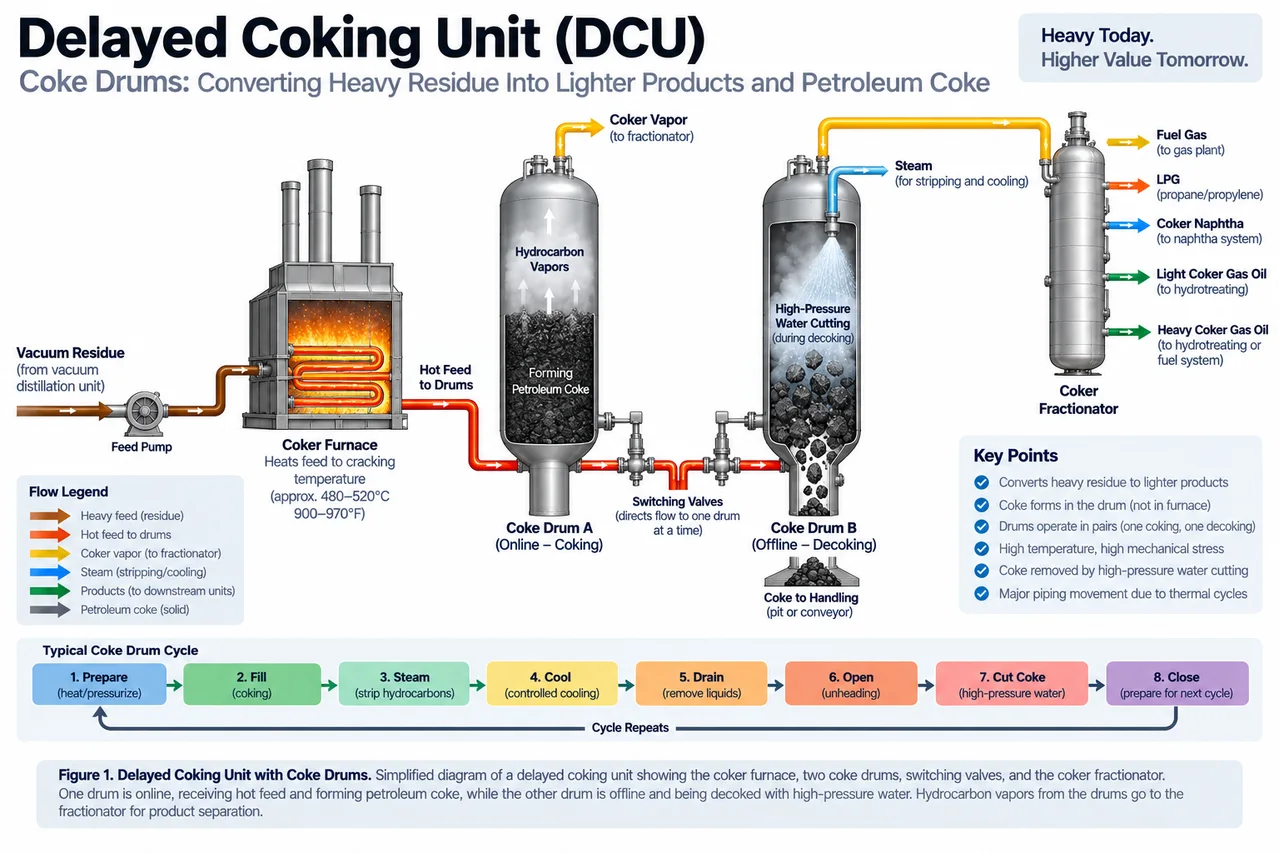
Figure 1. Delayed Coking Unit with Coke Drums. Simplified diagram showing how vacuum residue is heated in the coker furnace, routed to alternating coke drums where lighter hydrocarbon vapors separate from solid petroleum coke, and then sent to the coker fractionator while the offline drum is cooled and decoked.
A coke drum is a large vertical pressure vessel used in the delayed coking process.
Hot heavy hydrocarbon feed enters the drum after passing through the coker furnace.
The drum provides the residence time needed for thermal cracking reactions to continue.
As cracking occurs:
Heavy Hydrocarbons → Lighter Hydrocarbon Vapors + Petroleum Coke
The lighter hydrocarbon vapors leave the top of the drum and travel toward the coker fractionator.
The solid coke remains inside the drum.
Eventually, the drum fills with coke and must be taken out of hydrocarbon service.
Why Refineries Use Delayed Coking
After crude oil passes through atmospheric and vacuum distillation, a very heavy residual stream can remain.
This material contains some of the largest and heaviest hydrocarbon molecules in the refinery.
Instead of simply selling or disposing of all this residue as a low-value heavy product, a refinery can send it to a delayed coker.
The coker converts part of that heavy material into lighter products.
Depending on refinery configuration, coker products can include streams associated with:
- Fuel gas.
- LPG.
- Coker naphtha.
- Light coker gas oil.
- Heavy coker gas oil.
- Petroleum coke.
The lighter liquid streams can undergo additional refinery processing.
The solid coke is removed from the coke drum and handled separately.
Why It Is Called “Delayed” Coking
The name describes where coke formation is intentionally delayed until the heated feed reaches the coke drum.
The feed is heated rapidly inside the coker furnace.
Operators want to minimize significant coke formation inside the furnace tubes.
Instead, the hot feed leaves the furnace and enters the coke drum, where cracking continues and solid coke accumulates.
The intended sequence is:
Furnace Heats Feed → Feed Enters Drum → Cracking Continues → Coke Forms Inside Drum
Keeping coke formation concentrated in the drum rather than the furnace is fundamental to delayed-coker operation.
Heavy Feed Enters the Coker
The feed to a delayed coker is generally one of the heaviest hydrocarbon streams in the refinery.
A simplified upstream path is:
Crude Oil → Crude Distillation → Vacuum Distillation → Heavy Residue → Delayed Coker
Because the material is heavy and viscous, maintaining temperature is extremely important.
The Coker Furnace
Before entering the coke drum, heavy feed passes through a fired heater or coker furnace.
The furnace raises the feed to the temperature required for thermal cracking.
The basic path is:
Heavy Feed → Furnace Tubes → Extremely Hot Feed → Coke Drum
The furnace must heat the feed enough to drive cracking while minimizing premature coke deposition inside the furnace tubes.
That balance is critical.
Why Furnace Tube Coking Matters
If coke begins accumulating excessively inside furnace tubes, the internal flow area becomes smaller.
This can increase pressure drop and reduce heat transfer.
Tube-metal temperatures can also increase.
Operators therefore carefully monitor furnace conditions.
Steam may be used in portions of the process to help manage flow conditions and reduce coke deposition depending on the specific design.
Feed Enters the Coke Drum
Hot furnace effluent generally enters near the lower portion of the active coke drum.
Inside the drum, thermal cracking continues.
Lighter hydrocarbons vaporize and travel upward.
Heavier material progressively forms petroleum coke.
The basic separation becomes:
Hot Heavy Feed → Coke Drum → Hydrocarbon Vapors Rise + Solid Coke Remains
Over time, the coke bed grows upward inside the vessel.
Hydrocarbon Vapors Leave the Drum
Cracked hydrocarbon vapors leave through the upper portion of the coke drum.
They travel toward the coker fractionator.
The basic path is:
Coke Drum Overhead Vapor → Coker Fractionator → Product Separation
The fractionator separates the vapor mixture into different boiling ranges for additional processing elsewhere in the refinery.
Petroleum Coke
Petroleum coke is the carbon-rich solid material left behind after the heavy feed has undergone thermal cracking.
It accumulates inside the coke drum during the operating cycle.
The physical characteristics of petroleum coke vary according to feedstock and operating conditions.
Once the drum reaches its intended coke level, it must be removed from hydrocarbon service so the coke can eventually be removed.
Why Coke Drums Operate in Pairs
A coke drum cannot continuously receive feed forever.
Eventually it fills with coke.
Refineries therefore commonly use at least two drums.
While one drum is receiving hot feed:
Drum A → Coking
The other can be going through another part of the cycle:
Drum B → Steam / Cool / Drain / Open / Decoke / Prepare
When Drum A becomes full, feed can be switched to Drum B after Drum B has been properly prepared.
This allows the coker to continue processing while individual drums cycle between different operating states.
The Coke Drum Cycle
A simplified delayed-coker drum cycle can be thought of as:
Prepare → Warm → Fill → Steam → Cool → Drain → Open → Cut Coke → Close → Prepare Again
Each stage creates different temperatures, pressures, flows, and hazards.
That constantly changing operating condition is one reason coke drums experience such severe mechanical service.
Drum Switching
Switching feed from one coke drum to another is a critical operating event.
The incoming drum must be properly prepared and heated before receiving extremely hot feed.
The outgoing drum must be safely isolated from the live hydrocarbon process before cooling and decoking begins.
The transition must be carefully controlled.
Incorrect valve alignment or an improperly prepared drum can create extremely serious consequences.
Steam Stripping
After a drum is removed from active feed service, steam may be introduced to help remove remaining hydrocarbon vapors.
The simplified sequence is:
Feed Stops → Steam Introduced → Hydrocarbons Displaced → Drum Prepared for Cooling
Steam is therefore an important utility in delayed-coker operation.
The refinery steam system supports much more than process heating. It also plays important roles in purging, stripping, warming, and equipment preparation.
Cooling the Coke Drum
A coke drum contains an enormous amount of thermal energy after the coking cycle.
The vessel, coke bed, and internal material must be cooled before the drum can be safely opened and decoked.
Cooling is carefully controlled.
Introducing cooling water into extremely hot equipment creates major thermal stresses.
The vessel cannot simply be cooled instantly.
Temperature changes must occur according to the engineered operating procedure.
Why Thermal Cycling Is So Important
Few large refinery vessels experience thermal cycles as severe and repetitive as coke drums.
During operation, the drum becomes extremely hot.
During decoking, it is cooled substantially.
Then it is heated again for the next cycle.
This repeats continuously:
Heat → Cool → Heat → Cool → Heat → Cool
Steel expands when heated and contracts when cooled.
Repeated expansion and contraction can create fatigue over time.
This makes coke-drum mechanical integrity especially important.
Coke Drum Bulging
Repeated thermal cycling can contribute to localized deformation of coke-drum shells.
One well-known issue is shell bulging.
The vessel may develop areas where the shell geometry changes from its original shape.
This can be associated with complex thermal and mechanical stresses.
Inspection programs therefore pay close attention to coke-drum shell condition.
Weld Areas
Welds and heat-affected zones can become important inspection areas because repeated thermal cycling creates cyclic stress.
Areas of interest can include:
- Circumferential welds.
- Longitudinal welds.
- Nozzle connections.
- Skirt attachment areas.
- Shell transitions.
- Bottom-head regions.
The exact inspection strategy depends on the drum design, service history, and facility mechanical-integrity program.
Coke Drum Skirt
The coke drum is commonly supported by a structural skirt.
The skirt carries the enormous weight of the vessel and its contents into the foundation.
But the vessel also expands and contracts vertically as temperature changes.
The skirt and shell attachment therefore experience significant thermal and mechanical loading.
The support system is an important part of coke-drum integrity.
Coke Drum Piping
Coke drums connect to large high-temperature piping systems.
These can include:
- Furnace feed piping.
- Drum inlet piping.
- Overhead vapor piping.
- Steam connections.
- Quench-water connections.
- Drain piping.
- Blowdown connections.
- Vent piping.
- Utility connections.
These lines must accommodate substantial thermal movement.
Overhead Vapor Line
The coke-drum overhead line carries cracked hydrocarbon vapor toward downstream fractionation.
This line operates hot and can experience significant thermal expansion.
Because coke drums cycle between operating states, piping movement around the drum can be complicated.
Supports, guides, spring hangers, and piping flexibility must function as engineered.
Drum Inlet Valves
The lower inlet system controls which drum receives hot furnace effluent.
Depending on the coker design, specialized large valves may be used to switch flow between drums.
These valves operate under severe conditions involving:
- High temperatures.
- Heavy hydrocarbons.
- Coke formation.
- Thermal cycling.
- Large pipe sizes.
Reliable operation is critical to safe drum switching.
Top and Bottom Drum Openings
After the drum has been cooled, depressurized, isolated, and properly prepared, openings at the top and bottom allow decoking operations.
Historically, opening these areas required significant manual work.
Many modern cokers use remotely operated or automated unheading systems to reduce worker exposure.
Regardless of design, the top and bottom openings are critical areas of the coke drum.
What Is Decoking?
Decoking is the process of removing solid petroleum coke from the drum.
Once the drum is safely prepared and opened, high-pressure water is commonly used to cut the coke.
The basic process is:
Full Coke Drum → Cool → Open → High-Pressure Water Cutting → Coke Removed
The coke falls from the bottom of the drum into the coke-handling area.
High-Pressure Water Cutting
A specialized cutting tool is lowered into the drum from the top.
High-pressure water jets cut through the solid coke bed.
The operation commonly involves different cutting stages.
A pilot hole may first be created through the coke bed.
The cutting tool can then be configured to cut larger sections of coke away from the vessel.
This is powerful industrial equipment and requires strict control.
Coke Falls From the Drum
As the coke is cut, large quantities of solid material and water fall through the bottom opening.
The material may enter a coke pit, pad, containment area, or another handling system depending on refinery design.
Heavy equipment can then move or process the coke for storage and transportation.
The area below a coke drum during decoking is therefore a highly controlled work zone.
Why Decoking Is Hazardous
Decoking combines several hazards in one operation.
Potential hazards include:
- Residual heat.
- Residual hydrocarbons.
- Steam.
- Hot water.
- High-pressure water.
- Falling coke.
- Heavy equipment.
- Elevated work.
- Unexpected pressure.
- Mechanical equipment movement.
Workers must remain outside designated danger zones and follow site-specific procedures.
Water and Hot Coke
Water contacting very hot material can rapidly produce steam.
This is one reason cooling and drum preparation must be carefully controlled.
The relationship is simple but important:
Hot Coke + Water → Rapid Heat Transfer → Steam Generation
Unexpected water contact under inappropriate conditions can create dangerous pressure and energy release.
Coke Drum Blowdown System
Vapors and liquids removed during portions of the drum cycle may be routed into a blowdown or recovery system.
This allows hydrocarbons, steam, and water to be handled through controlled refinery equipment rather than released directly around the coke drum.
The blowdown system is therefore another important part of the delayed-coker process.
Thermal Expansion of Coke Drum Piping
Pipefitters working around coke drums must understand thermal movement.
A large line connected to a hot drum may move significantly between cold and operating conditions.
Engineered piping systems can use:
- Spring supports.
- Guides.
- Sliding supports.
- Expansion loops.
- Flexible geometry.
- Specialized supports.
A cold piping position does not necessarily represent its operating position.
Never force coke-drum piping into alignment without understanding the engineered cold setting and expected thermal growth.
Common Coke Drum Problems
Thermal Fatigue
Repeated heating and cooling can progressively damage the vessel.
Shell Bulging
Localized deformation can develop after repeated thermal cycles.
Cracking
High-stress areas can develop cracking over time.
Coke Buildup
Coke can accumulate in piping, valves, nozzles, and other locations.
Valve Problems
Large switching and isolation valves operate under severe conditions.
Piping Movement Problems
Damaged supports or incorrect alignment can increase loads on drum nozzles.
Erosion
High-velocity fluids and coke-containing streams can wear equipment.
Insulation Damage
Damaged thermal protection can create abnormal temperature distribution and expose hot surfaces.
Coke Drum Inspection
Because of severe thermal cycling, coke drums require careful mechanical-integrity monitoring.
Inspection can include:
- Visual shell inspection.
- Weld inspection.
- Ultrasonic thickness measurements.
- Crack detection.
- Shell-profile measurements.
- Bulge monitoring.
- Nozzle inspection.
- Skirt inspection.
- Support inspection.
- Piping inspection.
- Thermal monitoring.
Long-term inspection data can be particularly valuable because it allows engineers to identify changes developing over many operating cycles.
Delayed Coker Turnaround Work
A coker turnaround can involve extensive work throughout the unit.
Typical activities may include:
- Coke drum inspection.
- Shell repairs.
- Weld repairs.
- Nozzle repairs.
- Skirt inspection.
- Furnace inspection.
- Furnace tube work.
- Large-bore piping replacement.
- Valve maintenance.
- Overhead-line inspection.
- Support replacement.
- Decoking-equipment maintenance.
- Blowdown-system work.
- Structural repairs.
- Insulation replacement.
Coker work can involve nearly every major industrial craft.
Field Knowledge for Pipefitters
Coke-drum piping requires careful attention because the equipment moves significantly during thermal cycles.
Pipefitters should understand:
- Hot versus cold pipe position.
- Drum thermal growth.
- Spring-hanger settings.
- Guide locations.
- Sliding supports.
- Nozzle loading.
- Valve orientation.
- Drainability.
- Steam connections.
- Large-bore flange alignment.
Never assume a pipe is incorrectly aligned simply because it appears offset while the unit is shut down.
That offset may be intentional.
The important question is:
Where will the piping move when the drum reaches operating temperature?
Coke Drum Safety
Coke drums deserve exceptional respect because operating conditions change dramatically throughout the cycle.
Potential hazards include:
- High-temperature hydrocarbons.
- Steam.
- High-pressure water.
- Residual pressure.
- Falling coke.
- Hot coke.
- Flammable vapor.
- Toxic gases depending on feed.
- Heavy equipment.
- Work at elevation.
- Confined-space hazards.
- Stored mechanical energy.
Never assume that a drum being prepared for decoking is automatically safe because feed has been switched to the other drum.
Isolation, depressurization, steam-out, cooling, draining, atmospheric testing, and other required preparation steps must be completed according to facility procedures.
Troubleshooting Example
Suppose an overhead line connected to a coke drum begins showing abnormal movement during the heating cycle.
The immediate assumption might be that the pipe support is defective.
But the investigation could include:
- Drum temperature.
- Heating rate.
- Thermal growth.
- Spring-support position.
- Guide condition.
- Pipe-shoe movement.
- Nozzle movement.
- Nearby support condition.
- Piping alignment.
- Restrictions preventing intended movement.
The support showing unusual movement may only be reacting to a problem somewhere else in the system.
This reinforces an important troubleshooting principle:
The equipment showing the symptom is not always the equipment causing the problem.
Important Coke Drum Terminology
- Delayed Coking: Thermal cracking process for heavy refinery residue.
- DCU: Delayed Coking Unit.
- Coke Drum: Vessel where thermal cracking continues and petroleum coke accumulates.
- Petroleum Coke: Carbon-rich solid produced during delayed coking.
- Coker Furnace: Fired heater that raises feed to cracking temperature.
- Coking Cycle: Period during which a drum receives hot feed and accumulates coke.
- Drum Switching: Redirecting furnace effluent from one coke drum to another.
- Steam-Out: Use of steam during equipment preparation and hydrocarbon removal.
- Quench: Controlled cooling of the drum and coke.
- Decoking: Removal of petroleum coke from the drum.
- Unheading: Opening the drum for coke removal after proper preparation.
- Coke Cutting: High-pressure water removal of solid coke.
- Blowdown System: System handling vapors and liquids generated during portions of the drum cycle.
- Thermal Fatigue: Damage associated with repeated heating and cooling cycles.
- Shell Bulging: Localized deformation of the coke-drum shell.
Field Rules
- Respect the drum cycle. The same vessel can experience dramatically different conditions within hours.
- Never assume an offline drum is safe. It may still contain pressure, heat, steam, hydrocarbons, or hot coke.
- Understand thermal growth. Coke drums and their piping move substantially.
- Never force connected piping into alignment. Cold offsets may be intentional.
- Respect high-pressure water. Decoking equipment contains enormous energy.
- Stay clear of falling-coke zones. Large pieces of coke can fall from significant height.
- Protect pipe supports and spring hangers. They control movement of large hot piping.
- Watch for coke buildup. Coke can restrict piping, valves, and nozzles.
- Treat drum switching as a critical operation. Correct isolation and valve alignment matter.
- Remember thermal fatigue. Every heating and cooling cycle affects the vessel.
Knowledge Check
- What is the primary purpose of a delayed coker?
- Why is the process called delayed coking?
- What happens to heavy hydrocarbon feed inside the coke drum?
- Why are coke drums commonly operated in pairs?
- What happens to hydrocarbon vapor leaving the top of the drum?
- What is petroleum coke?
- Why is the coker furnace important?
- Why is excessive coke formation inside furnace tubes undesirable?
- What happens after a coke drum becomes full?
- Why must the drum be cooled before decoking?
- How is petroleum coke commonly removed?
- Why is thermal cycling a major coke-drum concern?
- What is shell bulging?
- Why must pipefitters understand hot and cold piping positions?
- Why is high-pressure coke-cutting water hazardous?
Practical Exercise
Using a simplified delayed-coker drawing, trace the hydrocarbon path:
Heavy Residue → Coker Furnace → Coke Drum → Overhead Vapor → Coker Fractionator
Then trace the solid-product path:
Heavy Feed → Thermal Cracking → Petroleum Coke → Drum Cooling → Decoking → Coke Handling
Next, identify both coke drums and determine which drum is:
- Receiving feed.
- Being steamed.
- Being cooled.
- Being drained.
- Being opened.
- Being decoked.
- Being prepared for the next cycle.
Finally, identify:
- Drum inlet piping.
- Overhead vapor line.
- Steam connections.
- Cooling-water connections.
- Blowdown connections.
- Top opening.
- Bottom opening.
- Drum skirt.
- Major pipe supports.
- Spring hangers.
- Switching valves.
Understanding the drum cycle is the key to understanding delayed-coker operation.
The Big Picture
A delayed coker takes some of the heaviest material in a refinery and converts part of it into lighter, more useful hydrocarbon streams.
The process begins with heavy refinery residue.
The coker furnace heats that material to cracking conditions.
The hot feed enters a coke drum, where thermal cracking continues.
Lighter hydrocarbons leave as vapor.
Solid petroleum coke remains behind.
When the drum fills, feed is switched to another drum.
The full drum is then steamed, cooled, drained, opened, and decoked before beginning another cycle.
Remember the hydrocarbon path:
Heavy Residue → Coker Furnace → Coke Drum → Cracking → Lighter Hydrocarbon Vapors → Fractionation
And the coke path:
Heavy Residue → Thermal Cracking → Petroleum Coke → Cooling → High-Pressure Water Cutting → Coke Handling
The defining characteristic of the coke drum is that it does not remain in one steady operating condition.
It repeatedly moves through heating, filling, steaming, cooling, opening, decoking, closing, and reheating.
Understanding that cycle—and the enormous thermal and mechanical stresses it creates—is the foundation for understanding one of the most demanding pieces of equipment in a refinery.
Equipment #19 — Coke Drum
Next: Equipment #20 — Desalter