Jet fuel has to meet demanding specifications before it can leave a refinery as a finished product. Sulfur content, freezing point, flash point, smoke point, thermal stability and other properties can determine whether a kerosene-range stream is suitable for aviation use.
One refinery process that helps prepare this material is the Kerosene/Jet Fuel Hydrotreater (KHT).
The KHT uses hydrogen, heat, pressure and catalyst to remove undesirable compounds from kerosene-range hydrocarbons while preserving the valuable material that can ultimately become jet fuel or other kerosene products.
The basic process can be remembered as:
Kerosene Feed → Hydrogen → Heat → Reactor → Cooling → Separation → Stripping → Treated Kerosene
Understanding this flow provides a foundation for understanding how refineries clean a middle-distillate stream before final product blending.
Where Kerosene Comes From
Kerosene begins much earlier in the refining process.
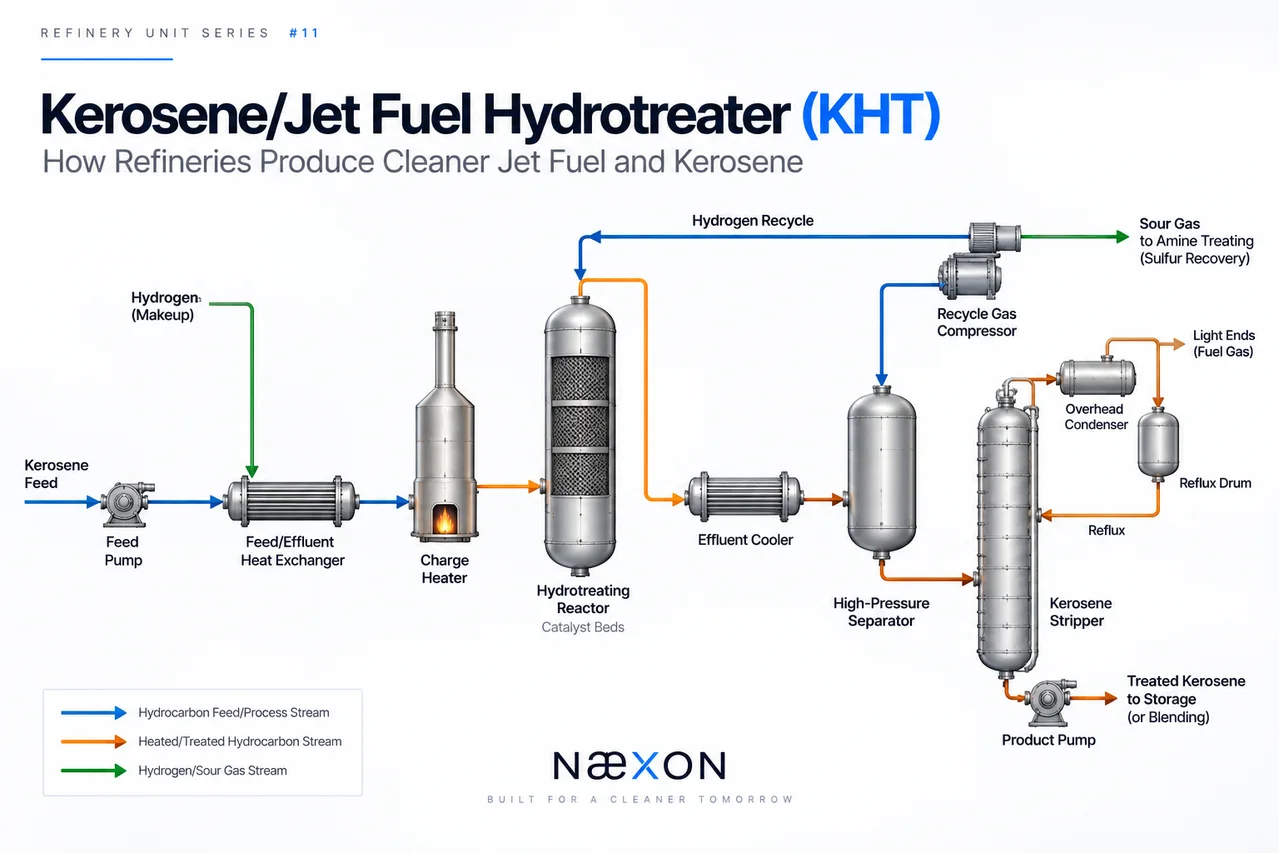
Figure: Simplified process flow of a Kerosene/Jet Fuel Hydrotreater (KHT), showing hydrogen addition, feed heating, catalytic hydrotreating, cooling and separation, hydrogen recycle, product stripping, and the production of treated kerosene for jet-fuel blending.
Crude oil first enters the Crude Distillation Unit (CDU), where heat and distillation separate crude oil into different boiling-range fractions.
Kerosene is one of the middle-distillate fractions recovered between lighter naphtha-range material and heavier diesel-range material.
Straight-run kerosene from crude distillation can contain sulfur compounds, nitrogen compounds and other undesirable materials. Depending on the crude source and required final product, additional treatment may be necessary.
That is where the KHT enters the process.
What Does a Kerosene Hydrotreater Do?
The KHT mixes kerosene with hydrogen and exposes the mixture to a hydrotreating catalyst at elevated temperature and pressure.
Chemical reactions inside the reactor convert undesirable compounds into forms that can be separated from the hydrocarbon product.
Sulfur-containing compounds are especially important. During hydrotreating, they react with hydrogen and are converted primarily into hydrogen sulfide (H₂S).
Nitrogen-containing compounds can produce ammonia (NH₃), while other reactions can improve the overall quality of the hydrocarbon stream.
The important concept is that contaminants are not simply filtered out.
They are chemically transformed.
Why Jet Fuel Requires Careful Processing
Aviation fuel operates under conditions very different from ordinary ground transportation fuels.
Aircraft can encounter extremely low temperatures at altitude. Fuel must remain sufficiently fluid and perform reliably throughout the aircraft’s operating environment.
Refineries therefore carefully control properties such as freezing point, flash point, sulfur content, smoke point, thermal stability and other characteristics required by the applicable product specification.
Hydrotreating can improve several important characteristics, but hydrotreated kerosene does not automatically become finished jet fuel.
The treated stream must still meet all applicable specifications before it can enter an approved aviation-fuel blend.
Step 1 — Kerosene Feed Enters the Unit
Kerosene-range feed commonly arrives from the atmospheric crude-distillation system or another suitable refinery source.
Feed pumps raise the liquid to the pressure required by the hydrotreating process.
The kerosene is then combined with hydrogen-rich gas.
Hydrogen is essential because the reactions occurring across the catalyst depend on an adequate hydrogen environment.
Step 2 — Feed Is Preheated
Before reaching the reactor, the kerosene and hydrogen mixture must be heated.
Refineries recover energy whenever practical by passing the incoming feed through feed/effluent heat exchangers.
Hot reactor effluent transfers heat into the cooler incoming feed.
This simultaneously cools the reactor effluent and preheats the incoming process stream, reducing the amount of additional firing required in the charge heater.
Step 3 — The Charge Heater Raises the Temperature
The preheated feed then enters a fired charge heater.
Burners provide the remaining energy necessary to bring the mixture to the required reactor inlet temperature.
Temperature control is critical.
Insufficient temperature can reduce hydrotreating effectiveness, while excessive temperature can encourage unwanted reactions and contribute to faster catalyst deactivation.
Step 4 — The Feed Enters the Hydrotreating Reactor
The heated kerosene and hydrogen enter the hydrotreating reactor.
Inside the vessel are one or more fixed catalyst beds. Hydrotreating catalysts commonly contain combinations such as cobalt-molybdenum or nickel-molybdenum supported on alumina, depending on the process design.
As the feed moves through the catalyst, hydrogen participates in reactions that remove contaminants.
One of the most important reactions is hydrodesulfurization.
In simplified form:
Sulfur-Containing Hydrocarbon + Hydrogen → Desulfurized Hydrocarbon + H₂S
The sulfur has not disappeared.
It has been converted primarily into hydrogen sulfide so that it can be separated and handled elsewhere in the refinery.
Step 5 — Reactor Effluent Is Cooled
Material leaving the reactor is still at elevated temperature.
The hot reactor effluent commonly passes back through the feed/effluent exchangers, transferring some of its heat to the incoming feed.
Additional air coolers or water-cooled exchangers can then reduce its temperature further.
Cooling prepares the mixture for effective gas-liquid separation.
At this point, the stream can contain treated hydrocarbons, hydrogen, hydrogen sulfide, light hydrocarbons and other reaction products.
Step 6 — Gas and Liquid Are Separated
The cooled reactor effluent enters a separator.
Hydrogen-rich gas separates from the hydrocarbon liquid.
Depending on the refinery configuration, hydrogen-rich gas can be treated and returned to the reactor circuit through a recycle-gas compressor.
Fresh makeup hydrogen replaces hydrogen consumed by reactions and other system losses.
Maintaining this hydrogen circulation is critical to stable hydrotreater operation.
Step 7 — Treated Kerosene Is Stripped
The liquid leaving the separator can still contain dissolved H₂S, light hydrocarbons and other volatile components.
A stripper or stabilizing section removes these lighter materials.
Heat supplied to the column helps drive volatile components upward while the heavier hydrotreated kerosene remains in the liquid product.
The resulting treated kerosene can then proceed toward additional processing, blending or storage depending on refinery configuration and product requirements.
The Hydrogen Recycle Loop
One of the most important systems to understand on a hydrotreater is the hydrogen recycle loop.
Instead of using hydrogen once and discarding the entire gas stream, the refinery can recover hydrogen-rich gas and circulate it back through the process.
The simplified loop is:
Separator → Gas Treatment → Recycle Compressor → Feed → Reactor → Separator
Fresh hydrogen is added as required.
The recycle-gas compressor therefore becomes a critical part of the unit. Loss of adequate hydrogen circulation can significantly affect reactor conditions and may require operators to reduce feed or shut down the unit according to established operating procedures.
What Happens to the Sulfur?
Removing sulfur from kerosene is only one part of the refinery’s larger sulfur-management system.
The KHT converts much of the sulfur in the feed into H₂S.
Sour gas containing H₂S can eventually be routed through refinery gas-treatment systems and ultimately toward sulfur recovery.
This demonstrates one of the most important concepts in refinery processing:
One unit’s waste stream can become another unit’s feed.
The refinery is an interconnected network rather than a collection of independent processes.
KHT vs. Diesel Hydrotreater
The Kerosene Hydrotreater and Diesel/Distillate Hydrotreater (DHT) operate on similar fundamental principles.
Both use hydrogen, catalyst, pressure and elevated temperature to remove undesirable compounds.
Their feedstocks and product objectives are different.
The DHT primarily treats diesel/distillate-range material, with sulfur reduction being particularly important for producing low-sulfur diesel components.
The KHT focuses on the lighter kerosene boiling range and can prepare material for aviation-fuel and kerosene blending.
Because aviation fuel has its own demanding specifications, the treated kerosene must still be carefully tested and controlled before becoming finished jet fuel.
Major Equipment Inside a KHT
A typical Kerosene Hydrotreater may contain:
- Feed pumps
- Feed/effluent heat exchangers
- Charge heater
- Hydrotreating reactor
- Catalyst beds
- Reactor-effluent coolers
- High-pressure separator
- Recycle-gas compressor
- Gas-treatment equipment
- Product stripper
- Reboiler
- Overhead condenser
- Reflux drum
- Product pumps
Each individual piece performs one part of the process, but together they form the complete Kerosene Hydrotreater unit.
What Industrial Trades Should Know
KHT maintenance can expose workers to combinations of hydrogen, hydrogen sulfide, hydrocarbons, elevated temperatures and pressure.
Opening a flange, valve, exchanger, vessel or piping system should never be treated as routine simply because the unit has been shut down.
Process equipment can retain pressure, hydrocarbons and toxic gases.
Approved isolation, depressurization, draining, purging, atmospheric testing and permitting procedures must be completed before containment is broken.
Workers must also verify piping specifications carefully.
A component that physically fits does not necessarily belong in that service.
Material grade, pipe schedule, pressure class, flange facing, gasket type, bolting, valve specifications and welding requirements all matter.
Hydrogen Service
Hydrogen requires particular attention.
It is highly flammable and can escape through very small leak paths. Certain combinations of hydrogen, temperature, pressure and metallurgy can also contribute to material-degradation mechanisms.
Hydrogen-service piping and equipment specifications therefore must be followed exactly.
Flange alignment, gasket installation, bolting practices, welding procedures and inspection requirements are critical parts of maintaining system integrity.
Hydrogen Sulfide Hazards
Hydrogen sulfide is another major concern.
H₂S is highly toxic and flammable.
Workers should never rely on smell to determine whether dangerous concentrations are present.
Equipment that has processed sour hydrocarbons must be treated as potentially hazardous until proper isolation, atmospheric testing and established site procedures demonstrate otherwise.
Catalyst Considerations
Hydrotreating catalyst gradually loses activity during operation.
Contaminants, coke deposition and normal operating exposure can reduce catalyst effectiveness over time.
Eventually, catalyst may require regeneration or replacement depending on the process and catalyst system.
Catalyst changeouts can become major turnaround activities involving specialized procedures, confined-space controls, inert-atmosphere considerations and careful handling of spent catalyst.
Common KHT Operating Problems
Catalyst deactivation can gradually reduce contaminant-removal performance.
Low hydrogen circulation can affect reaction effectiveness and catalyst condition.
Heat-exchanger fouling can reduce heat recovery and increase heater duty.
Heater problems can prevent the feed from reaching the required reactor temperature.
Separator problems can interfere with proper gas-liquid separation.
Recycle-compressor problems can disrupt hydrogen circulation.
Stripper problems can leave excessive light or sour components in the product.
Changes in feed composition can also affect the severity required to achieve the desired product quality.
Understanding the Entire Process
A Kerosene Hydrotreater can appear complicated when viewed as hundreds of lines, valves, instruments and individual pieces of equipment.
Reduce the unit to its fundamental purpose and it becomes much easier to understand.
Kerosene enters untreated.
Hydrogen is added.
The mixture is heated.
Catalyst converts contaminants.
The reactor effluent is cooled.
Gas and liquid are separated.
Sour and light components are stripped.
Treated kerosene leaves the unit.
Everything else supports those fundamental steps.
Field Rules
Treat KHT piping and equipment as potentially hazardous until proper isolation and testing establish otherwise.
Know the service before breaking containment. Hydrogen, H₂S and hydrocarbons can exist within the same process system.
Verify replacement materials against approved piping specifications rather than relying on appearance.
Never use flange bolts to force badly misaligned piping into position.
Understand where the line comes from and where it goes.
Most importantly, remember that removing sulfur from kerosene does not eliminate sulfur from the refinery. The sulfur has been chemically converted and transferred into another process stream that must also be safely handled.
Knowledge Check
- What is the primary purpose of a Kerosene Hydrotreater?
- Why is hydrogen added to the kerosene feed?
- What happens to sulfur during hydrodesulfurization?
- Why is reactor effluent used to preheat incoming feed?
- What does the separator accomplish?
- Why is hydrogen-rich gas recycled?
- What is the purpose of the product stripper?
- How does a KHT differ from a Diesel Hydrotreater?
- Why does hydrotreated kerosene still require testing before becoming finished jet fuel?
- Where can sulfur removed by the KHT ultimately go?
Practical Exercise
Draw the KHT using seven major process blocks:
Feed → Heater → Reactor → Cooler → Separator → Stripper → Product
Add a hydrogen line entering before the reactor.
Next, draw a line from the separator gas outlet back toward the reactor and label it Hydrogen Recycle.
Finally, draw a sour-gas outlet toward the refinery’s sulfur-management system.
If you can independently trace the hydrocarbon path, hydrogen path and sulfur path, you understand the basic KHT process.
The Bottom Line
The Kerosene/Jet Fuel Hydrotreater (KHT) cleans kerosene-range refinery streams using hydrogen and catalyst.
Sulfur and other undesirable compounds are chemically converted into forms that can be separated from the hydrocarbon product. The resulting hydrotreated kerosene can then move toward additional processing or blending, where it must satisfy the required specifications before becoming finished aviation fuel.
The easiest sequence to remember is:
Feed → Hydrogen → Heat → Reactor → Cool → Separate → Strip → Treated Kerosene
That simple flow connects the heater, reactor, exchangers, separator, compressor, stripper and associated piping into one understandable refinery process.
Refinery Unit Series — #11: Kerosene/Jet Fuel Hydrotreater (KHT)