A gang box can tell you a lot about the crew using it.
Some are packed so tightly that finding a 9/16-inch wrench requires moving three grinders, two extension cords, a welding hood, and something nobody remembers putting in there. Others look almost empty but somehow contain exactly what the crew needs.
The difference usually isn’t how many tools are inside.
It’s whether the box was built around the work.
Experienced industrial travelers eventually learn that a gang box isn’t supposed to be a storage unit. It’s a working system. The right tools need to be protected, organized, easy to find, and ready when the job changes unexpectedly.
On a refinery turnaround, power-plant outage, pipeline project, fab-shop job, or industrial construction site, those few minutes spent hunting for equipment can add up quickly.
A good gang box keeps the crew moving.
Start With the Tools That Make Money
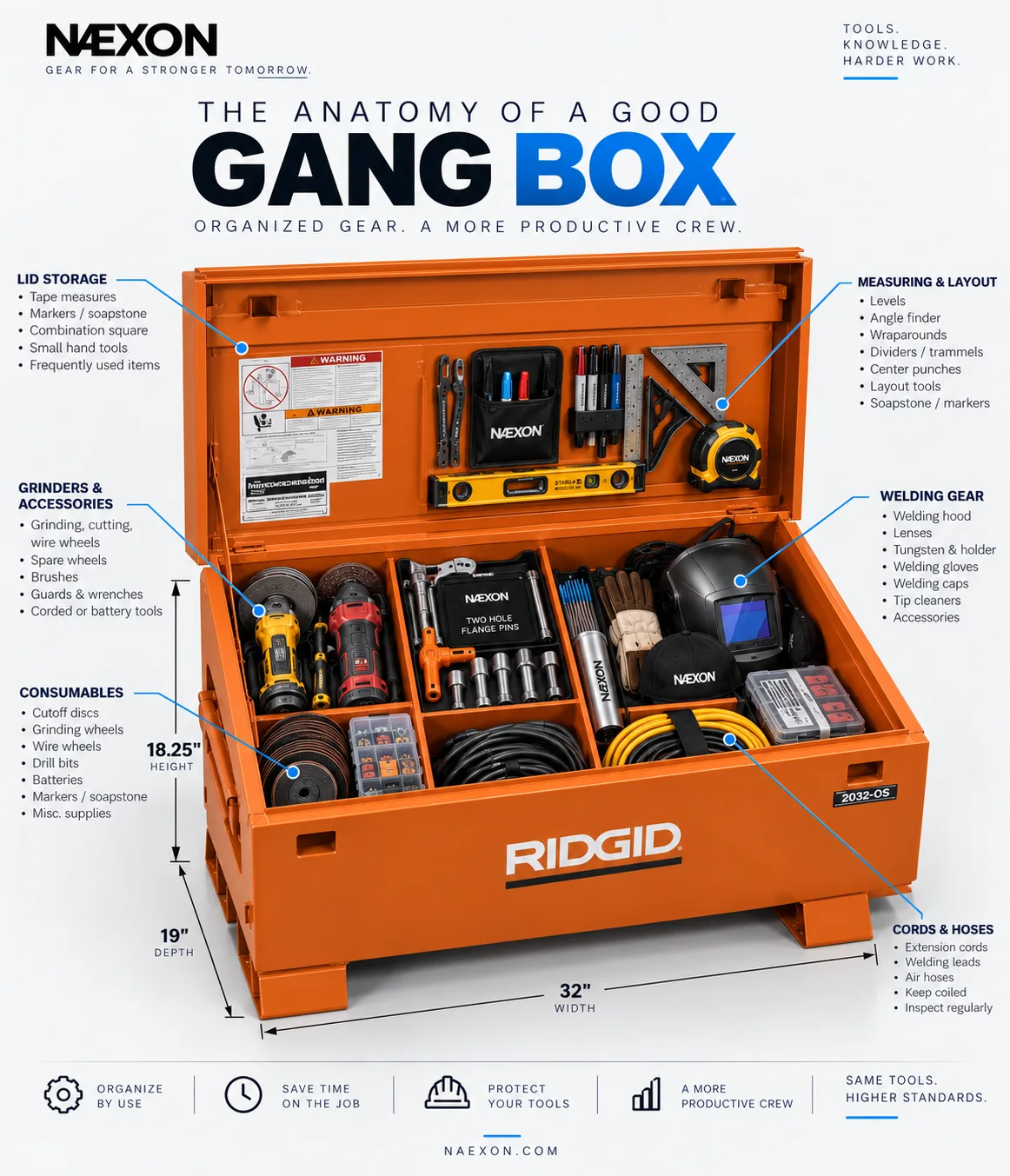
Figure: Anatomy of a well-organized industrial gang box, showing dedicated storage for measuring and layout tools, grinders, welding gear, consumables, flange tools, hardware, cords, and hoses—keeping essential equipment protected, accessible, and ready for the job.
The center of the box should be the equipment used constantly.
For a pipefitting or welding crew, that could mean grinders, levels, squares, flange tools, measuring equipment, clamps, welding accessories, layout tools, and commonly used hand tools.
These aren’t necessarily the most expensive tools in the box.
They’re the tools people reach for repeatedly.
If something gets used twenty times during a shift, burying it underneath rarely used equipment doesn’t make sense.
Experienced hands tend to organize around frequency of use rather than tool category.
The tools making money should be the easiest tools to reach.
Measuring and Layout Tools Deserve Their Own Area
A bent square, damaged level, or abused precision tool can create problems much larger than its purchase price.
Measuring and layout equipment should therefore have a protected location instead of being thrown underneath grinders and pipe wrenches.
Depending on the craft, that area might contain:
- Tape measures and folding rules.
- Torpedo and longer levels.
- Combination squares.
- Wraparounds.
- Soapstone and markers.
- Dividers and trammels.
- Center punches.
- Flange-alignment tools.
- Angle finders.
- Specialty layout equipment.
For pipefitters, these tools are often where fabrication accuracy begins.
A flange that’s slightly rotated or a measurement that’s transferred incorrectly can create far more work downstream.
Grinders Need a System
Few industrial tools create gang-box chaos faster than grinders.
One grinder becomes two. Two become four. Then come wheels, brushes, guards, batteries, cords, wrenches and replacement consumables.
A better setup separates the grinders from their accessories.
The crew might keep different machines ready for specific operations—such as grinding, cutting and wire brushing—rather than changing wheels constantly.
Consumables can then be organized separately so workers aren’t digging through loose discs every time one wears out.
Just as importantly, grinders should go back into the box in a condition that doesn’t create a hazard or destroy everything around them.
Flange Tools Become Their Own Family
Industrial pipefitters accumulate flange tools quickly.
There are alignment pins, wedges, spreaders, flange squares, bolt-up equipment and specialty tools that experienced fitters may fabricate themselves.
This equipment deserves a defined area because flange work often requires several tools at once.
Næxon Two Hole Flange Pins can fit naturally into this part of the working kit alongside the crew’s other alignment and layout equipment.
Keeping flange tools together means the crew can grab what it needs and move to the connection instead of making repeated trips back to the box.
Welding Gear Needs Protection
Welding equipment shouldn’t simply be thrown into whatever space remains.
Lenses, hoods, TIG equipment, tungsten, consumables and related accessories can be damaged or contaminated when they’re mixed with heavy tools.
A dedicated welding section might include:
- Welding hood and replacement lenses.
- TIG torch components.
- Tungsten.
- Welding caps.
- Gloves.
- Soapstone.
- Tip cleaners.
- Small wire brushes.
- Welding sleeves and arm protection.
A stainless Næxon Tungsten Holder is particularly useful for keeping prepared tungsten separated and protected rather than loose in a toolbox.
Personal protective equipment should also remain clean enough to perform its intended job. Welding gloves buried underneath greasy mechanical tools aren’t exactly an improvement.
Consumables Should Be Visible
Consumables are inexpensive compared with the labor lost when the crew runs out.
Grinding wheels, cutoff discs, wire wheels, markers, soapstone, batteries, drill bits and similar items should be stored where inventory can be checked quickly.
The worst time to discover the last cutoff wheel was used yesterday is when the crew needs one immediately.
Some crews establish simple minimum quantities.
When the supply reaches that point, someone replenishes it.
No complicated inventory system is necessary.
You just need to know what’s disappearing before it’s gone.
The Homemade-Tool Corner
This may be the most interesting part of an experienced crew’s gang box.
Industrial craftspeople have always fabricated tools for problems commercial manufacturers don’t solve particularly well.
Inside an older gang box, you might find homemade:
- Flange spanners.
- Dogs.
- Wedges.
- Alignment devices.
- Pipe clamps.
- Pulling tools.
- Layout templates.
- Specialty wrenches.
- Temporary positioning tools.
Some look crude.
Some look like professionally manufactured equipment.
What matters is whether they solve the problem safely and effectively.
Næxon Resources already explores this side of industrial fabrication through guides covering homemade fitting and alignment tools. These articles belong together as part of a larger shop-built industrial tools knowledge cluster.
There is one important boundary: homemade tools should never be treated casually when failure could drop, release, suspend, restrain, or unexpectedly move a load. Rigging and load-bearing applications require equipment appropriate for the service and job requirements.
The Spare-Hardware Compartment
Every experienced crew eventually develops a collection of hardware that somehow saves the day.
It might contain nuts, bolts, washers, cotter pins, small clamps, fasteners and miscellaneous pieces left over from previous work.
The key is preventing that collection from becoming twenty pounds of unidentified steel dumped into the bottom of the box.
Small containers work better.
Sort what’s actually useful.
Throw away what’s damaged or unlikely to be used.
There’s a difference between keeping useful hardware and operating a scrap yard.
Extension Cords Need Discipline
Few things can turn a gang box into a mess faster than extension cords.
Properly stored cords should be easy to remove without dragging half the box with them.
Before storing them, workers should also look for obvious damage to insulation, plugs and connectors.
The same principle applies to welding leads, air hoses and other long flexible equipment.
Coiling equipment properly isn’t about making the gang box pretty.
It’s about having it ready the next time someone needs it.
Keep Personal PPE Separate From Dirty Tools
Gang boxes frequently become temporary homes for welding caps, gloves, glasses and other PPE.
That doesn’t mean PPE should live underneath oily wrenches and grinding dust.
A separate clean area helps protect equipment that workers actually wear against their bodies.
Næxon gear such as Welding Caps, Rebel Welding Gloves, Bully Welding Arm Guards, FR Bandit Bandanas and Badger Z87 Safety Sunglasses belongs in the working system, but personal equipment should be stored appropriately rather than treated like scrap hardware.
The same goes for FR clothing.
Your workwear is protective equipment, not a shop rag.
The Top Tray Is Prime Real Estate
If the gang box has a top tray, don’t waste it.
This is where frequently used smaller equipment belongs.
Think of the tray as the dashboard.
The main compartment is the cargo area.
A good tray might contain measuring tools, markers, small wrenches, flange pins and other items the crew reaches for repeatedly.
Heavy equipment belongs lower.
Small high-frequency equipment belongs where it can be reached immediately.
What Shouldn’t Be in the Gang Box?
The answer depends on the jobsite, contractor and applicable rules, but experienced crews also learn that some things simply don’t belong there.
At minimum, periodically remove:
- Broken tools nobody intends to repair.
- Damaged electrical equipment awaiting proper disposition.
- Empty consumable packages.
- Worn-out grinding discs.
- Unidentified chemicals or containers.
- Excess scrap metal.
- Duplicate junk.
- Personal garbage.
- Equipment from another crew.
- Anything prohibited by site rules.
Every useless object consumes space that could be occupied by something the crew actually needs.
Don’t Turn the Box Into a Hardware Store
There is a temptation to prepare for every possible problem.
That’s how a gang box becomes impossible to move.
Experienced travelers often develop the opposite philosophy:
Carry what earns its space.
If a specialty tool is used once every six months and the contractor already provides one, hauling your own across three states may not make sense.
If a tiny homemade tool repeatedly saves thirty minutes of fabrication time, it may deserve a permanent position.
Size isn’t the deciding factor.
Utility is.
Security Is Part of Organization
Industrial jobsites can contain hundreds or thousands of workers.
Tools move.
Sometimes accidentally.
Sometimes not.
A gang box should be secured according to contractor and site requirements, and valuable equipment shouldn’t be left scattered around simply because the crew plans to return after lunch.
Marking tools can also make ownership easier to establish.
Many experienced travelers mark nearly everything—from expensive power tools down to ordinary hand tools.
It’s not paranoia.
It’s what happens after buying the same wrench three times.
Build the Box Around the Crew
A welder’s box should not look exactly like a millwright’s box.
A pipefitting crew working bolt-up shouldn’t necessarily carry the same setup as a fabrication crew building spools.
The box should change with the project.
A turnaround may demand one setup.
New construction may demand another.
A fab shop may need something completely different.
The best gang box is therefore not the one containing the most equipment.
It’s the one that matches the work happening outside it.
Reset It Before It Becomes a Disaster
Even a perfectly organized gang box eventually falls apart during a hard job.
That’s normal.
The problem is allowing temporary disorder to become permanent.
Periodically reset it:
- Return tools to their designated areas.
- Remove trash and scrap.
- Inspect commonly used equipment.
- Restock consumables.
- Separate damaged tools.
- Recoil cords and leads.
- Check frequently used measuring tools.
- Identify missing equipment.
Ten minutes spent resetting the box can prevent repeated interruptions during the next shift.
The Experienced-Traveler Test
Before something earns permanent space, ask three questions:
Do we actually use it?
Does it save meaningful time?
Would we regret not having it when we need it?
If the answer is no to all three, it probably doesn’t need to travel.
That’s one of the differences between a new hand’s toolbox and an experienced traveler’s.
New hands often want to bring everything.
Experienced hands eventually learn exactly what they don’t need.
A Gang Box Should Make the Crew Faster
A good gang box isn’t impressive because it’s full.
It’s impressive because someone can ask for a tool and another person knows exactly where it is.
The measuring equipment is protected. The grinders are ready. Consumables are stocked. Welding gear isn’t being crushed. Specialty tools have a home. Broken equipment isn’t mixed with working equipment.
Most importantly, the crew isn’t spending ten minutes looking for something it already owns.
The steel box itself doesn’t make anyone a better craftsperson.
But when it’s organized around the way experienced tradespeople actually work, it removes dozens of small problems from the shift.
And on an industrial job, removing small problems is often what keeps the big work moving.