Every pipe welder who has spent enough time around refinery work, pipeline construction, power plants, fabrication shops, or shutdowns eventually learns that X-ray has its own language.
You finish the weld. The inspector marks it. Radiography shoots it. Then comes the waiting.
And sometimes somebody walks over and tells you:
“You got a speeding ticket.”
No police officer is involved. There is no fine to pay. Your welding machine doesn’t have a speedometer.
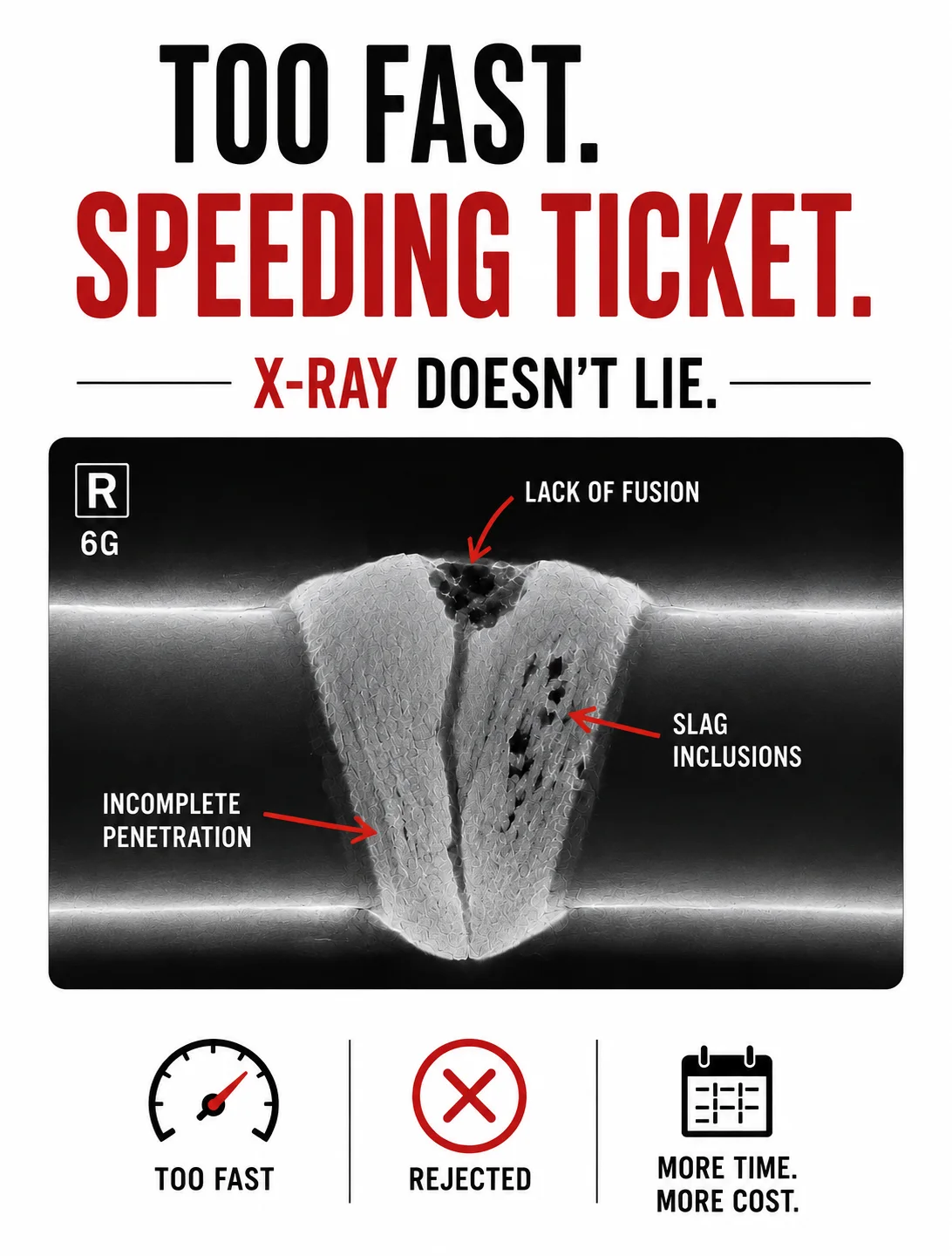
In jobsite slang, a “speeding ticket” can refer to an X-ray problem that welders associate with traveling too fast and failing to properly fuse the joint.
But is a speeding ticket actually a real welding defect? Can moving too fast really make an otherwise good pipe weld fail radiographic testing? And what is the X-ray actually seeing?
The answer is more interesting than the nickname.
First: “Speeding Ticket” Is Welder Slang
You generally will not find SPEEDING TICKET written as the official defect classification on a radiographic inspection report.
It is field terminology.
The actual indication has to be identified and evaluated according to the applicable welding code, procedure, inspection method, and acceptance criteria. Depending on what happened inside the weld, excessive travel speed can contribute to conditions involving lack of fusion, incomplete penetration, slag inclusions, undercut, poor bead profile, or other discontinuities.
So when somebody says a welder received a speeding ticket, what they usually mean is much simpler:
The welder may have been moving faster than the puddle and joint conditions allowed.
That distinction matters because speed itself isn’t what the X-ray is rejecting. The resulting discontinuity is.
What Happens When You Weld Too Fast?
A welding arc needs time and proper positioning to establish fusion.
When welding pipe, you aren’t simply depositing metal into an open space. The arc has to interact correctly with the base metal, previous weld metal, bevel faces, root, and toes of the weld depending on which pass is being made.
Travel too quickly and the weld puddle can become narrow. The amount of heat delivered to a particular area decreases. The arc may not spend enough time where fusion is needed.
Imagine painting a wall with a roller.
Move at the proper pace and the paint covers the surface evenly. Move the roller across the wall as fast as possible and you’ll start leaving thin spots behind.
Welding is obviously far more complex, but the basic idea helps explain the problem.
A fast-looking bead doesn’t automatically mean a properly fused bead.
The Puddle Sets the Speed
Experienced welders don’t determine travel speed solely by how quickly they can manipulate the electrode.
They watch the puddle.
That puddle provides information constantly.
Its width, shape, edges, penetration behavior, fluidity, and relationship with the surrounding base metal tell the welder whether the weld is behaving correctly.
This is especially important in pipe welding because conditions change continuously as the welder travels around the circumference.
The puddle at 12 o’clock doesn’t behave exactly like the puddle at 3 o’clock.
At 6 o’clock, gravity is working differently again.
The welder has to continuously adjust electrode angle, arc length, manipulation, amperage where appropriate, and travel speed.
That is one reason an experienced pipe welder can appear incredibly fast while still producing sound welds. The speed isn’t random. The welder has learned how quickly that particular puddle can travel while maintaining the required fusion and bead profile.
Fast Welding Isn’t Automatically Bad Welding
This is where the “speeding ticket” nickname can be misleading.
Fast does not automatically mean wrong.
Some welding procedures and techniques are intentionally performed at relatively high travel speeds.
A skilled welder running downhill with a cellulose electrode, for example, may move surprisingly quickly compared with somebody accustomed to other processes or positions.
The correct travel speed depends on numerous variables, including:
- Welding process
- Electrode or filler metal
- Electrode diameter
- Amperage and voltage
- Joint geometry
- Root opening
- Bevel preparation
- Welding position
- Pipe wall thickness
- Pass being deposited
- Welding procedure specification
The objective isn’t to weld slowly.
And it isn’t to weld fast.
The objective is to weld at the speed necessary to produce an acceptable weld within the qualified procedure.
Why Too Much Speed Can Cause Fusion Problems
One of the biggest concerns with excessive travel speed is fusion.
Think about what the arc has to accomplish. It needs to create enough localized heat to melt the required surfaces while the filler metal is being deposited.
If the electrode races ahead, the arc may not adequately work the edges of the puddle.
The weld can still look surprisingly good from the outside.
That’s what makes this dangerous from a quality standpoint.
A cap can look clean. The ripples can look consistent. The weld can appear smooth enough that somebody walking past it wouldn’t question anything.
But radiographic or other volumetric examination is concerned with what happened inside the weld, not how impressive the cap looks.
A beautiful exterior cannot compensate for an internal discontinuity.
The Classic Welder Mistake: Chasing Production
Industrial jobs run on schedules.
During a turnaround, every hour matters. On pipeline construction, production matters. In a fabrication shop, completed welds matter.
That pressure can quietly change the way somebody welds.
A welder who normally maintains a controlled pace starts moving slightly faster.
Then a little faster.
Maybe the previous joint passed.
Maybe everyone else is stacking welds.
Maybe the foreman is asking how many inches are left.
Eventually, the welder isn’t controlling the puddle anymore.
The welder is chasing it.
That’s where trouble starts.
Production matters, but a weld that has to be repaired isn’t productive.
One Repair Can Erase Everything You Gained
Suppose speeding up saves several minutes on a weld.
Great—until the weld is rejected.
Now the affected area may have to be located, evaluated, excavated, prepared, rewelded, re-examined, documented, and accepted according to the project’s requirements.
The repair can involve more than the welder.
Quality control may become involved. Inspection may become involved. Supervision may become involved. Additional examination may be required.
Suddenly those few minutes saved by rushing don’t look very impressive.
That is one of the lessons experienced production welders eventually understand:
The fastest weld isn’t necessarily the weld completed first. The fastest weld is often the one you only have to weld once.
Root Passes Are Especially Unforgiving
The root establishes the foundation for everything that follows.
If the root isn’t right, adding more weld metal doesn’t magically repair what happened underneath.
Traveling excessively fast during the root can contribute to problems involving penetration and fusion depending on the joint, process, technique, and procedure being used.
Root welding requires balance.
The welder is managing the keyhole or puddle behavior, electrode position, heat, root opening, land, internal bead profile, and travel speed simultaneously.
Go too slowly and another set of problems can develop.
Go too quickly and another set can appear.
Good root welders develop a rhythm where the arc, puddle, joint, and movement work together.
That rhythm is worth far more than simply being fast.
Hot Passes Can Get You Too
After making a good root, it can be tempting to relax.
Don’t.
The hot pass has important work to do. Depending on the process and procedure, it helps establish proper fusion and manage the profile left by the root before subsequent passes are deposited.
Poor technique or excessive travel speed can leave undesirable conditions behind that become buried beneath additional weld metal.
Once buried, you don’t get another opportunity to look at them.
The next person who might see the evidence is the inspector.
Fill Passes Aren’t Just About Filling the Groove
When the joint starts filling up, some welders begin treating the remaining groove like a hole that simply needs metal.
That’s a mistake.
Every pass has to properly interact with the previous weld metal and the sides of the joint.
The puddle needs to tie in correctly.
If the welder races through the fill passes, poor fusion can become trapped between weld layers or along the sidewall depending on the technique and conditions.
Again, the surface may provide very little warning.
The cap can eventually cover everything.
But X-ray doesn’t care how well the problem was covered.
The Cap Has a Speed Limit Too
The final pass is the part everyone sees, so welders naturally care about its appearance.
Travel too fast and the cap may become narrow, poorly tied in, irregular, or underfilled in areas. Depending on technique and conditions, poor toe fusion or undercut can also become concerns.
Going excessively slow isn’t the answer either. Too much heat or excessive deposition can create its own problems.
The goal remains the same:
Control the puddle instead of forcing the puddle to follow your preferred speed.
What Does a “Speeding Ticket” Look Like on X-Ray?
This is where terminology becomes important.
Radiography does not measure how quickly the welder traveled.
It records differences related to the material and weld volume that can reveal internal discontinuities.
An interpreter evaluates the radiograph and determines what the indication represents according to the applicable requirements.
Therefore, there isn’t one universal radiographic shape officially called a speeding ticket.
What workers call a speeding ticket may ultimately be classified using a recognized indication or discontinuity terminology.
That’s why two welders from different jobsites may use the phrase slightly differently.
Jobsite slang travels from project to project, and its meaning isn’t always perfectly standardized.
Don’t Confuse Slang With Code Terminology
Industrial construction has hundreds of unofficial expressions.
Næxon’s guide to 250 funny blue-collar words, phrases, and jobsite lingo already includes another X-ray favorite: “X-Ray Lottery” — waiting for weld inspection results.
“Speeding ticket” belongs to that same world.
It’s a useful phrase because welders immediately understand the lesson behind it, but when discussing an actual reject with QC, an inspector, welding engineer, or supervisor, use the actual terminology associated with the indication.
Ask what was found.
Ask where it was located.
Understand what caused it.
Then correct the cause instead of simply telling yourself to “weld slower.”
Slowing Down Isn’t Always the Fix
This may be the most important part of the entire discussion.
If a weld rejects and somebody says you were traveling too fast, simply slowing everything down isn’t automatically the correct solution.
Travel speed is only one welding variable.
The real problem might involve electrode angle, arc length, amperage, joint preparation, contamination, electrode manipulation, bead placement, improper cleaning between passes, or a combination of factors.
A welder should diagnose the actual problem.
Otherwise, you can go from welding too fast to welding unnecessarily slow and create an entirely different problem.
Good welding isn’t about finding one magic travel speed.
It’s about understanding what the puddle needs.
Experienced Welders Look Behind the Puddle
Newer welders often become fixated on the arc itself.
Experienced welders learn to observe more.
They’re watching the puddle.
They’re watching both edges.
They’re watching how the metal freezes behind the arc.
They’re watching bead placement.
They’re paying attention to whether the weld is actually washing into the areas where fusion is required.
That visual awareness is one of the differences between simply being able to burn rod and being able to consistently make welds that survive examination.
The hood hides the welder from everyone else.
It doesn’t hide the weld from X-ray.
The Real Speed Limit Is Quality
There isn’t a universal number of inches per minute that separates a “good” pipe welder from a “speeding” pipe welder.
The correct range comes from the welding procedure and the variables involved.
A welder can be extremely productive and still produce excellent work.
In fact, some of the best industrial welders are remarkably fast.
But their speed comes from efficiency.
They aren’t wasting movement. They aren’t constantly stopping. They understand electrode manipulation. They know what they’re seeing through the hood. Their body position is prepared before they strike. Their arc stays where it needs to be.
Speed becomes the result of control—not a substitute for it.
That is an enormous difference.
Before You Try to Weld Faster
If you’re trying to increase production without sacrificing quality, concentrate on consistency before raw speed.
Make sure you can repeatedly control:
- Arc length
- Electrode angle
- Puddle width
- Sidewall tie-in
- Bead placement
- Interpass cleaning
- Body positioning
- Starts and stops
Once those become automatic, efficiency naturally improves.
Trying to manufacture speed before developing control usually works backward.
X-Ray Has the Final Word
There is something humbling about welding pipe that will receive volumetric examination.
You can have twenty years under the hood.
You can make the prettiest cap on the project.
You can have everyone around you saying the weld looks perfect.
Then the film gets interpreted.
The inside of the weld tells its own story.
That’s why good pipe welders develop respect for inspection rather than treating it purely as an enemy. Radiography can expose things that cannot necessarily be determined from surface appearance alone.
It provides feedback.
And sometimes that feedback comes in the form of what the crew jokingly calls a speeding ticket.
Weld the Puddle, Not the Clock
Production will always matter in industrial construction.
Schedules matter. Man-hours matter. Weld counts matter.
But quality matters too.
If you’re moving so quickly that the arc isn’t accomplishing what it needs to accomplish, you’re not really saving time. You’re borrowing time from the repair crew.
Learn the procedure. Understand the joint. Watch both sides of the puddle. Pay attention to how the metal freezes. Make adjustments as the welding position changes around the pipe.
And remember:
Don’t weld according to how fast your hand can move. Weld according to what the puddle is telling you.
Because the pipe doesn’t know you’re trying to break a production record.
And X-ray doesn’t care.
At Næxon, we build gear for the welders, pipefitters, refinery workers, and industrial tradespeople who spend their careers doing work that has to hold up when it counts. Explore more welding, industrial workwear, and blue-collar field content in the Næxon Resources Center or learn more about choosing proper protective workwear in our Ultimate Guide to Industrial Workwear.