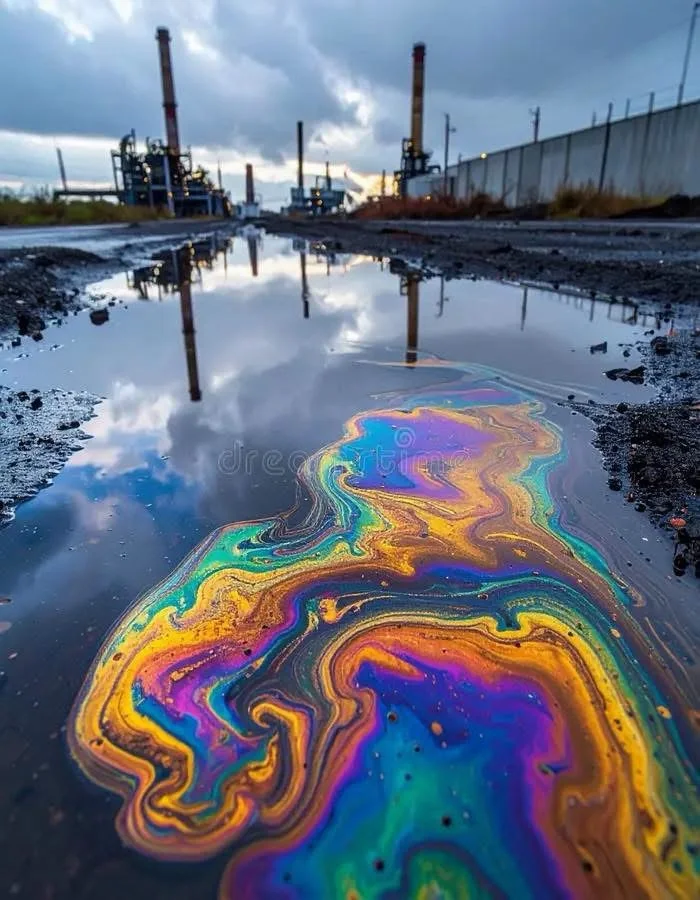
If you’ve spent enough time inside an oil refinery, chemical plant, tank farm, fabrication facility, or other industrial site, you’ve probably seen something like this before.
Rain falls, water collects in a low spot on the pavement, and suddenly the surface looks like a rainbow. Purple, blue, green, yellow and orange swirl together in patterns that almost look too colorful to belong inside a refinery.
Most industrial workers immediately have the same thought:
That’s oil.
Sometimes petroleum or another oily substance may indeed be responsible for the sheen. But the rainbow itself doesn’t tell you exactly what’s in the water. The colors are largely the result of an interesting optical phenomenon called thin-film interference.
Understanding the difference between what you’re seeing and what might be causing it is important—especially inside an industrial facility where an unidentified liquid should never simply be dismissed.
The Rainbow Isn’t Actually the Color of the Oil
The first thing to understand is that you’re usually not looking at purple oil, blue oil, green oil and orange oil.
You’re looking at light interacting with an extremely thin film on top of water.
When light reaches that film, some of it reflects from the upper surface while some travels through the film and reflects from the boundary beneath it. Those reflected light waves can interact with one another.
Depending on the thickness of the film, the wavelength of the light and the viewing angle, certain wavelengths can become more visible while others are reduced.
Your eyes interpret the result as those familiar swirling rainbow colors.
It’s related to the same optical effect that produces colors on a soap bubble or a very thin film on another surface.
So the rainbow itself is physics.
Determining what created the film is a completely different problem.
Why Is This Common Around Refineries?
A refinery is an enormous industrial environment containing process equipment, pumps, compressors, piping, storage systems, vehicles, cranes, forklifts, maintenance equipment and thousands of components that use or handle different fluids.
Roads and work areas can also accumulate small amounts of oily residue over time.
Then it rains.
Stormwater begins moving across pavement and through drainage areas. Material that was barely noticeable on dry pavement can spread across the surface of the water.
Because many oils don’t readily mix with water, a very small quantity can potentially spread into an extremely thin surface layer.
That’s when the rainbow becomes visible.
Potential sources around an industrial facility can include petroleum hydrocarbons, lubricating oils, hydraulic fluids, fuels, equipment leakage, vehicle leakage, maintenance activity or residues already present on the pavement.
But there’s an important rule:
Appearance alone doesn’t identify the substance.
A colorful sheen is an observation—not a chemical analysis.
Why Can Such a Small Amount Create Such a Huge Rainbow?
This is one of the most interesting things about an oil-like film on water.
Many petroleum-based substances don’t readily dissolve into the water. Instead, material can remain at or near the surface and spread outward.
The layer can become extraordinarily thin while still producing a visible optical effect.
That means a rainbow covering a large puddle doesn’t automatically mean there’s an equally large volume of oil underneath it.
A relatively small amount of material may create substantial visible surface coverage.
That doesn’t mean the condition should be ignored.
It means you can’t reliably estimate the quantity of an unknown material simply by looking at the size of the rainbow.
The source still needs to be evaluated according to the facility’s procedures.
Does Every Rainbow Puddle Mean There’s an Oil Leak?
No.
That’s an important misconception.
Petroleum products can produce an iridescent sheen, but unusual films on standing water can have other causes as well. Naturally occurring biological activity, organic matter and other materials can sometimes create surface films that resemble petroleum sheens.
Industrial facilities also contain many different substances.
That is why identifying an unknown liquid solely from its appearance can be misleading.
The surrounding circumstances matter.
Where was the puddle found?
What equipment is nearby?
Did it recently rain?
Has maintenance occurred in the area?
Is there an active leak?
Where does the drainage originate?
Where is the water going?
Those questions provide far more useful information than simply saying, “It looks like oil.”
The Puddle May Not Be Anywhere Near the Actual Source
This is where industrial troubleshooting becomes interesting.
The rainbow might be obvious.
The source may not be.
Water follows elevation, pavement contours, trenches and drainage systems. Rainwater can travel from another portion of the unit before eventually collecting in a low spot.
That means the pump, pipe or vehicle sitting closest to the rainbow isn’t automatically responsible.
Someone investigating the condition may need to work backward.
Follow the drainage.
Look uphill.
Check nearby equipment.
Consider recent maintenance activities.
Look for evidence of leakage.
A colorful puddle can sometimes be the visible clue to a much smaller problem located somewhere else.
This is one reason experienced refinery workers learn to pay attention to their surroundings. Small changes around equipment can sometimes tell you that something has changed before the problem becomes obvious.
For workers entering refinery environments for the first time, our What to Wear During Refinery Turnarounds & Maintenance Outages guide also explains some of the conditions, hazards and PPE considerations commonly encountered during major plant maintenance.
Equipment Doesn’t Have to Be Process Equipment to Leak
When workers hear “refinery leak,” they naturally think about process piping, valves, vessels or pumps.
But an industrial site contains many other potential sources of fluid.
Mobile equipment may contain hydraulic fluid.
Vehicles contain engine oil, coolant, transmission fluid and fuel.
Cranes and construction equipment contain numerous lubricants and hydraulic systems.
Pumps, compressors and rotating equipment may use lubricating oils.
Temporary equipment brought onto the site can introduce additional potential sources.
Even something as simple as a contractor vehicle can leave residue on pavement.
After rainfall, that residue may move and become far more visible than it was when the ground was dry.
Why Refineries Pay Attention to Sheens
Rain inside a refinery isn’t necessarily treated the same way as rain falling onto an ordinary parking lot.
Stormwater can interact with industrial areas containing process equipment, storage systems, roads, maintenance activities and various residues.
Facilities therefore use combinations of drainage systems, containment areas, collection systems, separators, inspections and operating procedures to manage water and potential contaminants.
The exact system varies considerably from facility to facility.
When an unexpected sheen appears, the important question isn’t whether the colors look dramatic.
The important questions are:
- What is the material?
- Where did it originate?
- Is the source still active?
- Where is the water traveling?
- Does it require containment, reporting or cleanup under the facility’s procedures?
That is why seemingly minor observations can matter inside industrial facilities.
Don’t Identify Unknown Liquids With Your Hands or Nose
Experienced industrial workers become very familiar with what diesel, hydraulic oil, lubricants and other common materials look like.
That experience is useful.
But it shouldn’t turn your hands or nose into laboratory equipment.
If you don’t know what a substance is, don’t assume it’s harmless because it resembles something familiar.
Refineries and chemical facilities can contain substances whose hazards aren’t obvious from appearance alone.
Follow the site’s procedures for unidentified liquids, leaks and spills. Notify the appropriate personnel and allow the material to be evaluated using the methods required by that facility.
Industrial PPE should also be selected for the actual hazard rather than simply because a worker is entering a refinery. Our Ultimate Guide to Industrial Workwear explains how workwear, FR clothing and PPE fit into the larger industrial safety picture.
Rain Can Reveal Problems That Were Already There
Rain doesn’t necessarily create the contamination.
Sometimes it simply makes an existing condition easier to see.
Imagine a tiny amount of hydraulic fluid slowly leaking onto dark pavement. On a busy industrial road, the residue might be difficult to notice.
Then a heavy storm arrives.
Water begins flowing across the pavement.
The residue spreads.
Eventually the water reaches a low spot.
Suddenly there’s a large rainbow sheen that wasn’t obvious before.
The rain has effectively made the evidence easier to see.
This is why housekeeping and routine equipment inspections can be important even when a leak appears minor.
Why the Colors Keep Changing
If you’ve ever walked around one of these puddles, you may notice that the colors seem to move or change.
That’s because viewing angle matters.
The thickness of the film may also vary across the water surface. One portion might be extremely thin while another is slightly thicker.
Those differences change which wavelengths of visible light interfere with each other.
As the water moves, the film moves.
As the film thickness changes, the colors change.
As you move your head or camera, the viewing geometry changes again.
That’s why the surface can look blue and purple from one position and suddenly shift toward gold, green or red from another.
The Picture Can Be Beautiful and Still Represent a Problem
There’s an interesting contradiction in photographs like this.
Visually, they’re incredible.
The rainbow patterns can look almost artistic against the gray steel, piping, pavement and towers of an industrial facility.
But industrial workers shouldn’t allow the appearance to distract from the real question.
Why is that film there?
If it’s petroleum or another industrial fluid, the colorful pattern is simply making the material easier to notice.
That makes the rainbow useful.
It’s essentially a visual indicator telling you that something on the water surface is interacting with light differently from the water itself.
Refinery Workers Learn to Notice Small Things
One of the biggest differences between someone new to industrial work and someone who has spent years inside plants is often situational awareness.
Experienced workers notice things.
A different vibration.
An unusual sound.
A smell that wasn’t there yesterday.
A valve position that looks different.
Fresh staining underneath equipment.
A drip.
A puddle.
A rainbow sheen.
None of those observations automatically tells you exactly what’s wrong. But they can tell you that something deserves attention.
That type of awareness is part of working effectively in demanding industrial environments.
It’s also why proper clothing and PPE have to support the worker rather than become a distraction. Næxon’s article on why proper workwear fit matters on the jobsite explains how mobility, comfort and proper fit can affect workers throughout long industrial shifts.
A Rainbow Is a Clue, Not a Diagnosis
The most useful way to think about a refinery rainbow puddle is this:
The rainbow tells you there’s a thin film affecting how light reflects from the water. It doesn’t automatically tell you what that film is.
Petroleum hydrocarbons are one possible explanation.
Lubricating oil may be another.
Hydraulic fluid may be another.
There may also be non-petroleum explanations.
Determining the source requires context, investigation and, when necessary, appropriate identification or testing.
That distinction matters because good industrial troubleshooting is based on evidence rather than assumptions.
The Science Behind Something Industrial Workers See Every Day
Industrial facilities are filled with everyday examples of engineering, chemistry and physics that workers encounter without necessarily thinking about the science behind them.
A rainbow puddle is one of them.
The swirling colors come primarily from the interaction between visible light and a very thin surface film.
The film’s thickness changes.
The viewing angle changes.
Different wavelengths of light interfere.
And suddenly a gray refinery road looks like someone poured a rainbow across it.
The physics is fascinating.
But inside an operating industrial facility, the practical response remains simple:
Notice it. Don’t guess what it is. Follow the site’s procedure. Find the source.
Because sometimes the smallest thing on the ground can tell you something important about what’s happening somewhere else in the plant.
Related Næxon Gear
Industrial environments demand clothing and PPE appropriate for the specific hazards and requirements of the jobsite. Næxon builds workwear and protective gear for welders, pipefitters, refinery workers and other skilled trades working in demanding conditions.
Explore Næxon industrial workwear and PPE for FR pearl snap shirts, welding caps, safety eyewear, gloves and other jobsite gear. Always follow your employer’s PPE requirements and select protective equipment appropriate for the actual task and hazard.
Keep Reading on Næxon
If you work in refineries, power plants, pipelines or industrial construction, continue with the Ultimate Guide to Industrial Workwear for a broader look at FR clothing, PPE and jobsite gear.
For turnaround workers, read What to Wear During Refinery Turnarounds & Maintenance Outages for practical guidance on preparing for long outage shifts.
And for something lighter after all that refinery science, check out The Language of the Blue Collar: 250 Funny Words, Phrases & Jobsite Lingo—because industrial workers have developed a name for almost everything.
Explore more refinery, welding, workwear and skilled-trades content in the Næxon Resources Center.